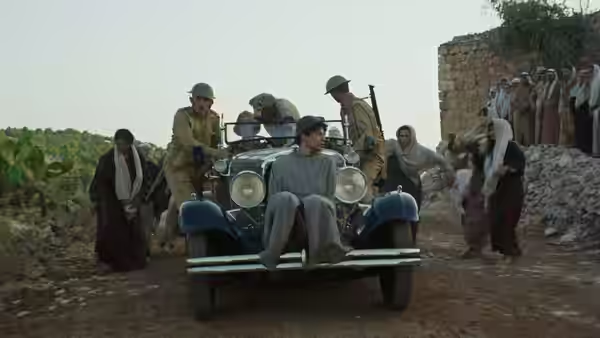
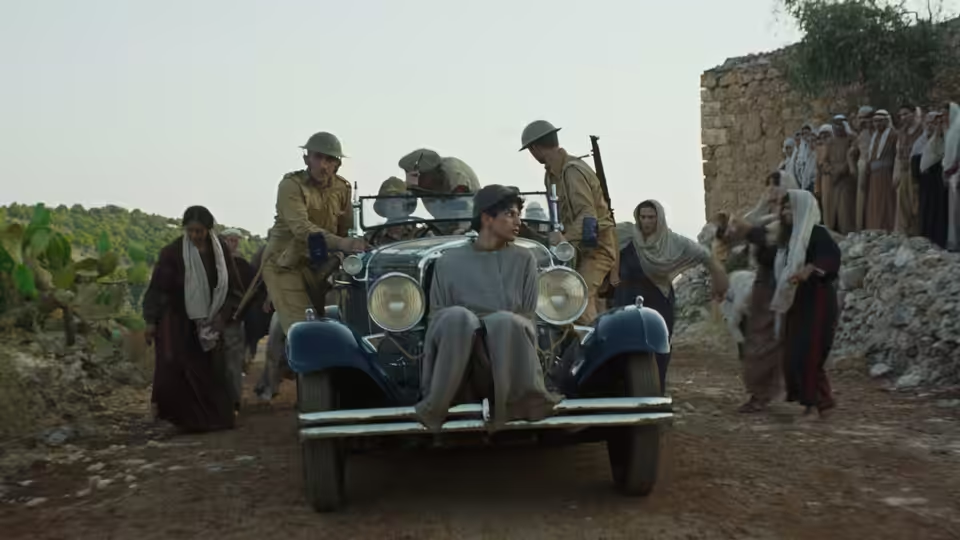
Villagers gather around a car carrying a seated man beside a stone building
Film review

Palestine 36

2025 · Directed by Annemarie Jacir · 2h 00m

In a sentenceThe people hold our attention until the history lesson interrupts them

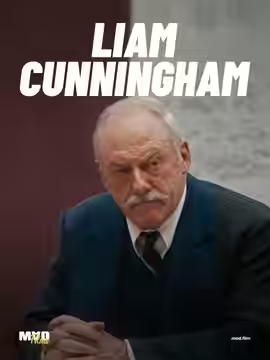
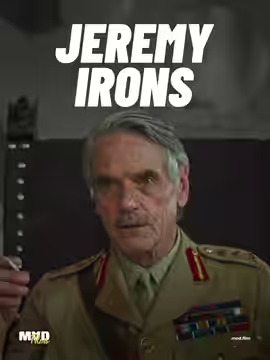
An uprising against an empire brings together a cross-section of Palestinian lives. Yusuf (Karim Daoud Anaya) is at the centre of an ensemble that includes Hanan (Hiam Abbass), Khouloud (Yasmine Al Massri) and Khalid (Saleh Bakri). On the British side are Captain Wingate (Robert Aramayo), Charles Tegart (Liam Cunningham) and High Commissioner Wauchope (Jeremy Irons). Moving between village life and the people exercising colonial authority, the drama follows a population facing resistance, repression and competing demands, with individual lives caught up in a struggle that extends beyond any one household.

Plays from YouTube when you press play; nothing loads from them until then.

Fi1m review

Annemarie Jacir’s historical drama earns its force through its ensemble and its attention to Palestinian life. We recommend it with a reservation: the crowded storytelling too often makes people explain what their performances already convey.

Palestine 36 is a good historical drama with an overcrowding problem. Annemarie Jacir wants to show how resistance involves a whole population, and gives several lives space within the same film. That breadth is worth having: the people outside the centre of the story matter here. But in trying to accommodate so much, the screenplay sometimes settles for introducing someone and explaining their position when we need longer in their company.

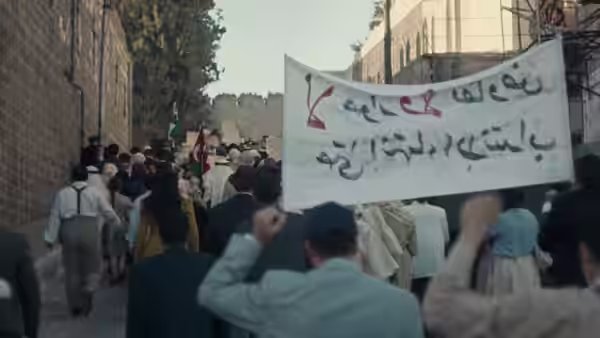
The attention to Palestinian village life gives the film its strongest passages. Everyday existence is allowed some importance of its own, rather than serving merely as preparation for the next confrontation. We were moved by the archival images of Palestine, because they give the places and people a presence that the explanatory dialogue cannot match. For those moments, we stopped waiting for the story to advance and wanted time to look.

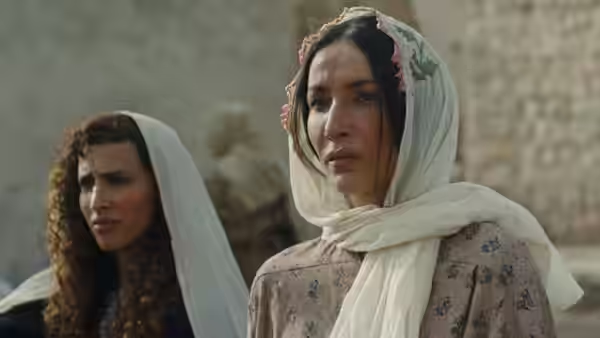
The ensemble helps sustain that interest across the changes of focus. Karim Daoud Anaya plays Yusuf, though the writing gives the central character less room to develop than the scale of the undertaking requires. Hiam Abbass and Yasmine Al Massri belong to a cast whose persuasive work makes the broader characterisations easier to accept. Faces often communicate fine differences of feeling; the script is less reliable when it requires those same people to state a historical position.

The period images are carefully made, with cinematography credited to Sarah Blum, Hélène Louvart and Tim Fleming. Their work gives the setting enough visual detail to reward attention beyond whoever is speaking. Nael Kanj’s production design contributes to that sense of a place inhabited by people with lives to carry on. There is pleasure in the care, although the polish sometimes makes a difficult history look more comfortably familiar than it should.

Tania Reddin’s editing keeps the interconnected stories moving, but movement cannot quite compensate for the shortage of time with particular characters. A transition can be clear and still arrive before a scene has given us enough. Ben Frost supplies the music; the performances and the historical images remain the more persuasive sources of feeling. Across its 120 minutes, the film has room for a substantial ensemble, but not quite for all the explanation that accompanies it.

Robert Aramayo’s Captain Wingate is the clearest weakness in the characterisation. The performance pushes towards caricature, making the military figure less convincing than the people around him. The problem is not that the film judges colonial authority harshly; it is that broad villainy asks too little of an actor and an audience. Annemarie Jacir’s writing is more effective when it allows uncertainty and conflicting pressures to emerge without spelling out their significance.

Against the conventions of the historical drama, this is a serious, accessible effort whose collective focus deserves attention. Its shortcomings are familiar ones: too many introductions, dialogue burdened with explanation, and a central figure who needs more development. Yet enough of the people register for the history to become more than information, and the care taken over their surroundings matters. Watch it for the ensemble, and allow for the passages when the screenplay insists on doing the talking.

Critical consensus AI synthesised

72
Positive
10
Mixed
2
Negative
1

Most critics respond warmly to Palestine 36, praising its account of Palestinian history and the emotional weight it gives to individual lives within a large ensemble. Praise centres on the committed performances, detailed period settings and evocative use of archival footage, with several reviews finding the connections between past and present particularly affecting. The village scenes and relationships draw approval for making the history accessible without losing its human consequences.

Reservations cluster around how much the film tries to cover: characters can seem underdeveloped, dialogue overly explanatory and the interconnected stories thinly spread. The reviews differ on pacing, finding it either purposeful or stolid, though most regard these shortcomings as limits rather than reasons to dismiss the film. Deadline offers the clearest dissent, finding the ensemble uneven, the historical context insufficiently developed and the visual choices familiar. The spread is mostly favourable, but enthusiasm for the subject does not produce agreement about the storytelling.

The Hollywood Reporter
26 November 2025 · Sheri Linden
85*

Linden finds the film vivid, stirring and resonant, with a clear Palestinian perspective that still allows for nuance. She especially praises its evocative archival footage and richly detailed sense of place.

Read the full review →
Variety
11 September 2025 · festival review · Murtada Elfadl
85*

Elfadl finds the film ambitious, emotionally resonant, and effective in joining intimate lives to sweeping history. He especially praises its ensemble performances and detailed period visuals, while faulting Robert Aramayo’s caricatured military captain.

Read the full review →
Little White Lies
31 October 2025 · 3/4/3 · Marcel Steinbauer-Lewis
80

The critic finds the film engaging and polished, though predictable and sometimes reduced to headline-style storytelling. They praise its careful performances and its most affecting moments, which connect historical footage with the present.

Read the full review →
Screen Daily
16 October 2025 · Lee Marshall
80*

Marshall finds the film a passionate, timely and thoughtful historical epic. He praises Jacir’s brisk, interconnected storytelling and its emotional focus on village life and the friendship between two children.

Read the full review →
IndieWire
5 September 2025 · B- · Ritesh Mehta
70

The critic finds the sprawling historical drama overambitious but resonant. He praises its period and cultural specificity, while faulting its quilt-like structure for struggling to convey the history and develop its characters.

Read the full review →
Los Angeles Times
27 March 2026 · Robert Abele
70*

Abele finds the historical drama broad and occasionally overstuffed, but ultimately vital and worthy of its place. He praises its sweeping, detailed depiction of a rarely represented history and the committed cast.

Read the full review →

Straight answers AI written, from our review

Is Palestine 36 worth watching?
Palestine 36 is worth watching for its persuasive ensemble and attention to Palestinian life, particularly if historical drama is your territory; we score it 73 out of 100. We recommend it with a reservation: the crowded storytelling gives some characters too little room, while explanatory dialogue too often repeats what the performances already convey.
How long is Palestine 36, and what is it rated?
Palestine 36 runs 2h 00m. It is a drama and history film.
Where can I watch Palestine 36 in the UAE?
Palestine 36 is streaming on Netflix in the UAE. Availability is checked daily; the links above go straight to each service.
How violent or frightening is Palestine 36, and is it suitable for children?
Palestine 36 carries a UK 12A certificate, which permits children under 12 to attend a cinema screening only with an accompanying adult. Its story involves resistance and colonial repression, but we cannot give a precise account of graphic violence or frightening material. We advise caution for younger or sensitive children rather than treating it as family viewing.
How does Palestine 36 compare to The Battle of Algiers?
Palestine 36 is gentler in its dramatic approach than The Battle of Algiers, which we find the more gripping collective portrait of resistance. Both sometimes struggle to give individuals enough time, but Jacir’s film makes more room for everyday village life. Choose it for that human detail; choose The Battle of Algiers for harsher urgency and documentary-style immediacy.

Cast

If you liked this, try…

  1. The Battle of Algiers (1966, Fi1m 93)Another collective portrait of resistance, with a harsher, more urgent dramatic approach.

  2. Wajib (2017) · not on Fi1m yetFor Palestinian daily life observed through family friction and difficult conversation.

  3. The Wind That Shakes the Barley (2006) · not on Fi1m yetResistance to British rule becomes painfully entangled with loyalties close to home.

  4. The Time That Remains (2009) · not on Fi1m yetPalestinian history approached through family memory, patient observation and dry humour.

  5. A City of Sadness (1989) · not on Fi1m yetA family provides the intimate perspective on another crowded, turbulent national history.