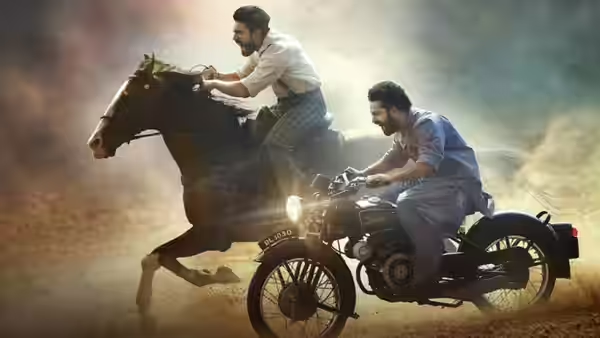
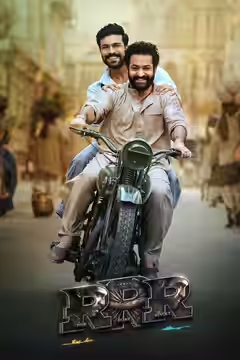
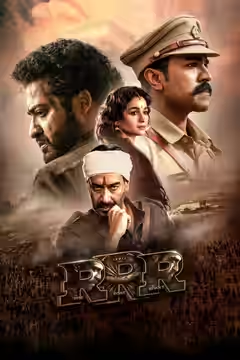
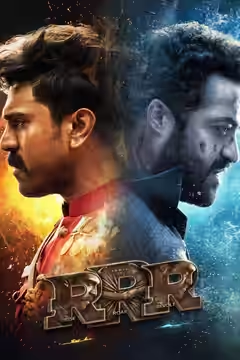
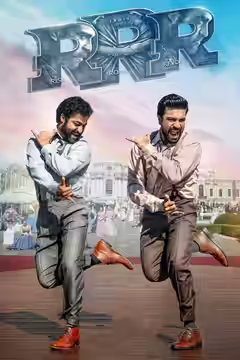
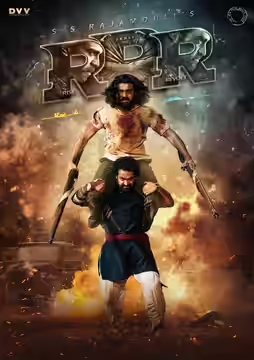
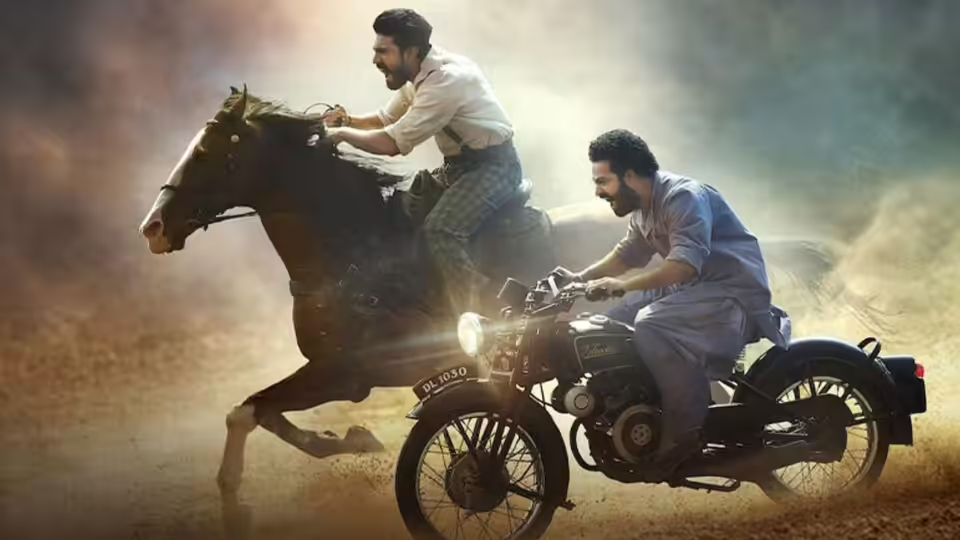
Komaram Bheem (N.T. Rama Rao Jr.) rides a horse beside Alluri Sitarama Raju (Ram Charan) on a motorcycle
Film review

RRR

2022 · Directed by S. S. Rajamouli · 3h 07m

In a sentenceThe British Empire, defeated by two men, a great deal of slow motion and one dance-off at a garden party

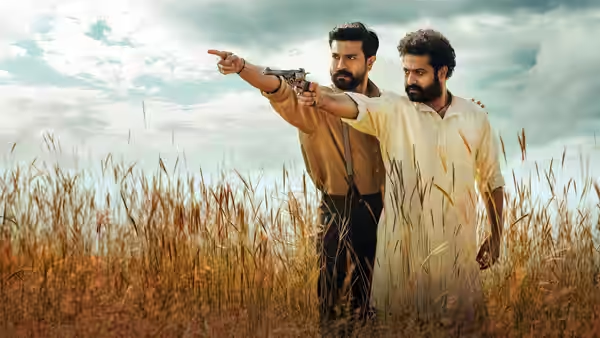
Delhi, 1920, under the British Raj. Governor Scott Buxton (Ray Stevenson) and his wife Cassandra (Alison Doody) take a girl, Malli (Twinkle Sharma), from her forest village because Cassandra likes her singing. Komaram Bheem (N.T. Rama Rao Jr.), protector of her tribe, follows her to the city and searches for her under a false name. Alluri Sitarama Raju (Ram Charan) is an Imperial police officer who wants a promotion the British will not give an Indian, and volunteers to catch the tribesman he hears is coming. The two meet when a train wrecks on a bridge and a boy needs pulling from the water, and they become friends without knowing who the other is. Bheem meets the Governor’s niece Jenny (Olivia Morris), who is kind to him.

Plays from YouTube when you press play; nothing loads from them until then.

Fi1m review

S. S. Rajamouli takes two real revolutionaries who never met, invents a friendship for them in Delhi, and stages the most exuberant action film in years around it. It is 187 minutes long, its villains are cardboard, and we enjoyed nearly all of it.

Alluri Sitarama Raju and Komaram Bheem were real men who fought the British in the early twentieth century and who never, as far as anyone knows, met. S. S. Rajamouli, working from a story by K. V. Vijayendra Prasad, decides that they did, in Delhi in 1920, and that they became friends without either knowing what the other was for. From that invention he builds 187 minutes of trains, dances and fistfights. It is the most exuberant action film we have seen in years. It is also forty minutes too long, its Englishmen are drawn in crayon and its India has room for two kinds of person. We recommend it warmly, for a cinema with a crowd in it.

The first meeting sets the standard. A train derails on a river bridge, a boy is stranded in the water among burning oil, and two strangers on opposite banks look at each other, agree a plan in a glance and carry it out with a rope, a horse, a motorbike and a flag. Senthil Kumar shoots it in late-afternoon gold and long slow motion so that you can follow every stage, and A. Sreekar Prasad cuts between the two faces so that we understand the plan before they have finished it. We laughed at the cheek of it. Then the two hands met in mid-air over the fire and we were moved, and we had not expected both from one shot.

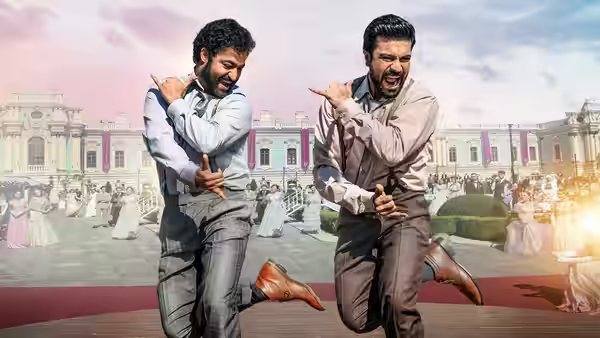
M.M. Keeravaani’s music is the engine, and the songs are scenes, not breaks between them. The best is a dance at the Governor’s party, where a sneering Englishman informs Bheem that Indians know nothing of dancing and the two friends answer with a routine of such speed and stamp that the Europeans fall over trying to keep up. Sabu Cyril’s white-columned palace and Rama Rajamouli’s braces and shirtsleeves make the pair look like two labourers who have wandered into a Merchant Ivory film and taken it over. We grinned through the whole number. It is the only fight in the film in which nobody bleeds.

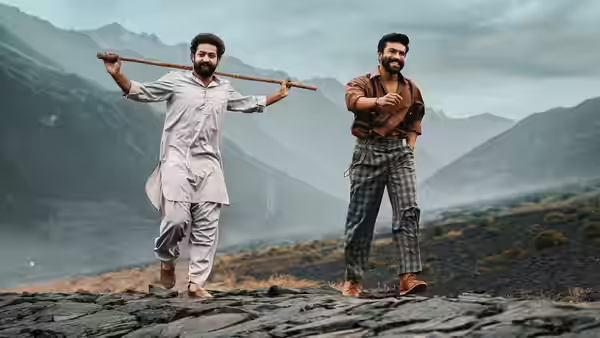
N.T. Rama Rao Jr. plays Bheem as a large, gentle man who fights like something let out of a cage, and he is the film’s heart. When he cannot find Malli, his face does the grieving the script is too busy for. Ram Charan gives Raju a straight back and a shut face, and his is the harder job, because Raju spends the first half doing his masters’ work and the film needs us to keep faith. Their scenes together, riding side by side or eating in the street, are why the film works: two men who like each other so much the plot has to prise them apart. Ray Stevenson’s Governor and Alison Doody’s Cassandra are villains from a Victorian melodrama, all sneer and lace, and the film wants them that way. Olivia Morris’s Jenny is warm and has nothing to do but be kind, and Alia Bhatt’s Sita has three scenes.

The length is felt. A montage of friendship is followed by a second that says the same thing. Every punch in the second half is filmed from three angles when one would do. The digital work is uneven: fire and water are excellent, crowds are not, and the more the film asks of its computers the rubberier the result. And the politics are as simple as the villains. The British are monsters, the two men are close to gods, and nobody in between has a name. We were stirred more than once, and once or twice uneasy about how cheaply we had been stirred.

Set against Rajamouli’s own Baahubali films, this is the more disciplined work: the story is smaller, the stakes are personal and the fights have consequences. Set against what Hollywood currently calls an action film, it is a rebuke. There is not a set-piece here in which you cannot say where everyone is standing. Most critics have placed it higher than we have; they were happier than we were to forgive the length.

See it in a cinema if you can, with as many people as the place holds. At home, do what the film asks and stop at the interval to put the kettle on. It was built for a break, and by that point so were we.
Critical consensus AI synthesised

84
Positive
14
Mixed
1
Negative
0

The reviews for RRR are close to unanimous. Almost every critic finds the film exhilarating, and most say so with evident pleasure, treating it as a large, sincere entertainment built for a big screen. The praise gathers around two things: Rajamouli’s action set pieces, which critics describe as inventive, precisely staged and cheerfully ridiculous, and the partnership between the two leads, whose friendship several reviews call the film’s real engine. The musical numbers are singled out almost as often as the fights.

The reservations are mild and scattered rather than shared. Sight and Sound finds the film bloated and nationalistic before giving in to its showmanship, and The New Yorker notes that the storytelling leans on shortcuts. Deadline points out that the women are largely sidelined, and Variety mentions the historical liberties but decides they serve the story. The spread is narrow: one mixed review, none negative, and the complaints come from critics who enjoyed themselves anyway.

IndieWire
26 March 2022 · A · Siddhant Adlakha
95

The critic calls RRR a dazzling, emotionally sincere action saga and a triumphant return to the theatrical experience. They especially praise the energetic filmmaking and the chemistry between its two leads.

Read the full review →
Empire
5 July 2022 · Ian Freer
90*

Freer calls the film a bombastic delight and finds it entertaining from beginning to end. He particularly praises Rajamouli’s inventive action spectacle and the infectious charisma of its leads.

Read the full review →
The AV Club
16 June 2022 · Todd Gilchrist
90*

The critic celebrates RRR as a hugely entertaining, culturally specific epic that also speaks through familiar cinematic conventions. He especially praises its inventive action and dance sequences, along with the lead performances and the central friendship.

Read the full review →
The Hollywood Reporter
27 November 2022 · Frank Scheck
90*

Scheck finds the film deliriously entertaining throughout its lengthy runtime. He especially praises the dazzling action and musical numbers, along with the charismatic leads.

Read the full review →
The New York Times
3 August 2022 · Manohla Dargis
90*

The review finds RRR extravagantly entertaining. It praises the film’s exuberant action and spectacle.

Read the full review →
Variety
4 April 2022 · Joe Leydon
90*

Leydon finds the film an exhilarating, irresistible celebration of cinematic excess. He praises the leads’ chemistry and the audacious action spectacle, while noting that its historical liberties serve an exciting story.

Read the full review →

Straight answers AI written, from our review

Is RRR worth watching?
RRR is worth watching for anyone who wants an action film staged with wit and stamina, and we scored it 78. It is 187 minutes long, its British villains are drawn in crayon and its politics are as simple as they are, but the set-pieces are the most exuberant we have seen in years. See it with a crowd if you can.
How long is RRR, and what is it rated?
RRR runs 3h 07m. It is an action and history film.
Where can I watch RRR in Italy?
RRR is streaming on Netflix in Italy. Availability is checked daily; the links above go straight to each service.
How violent or frightening is RRR, and is it suitable for children?
RRR carries a UK 15 certificate and is a violent film, with fistfights, floggings and battles that bleed, though the tone is exuberant rather than grim. Younger children will find the brutality of the British villains hard going; teenagers used to action cinema will be fine. The dance at the Governor's party is the only fight in which nobody bleeds.
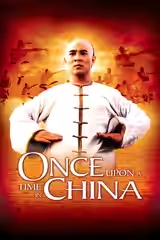
How does RRR compare to Once Upon a Time in China?
RRR and Once Upon a Time in China share a hero who fights colonial bullies with his fists, but Rajamouli's film is louder, longer and far more sentimental, while Tsui Hark's is the tighter, drier work with a stiller lead in Jet Li. If you want fights of pure craft, take the earlier film. If you want spectacle, songs and a friendship worth crying over, take RRR.
What should I watch after RRR?
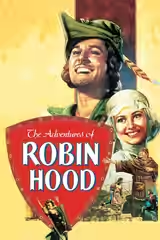
After RRR, try Once Upon a Time in China (1991, Fi1m 81): Jet Li fights colonial bullies in Canton with much the same idea of a hero. Then The Adventures of Robin Hood (1938, Fi1m 90): Errol Flynn grinning at tyranny in Technicolor; the same swagger, eighty-odd years earlier.

Cast

Awards

Golden Globes, 2023

Nominated
Best Non-English Language Film

If you liked this, try…

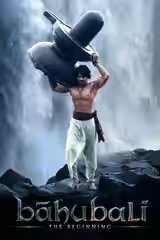
  1. Baahubali: The Beginning (2015) · not on Fi1m yetRajamouli’s earlier two-parter, with a waterfall, a war and even less restraint.

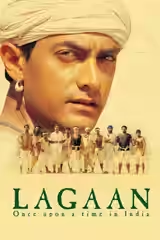
  2. Lagaan (2001) · not on Fi1m yetVillagers take on the Raj at cricket over nearly four hours, and earn every one.

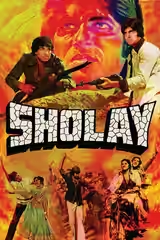
  3. Sholay (1975) · not on Fi1m yetTwo friends, one motorbike, a bandit; the film every Indian buddy picture answers to.

  4. Once Upon a Time in China (1991, Fi1m 81)Jet Li fights colonial bullies in Canton with much the same idea of a hero.

  5. The Adventures of Robin Hood (1938, Fi1m 90)Errol Flynn grinning at tyranny in Technicolor; the same swagger, eighty-odd years earlier.