Emerald Fennell’s country-house comedy is handsome, well acted and rude in all the right places, and it mistakes rudeness for satire. Rosamund Pike and Richard E. Grant earn the ticket; the last twenty minutes nearly hand it back.
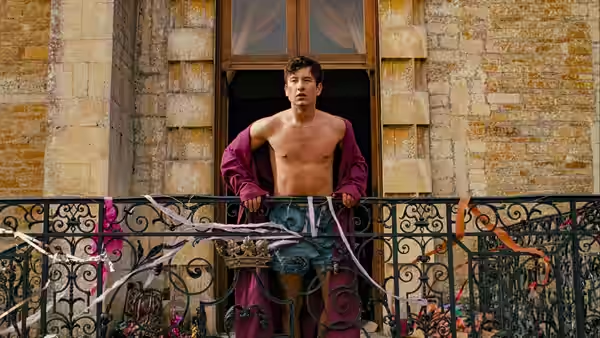
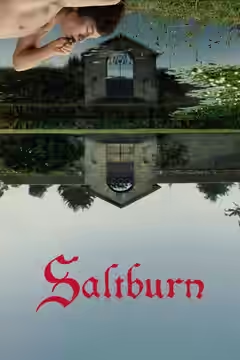
Emerald Fennell’s second film, after Promising Young Woman, sends a scholarship boy to Oxford, hands him a golden friend, and invites them both to the friend’s country house for the summer. Oliver Quick (Barry Keoghan) is poor, clever and watchful; Felix Catton (Jacob Elordi) is rich, kind and never alone. The house is Saltburn, and its family have never been told no. Anyone who knows Waugh or Highsmith will know the shape of the plot, and Fennell knows they know. What follows is 131 minutes that are handsome, rude and often funny, with less to say about the English class system than either of the books it grew from.
Keoghan is good at watching. He gives Oliver a stillness that reads as shyness early and as something else later, and he can hold a close-up while doing nothing. Elordi has the harder job, since Felix has to be worth all this wanting, and he manages it by playing the boy’s generosity as a habit he has never examined. Ewan Mitchell is sharply funny as Michael Gavey, the other outsider in college, who is dropped the moment Oliver finds better company. The Oxford stretch is the tightest writing in the film, cruel about the pecking order and honest about how much people want in.
Then the summer, and the family. Rosamund Pike’s Elspeth is the reason to buy a ticket: a woman who has never had a thought she felt the need to keep to herself, played with a gaze that drifts away from the person she is insulting halfway through the insult. Richard E. Grant’s Sir James is delighted to have a guest and cannot remember why. Carey Mulligan’s Poor Dear Pamela has outstayed a welcome nobody quite extended, and Alison Oliver’s Venetia drifts up from the pool with a cigarette and something she has been told not to say. We laughed a great deal at that dinner table, with a nastier edge than we expected, because Pike never once signals that Elspeth is a joke.
Fennell’s crew have built her a place worth coveting. Linus Sandgren shoots in a frame close to square, so the house is cut off at the edges and the people a little too near; the dinners are lit by candle and the lawns by a long yellow evening. Suzie Davies’s Saltburn is dark wood, stuffed birds and dust in the sunlight. Sophie Canale dresses the Cattons as if they have never bought anything and Oliver as if he bought everything last week. Anthony B. Willis writes a choir under it all, and Victoria Boydell cuts the summer as montage, so that weeks of swimming and drinking go by in a couple of noughties pop songs.
The trouble is that the film wants two things. It wants us to see the Cattons as grotesques, and it wants us to want the house, the lawn, the endless summer, and it does the second better. Archie Madekwe’s Farleigh, the cousin on sufferance, is the only character who understands what the money is doing to everyone, and the film keeps him at the edge of the frame. Oliver is a blank. We know what he wants; we never learn why, and by the second hour that had stopped feeling like mystery and started to feel like a decision Fennell had not got round to making.
The second half takes a turn we will not describe. Having taken it, the film explains it, with a montage and a voiceover, in case we had missed anything. We had not. That last stretch is where we went from amused to irritated: it treats the audience as slower than the film, and the film is not quick.
Promising Young Woman was a nasty, focused piece with one idea it saw through to the end. Saltburn has several ideas, most of them older than Fennell, and finishes none of them. See it for Pike and Grant, for the house, and for a first hour that is sharper than most of the reviews allow. Do not stay up afterwards discussing what it meant; it has already told you. It carries a 15 certificate.