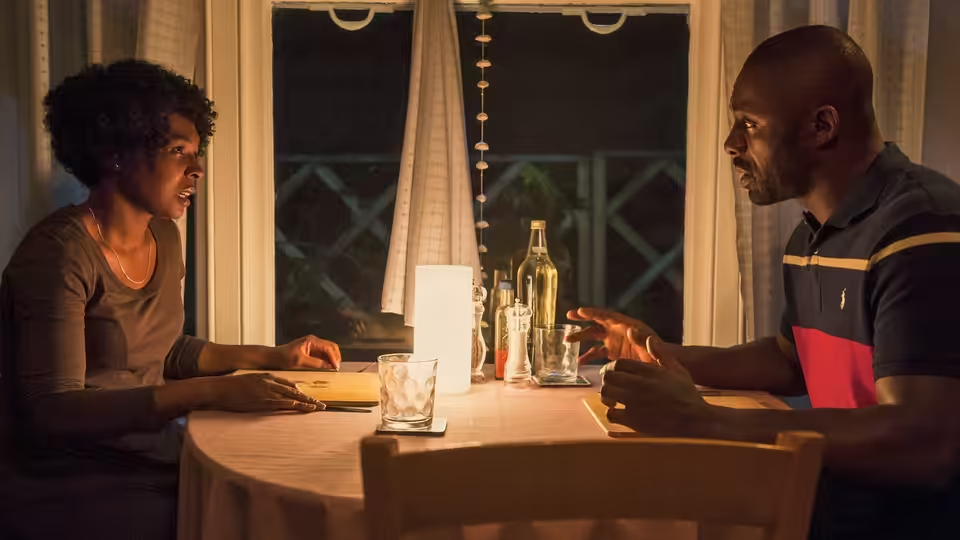
Jax (Nadine Marshall) and Mark (Idris Elba) sit across a dining table, talking
Film review

Second Coming

2014 · Directed by Debbie Tucker Green · 1h 45m

In a sentenceThe husband hasn’t touched her in months, the test says pregnant, and the bathroom ceiling has started raining indoors

South London, the present day. Jax (Nadine Marshall) lives in a terraced house with her husband Mark (Idris Elba) and their son JJ (Kai Francis Lewis). She goes to the office, comes home, cooks, and says as little as she can get away with. Then a pregnancy test comes back positive, and she and Mark have not slept together in months. She tells no one: not Mark, not her friend Bernie (Sharlene Whyte), not her mother (Llewella Gideon) or her father Vincent (Larrington Walker), at whose table the family gathers for dinner. Mark, who talks easily and is adored by JJ, begins to notice the silence. Jax begins to notice that the bathroom, when she locks herself in it, is not behaving as a bathroom should.

Plays from YouTube when you press play; nothing loads from them until then.

Fi1m review

Debbie Tucker Green’s first film takes a woman who is pregnant without explanation and refuses to explain her. Nadine Marshall is remarkable, Idris Elba is quietly good, and the film around them is patient to a fault. Worth the evening, if you have the patience too.

Debbie Tucker Green comes to cinema from the theatre, and her first film has a stage writer’s nerve. It takes a premise most films would spend their length explaining and declines to explain it at all. Jax (Nadine Marshall) is pregnant. She and her husband Mark (Idris Elba) have not slept together in months. She says nothing, to him or to anyone, and Second Coming sits with her in that silence for 105 minutes. Whether this is a miracle, an affair or something she cannot yet put words to is a question raised in the first ten minutes and then left on the table. We admired the nerve. We did not always enjoy the wait.

Marshall is the reason to see it. Jax barely speaks, and when she does it is in half-sentences that stop before the hard word. Marshall plays her as a woman who has gone somewhere behind her own face, and she lets us see how much it costs to stay there: the set of the shoulders at the sink, a direct question answered with a slow blink. At work she lets her friend Bernie (Sharlene Whyte) talk at her and gives nothing back. It is a performance made almost entirely of refusals, and it holds the screen for the whole running time.

Elba is cast against what he usually does, and it suits him. Mark is a talker, an easy, physical father who wrestles JJ (Kai Francis Lewis) on the stairs and fills every room he walks into, and for the first half hour his warmth is the film’s warmth. Then he starts asking questions, and the asking turns into something harder, and Elba lets the charm sour a degree at a time without ever playing a villain. Lewis, as the boy between them, does almost nothing and does it well. He watches his parents the way children do, knowing something is wrong before he knows what.

Urszula Pontikos shoots the house in whatever light the house has, which is not much: lamplight, the television, grey from the window. Lisa Marie Hall’s rooms are cluttered and particular, coats on the banister, a kitchen that has been cooked in for years. The one place lit differently is the bathroom, and we will say only that water falls where water should not, and that the first time it happened we were unsettled and were not sure the film wanted us to be. Mark Eckersley cuts conversations off before they finish and holds on faces after they do, so the rhythm is a stage rhythm, overlapping and interrupted. There is almost no music. The soundtrack is the radio, the kettle and the stairs.

The dinner at her parents’ house is the sequence we will remember. Jax’s mother (Llewella Gideon) and her father Vincent (Larrington Walker) preside, the relatives talk over one another, and Mark chooses this table to say the thing he has been holding in. We sat rigid through it. Tucker Green writes the family as one organism with Jax as the part that has stopped responding, and nobody at the table is wrong, exactly, which is what makes it so hard to watch.

What does not work is the middle. Once the film has set its terms it repeats them: Jax silent, Mark pushing, JJ watching, the bathroom again. Around the hour mark we noticed the same scene coming round for the third time and felt the running time, which at 105 minutes should not happen. The sessions with a counsellor (Nicola Walker) are sharp and far too brief; Walker gets one good scene of professional patience and the film moves on. And the refusal to explain, which is brave, is also a way of not deciding what the pregnancy means to Jax, and by the end we wanted the film to have decided.

Most critics have been warm about it, and so are we, with reservations. Tucker Green has made a first film that looks and sounds like nobody else’s, built around a lead performance that gives away nothing and tells us everything. See it at home, in the evening, with the lights down and the phone in another room. It is a film that notices when you stop paying attention, and so, to its credit, will you.

Critical consensus AI synthesised

70
Positive
8
Mixed
3
Negative
1
Little White Lies
4 June 2015 · 4/4/4 · Ashley Clark
80

Clark praises the film as an intriguing, morally ambiguous family drama and sees it as the arrival of a major filmmaking talent. He singles out Nadine Marshall’s extraordinary performance and the film’s atmospheric, carefully poised cinematic style.

Read the full review →
Radio Times
★★★★ · Trevor Johnston
80

The four-star rating indicates a positive verdict. The critic singles out the film’s intertwining of everyday life and spirituality.

Read the full review →
The Guardian
7 June 2015 · Mark Kermode
80*

Kermode finds the film an elusive but affecting drama with a tangible human heart. He praises the believable performances, especially Nadine Marshall’s nuanced central turn.

Read the full review →
Time Out
1 June 2015 · ★★★★ · Dave Calhoun
80

The review regards the film as an impressive, uneasy family drama. It singles out Idris Elba’s powerful performance and the searching writing for praise.

Read the full review →
Sight and Sound
15 July 2020
78*

The critic finds the film subtle and ultimately uplifting, despite its refusal to explain Jackie’s pregnancy. They particularly praise Nadine Marshall’s portrayal of frozen despair and vulnerability.

Read the full review →
Evening Standard
5 June 2015 · Charlotte O'Sullivan
75*

O’Sullivan calls it a brazenly weird romantic drama that rewards viewers who stay with its slow pace. She praises the performances, Green’s jolting rhythms, and a touching ending.

Read the full review →

Straight answers AI written, from our review

Is Second Coming worth watching?
Second Coming is worth watching for anyone with the patience for a drama that refuses to explain itself, and we scored it 71. Nadine Marshall is the reason to see it, playing a pregnant woman who says almost nothing and tells us everything, with Idris Elba quietly good as the husband who starts asking questions. The middle repeats itself, and the running time shows around the hour mark.
How long is Second Coming, and what is it rated?
Second Coming runs 1h 45m. It is a drama film.
Where can I watch Second Coming in Spain?
Second Coming is not on any streaming or rental service in Spain at the moment. It is available in 6 other countries; change your country at the top of the page to see where. Availability is checked daily.
How does Second Coming compare to Secrets & Lies?
Second Coming and Secrets & Lies are both British family dramas built around a secret and a dinner that is hard to sit through, but they work in opposite ways. Mike Leigh's film talks its feelings out, sometimes more than it needs to, and is the warmer and funnier of the two. Debbie Tucker Green's withholds nearly everything, which makes it the braver film but the harder evening.
What should I watch after Second Coming?
After Second Coming, try Secrets & Lies (1996, Fi1m 88): Mike Leigh’s family keeps a different secret and the dinner is just as unbearable. Then Ratcatcher (1999, Fi1m 88): Lynne Ramsay watches a Glasgow childhood with the same patience and the same water; and Ordet (1955, Fi1m 86): Dreyer takes a miracle in a farmhouse entirely seriously, which is rarer than it sounds.

Cast

Awards

IFFR audience award, 2015

Nominated
IFFR audience award

If you liked this, try…

  1. Secrets & Lies (1996, Fi1m 88)Mike Leigh’s family keeps a different secret and the dinner is just as unbearable.

  2. Ratcatcher (1999, Fi1m 88)Lynne Ramsay watches a Glasgow childhood with the same patience and the same water.

  3. Ordet (1955, Fi1m 86)Dreyer takes a miracle in a farmhouse entirely seriously, which is rarer than it sounds.

  4. A Woman Under the Influence (1974, Fi1m 86)Gena Rowlands as a wife the household cannot read; Cassavetes never explains her either.

  5. Rocks (2019) · not reviewed yetEast London, a mother who vanishes, and a girl who says less than she knows.