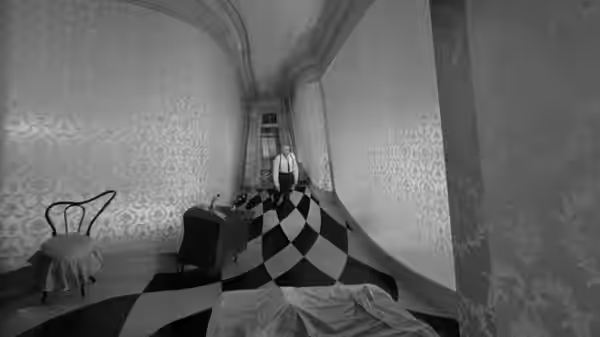
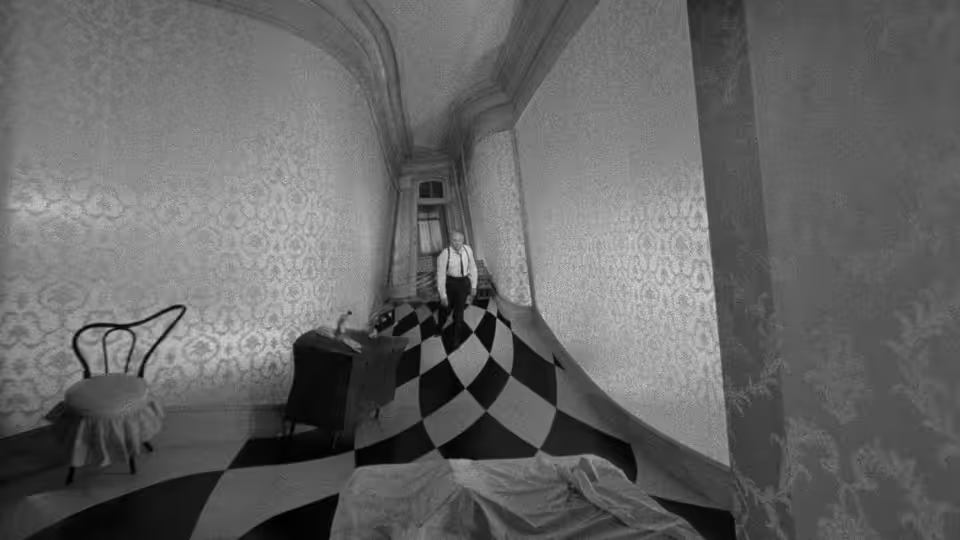
A man stands at the far end of a long, checkerboard-floored hallway
Film review

Seconds

1966 · Directed by John Frankenheimer · 1h 47m

In a sentenceRock Hudson, of all people, as the man who bought Rock Hudson’s face and could not wear it

Arthur Hamilton (John Randolph) is a banker in his fifties who commutes into Manhattan and comes home each night to a wife, Emily (Frances Reid), he has nothing left to say to. Then the phone calls start. The voice is Charlie Evans (Murray Hamilton), an old friend Arthur believes is dead, and he has an address. The address sends Arthur to a dry cleaner’s, then a meat-packing plant, then a set of offices with no name on the door. There Mr. Ruby (Jeff Corey) and a gentle Old Man (Will Geer) explain the service: a new face, a new name, a corpse to leave behind, and a fresh start somewhere warm. Arthur wakes up as Tony Wilson (Rock Hudson), a painter with a house on the California coast.

Fi1m review

Frankenheimer’s story of a banker who buys a new face and a new life is as frightening as anything from its decade, with James Wong Howe’s camera doing most of the frightening. The middle hour in California drifts; everything either side of it is exact.

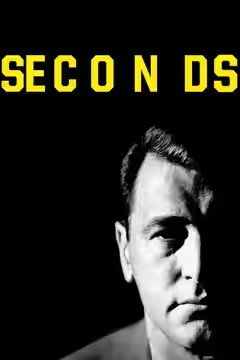
John Frankenheimer had already made The Manchurian Candidate when he took on David Ely’s novel, and Seconds is the colder film. Lewis John Carlino’s screenplay asks a plain question: if a company could give you a new face and a new life, would the man inside change with it? The answer is no, and the film spends 107 minutes making that answer hurt. It is a horror film with almost no violence in it, and it frightened us more than most that have a good deal.

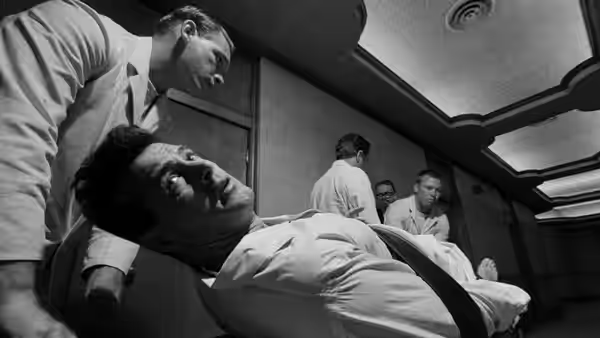
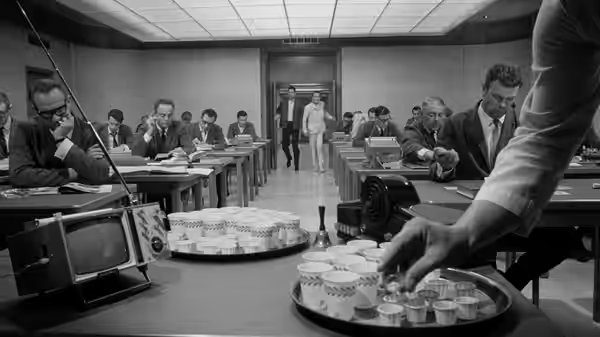
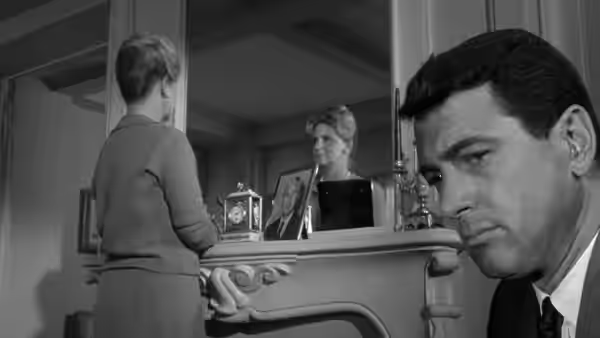
The first reason to see it is James Wong Howe. He shoots the opening at Grand Central with lenses so wide that the pillars bend and a face a few inches from the camera stretches like something pulled. The camera follows John Randolph’s Hamilton through the crowd at shoulder height, hand-held, so that we are the thing tailing him. Later Howe rigs the camera to the actor so that a corridor lurches and the face in front of it does not. Ferris Webster and David Newhouse cut the early scenes a beat short each time, as if somebody were listening at the door.

Randolph plays Hamilton as a man who has stopped noticing his own life. His conversations with Emily (Frances Reid) are held from separate beds, about nothing. When the Company gets hold of him, its people are the politest in the film. Jeff Corey’s Mr. Ruby eats his lunch while he explains the terms. Will Geer’s Old Man speaks softly about a man’s right to his dream, and means it, and that is the most frightening thing in the first hour. They show Hamilton a film of himself doing something he has not done and offer him the choice of signing or not. We watched Randolph’s face during that screening and felt sick, which is what the scene is for.

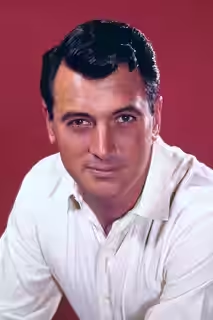
Then Rock Hudson arrives, and the casting is the film’s best idea. Hudson was the handsomest man in American pictures for a decade, and here he plays a middle-aged banker who has been handed that face and does not know what to do with it. For a while he is stiff, and we took it for a weakness before we understood it. Tony Wilson walks like a man in someone else’s suit. The scene that undoes him is a cocktail party at his new house, where he drinks too much and begins telling the guests things a painter from California could not know. Hudson goes from good cheer to panic without the film cutting away, and it moved us more than we thought this film had room for. He is playing a man who has found out that what he wanted was not a new life but the old one, lived properly.

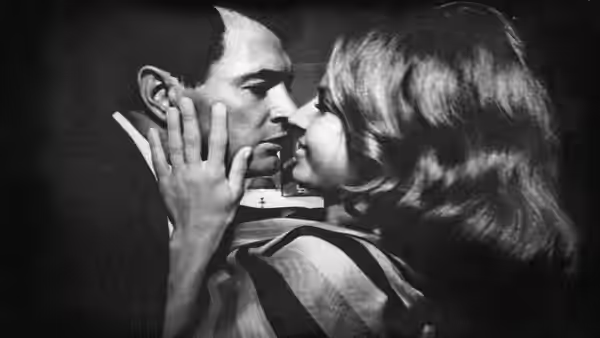
The California stretch is where the film slackens. Salome Jens’s Nora Marcus finds Wilson on the beach and takes him to a grape harvest in the hills, where several dozen naked people stamp fruit and shout about freedom. It is meant to show a man failing to let go, and it does, but Frankenheimer lets it run well past that point, and Nora is a way of getting Wilson to the party rather than a woman in her own right. Jerry Goldsmith’s score, an organ and strings that sound like a funeral service played at the wrong speed, is exactly right in the offices and lays it on thick in the sun.

The reviews in 1966 were divided, and we can see why: the film changes its manner three times and asks you to trust that the pieces belong to the same story. They do. The last quarter of an hour, which we will not describe, is the place the whole film has been walking towards, and Frankenheimer shoots it with a stillness the opening has taught you to dread. We came out of it quiet.

Watch it at night, and do not read about the ending anywhere first. It is one of the few films from its decade that has not softened with age.
Critical consensus AI synthesised

75
Positive
6
Mixed
2
Negative
1

Most critics admire Seconds, and the praise lands in two places. James Wong Howe’s black-and-white cinematography is named again and again, described as disorienting, stark and agitated, the thing that turns a story about a bored banker into something closer to a nightmare. Rock Hudson’s performance draws nearly as much comment, with several reviews calling it revealing. The words that recur are bleak, unsettling and frightening, and most of the reviews mean them as compliments; one critic calls the film years ahead of its time.

The spread is wide. The warmest notices come from later reviews, written after the film was restored, and the one clear dissent is the earliest: Variety finds it intriguing but unsuccessful as thriller, science fiction or fable, and faults the Faustian theme as underdeveloped. Two of the nine reviews could not be read in full, so the middle ground is thinner than the numbers suggest.

IndieWire
3 December 2014 · Max O'Connell
90*

O’Connell presents the film as a striking, unsettling work of existential terror and paranoia. He singles out its disorienting cinematography and Rock Hudson’s revealing performance for praise.

Read the full review →
Slant Magazine
11 August 2013 · ★★★★½ · Bill Weber
90

Weber finds Seconds a bleak, visually striking film whose restoration enhances its Kafkaesque descent. He especially praises James Wong Howe’s disorienting black-and-white cinematography and the transfer’s depth and detail.

Read the full review →
The AV Club
14 August 2013 · B+ · Sam Adams
83

Adams finds the film unsettling, audacious, and stylistically daring. He especially praises John Hudson’s performance and the film’s agitated visual style.

Read the full review →
Radio Times
★★★★ · Tony Sloman
80

The critic calls the film brilliant, frightening, and years ahead of its time. They praise its stark black-and-white cinematography and Rock Hudson’s performance.

Read the full review →
The New Yorker
30 September 1966 · Brendan Gill
80*

Gill finds Seconds exhilarating and ultimately delightful despite its bleak theme. He praises its superb plot and James Wong Howe’s varied, ravishing camerawork.

Read the full review →
The New York Times
6 October 1966
64*

The page content is blocked, so the critic’s verdict cannot be verified. No praise or complaint can be reliably identified from the available text.

Read the full review →

Straight answers AI written, from our review

Is Seconds worth watching?
Seconds is worth watching for anyone who can take a slow, frightening film about a man who cannot escape himself, and we scored it 84. John Frankenheimer's story of a banker who buys a new face is as unsettling as anything from the 1960s, with James Wong Howe's lurching camera and Rock Hudson's stiff, panicked performance doing most of the work. The California middle hour drifts; watch it at night and read nothing about the ending first.
How long is Seconds, and what is it rated?
Seconds runs 1h 47m. It is a science fiction and thriller film.
Where can I watch Seconds in Greece?
Seconds is not on any streaming or rental service in Greece at the moment. It is available in 19 other countries; change your country at the top of the page to see where. Availability is checked daily.
How violent or frightening is Seconds, and is it suitable for children?
Seconds contains almost no violence, but it is a horror film all the same and we would not show it to children. It has no UK certificate and carries an R rating in America; the fear comes from bending wide-angle photography, polite men calmly explaining a sinister service, and a grape-harvest scene with a good deal of nudity. Older teenagers who can sit with dread rather than action should be fine.
How does Seconds compare to Eyes Without a Face?
Seconds and Eyes Without a Face are both quiet horror films about stolen faces, but Franju's is the sadder and more elegant, and Frankenheimer's the colder and more paranoid. Franju's surgeon takes faces for his daughter; Frankenheimer's Company sells them to men who want to disappear. Both slacken in the middle, and we recommend them as a pair, Franju for melancholy and Seconds for dread.
Is Seconds based on a true story or a book?
Seconds is based on a novel by David Ely and is not a true story. Lewis John Carlino's screenplay keeps the premise, a company that sells a new face and a new life, though we cannot say how closely the film follows the book beyond that. You need not have read it; the film works best on someone who knows as little as possible going in.
What should I watch after Seconds?
After Seconds, try Eyes Without a Face (1960, Fi1m 86): Franju’s surgeon steals faces for his daughter; quiet, elegant and hard to shake. Then The Manchurian Candidate (1962, Fi1m 88): Frankenheimer’s earlier paranoia, faster and funnier, with the same distrust of smiling men.

Cast

Awards

Academy Awards, 1967

Nominated
Best Cinematography, Black-and-White

If you liked this, try…

  1. The Face of Another (1966) · not on Fi1m yetTeshigahara’s man in a borrowed face, made the same year and just as cold.

  2. Eyes Without a Face (1960, Fi1m 86)Franju’s surgeon steals faces for his daughter; quiet, elegant and hard to shake.

  3. The Swimmer (1968) · not on Fi1m yetBurt Lancaster crosses suburbia pool by pool while his life comes apart behind him.

  4. The Manchurian Candidate (1962, Fi1m 88)Frankenheimer’s earlier paranoia, faster and funnier, with the same distrust of smiling men.

  5. The Tenant (1976) · not on Fi1m yetPolanski moves into a dead woman’s flat and slowly stops being himself.