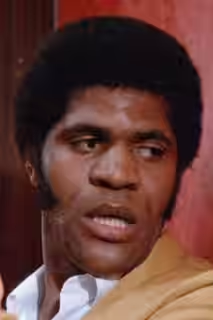
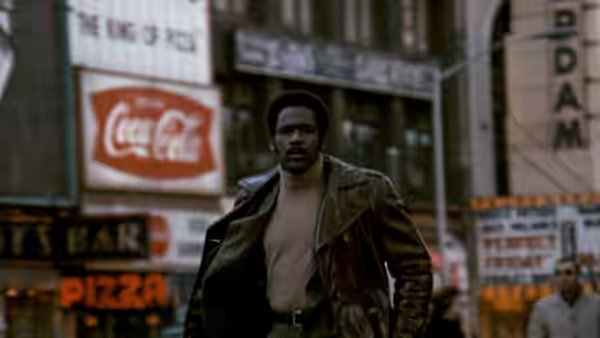
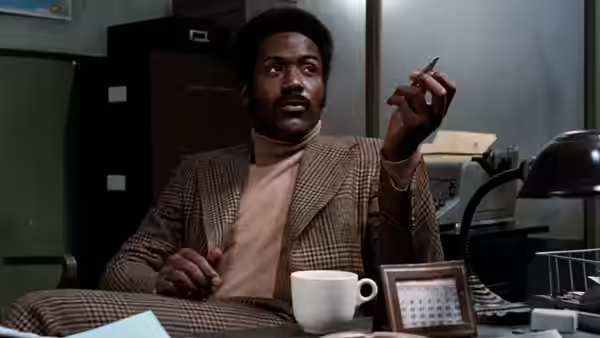
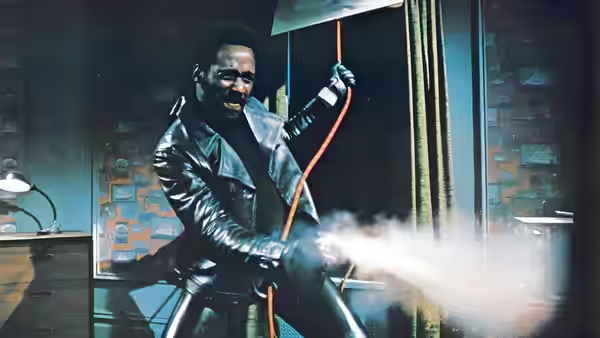
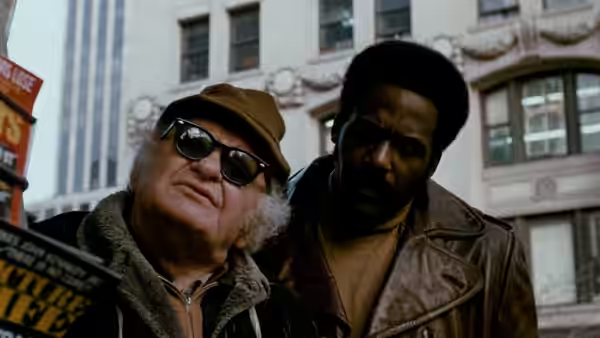
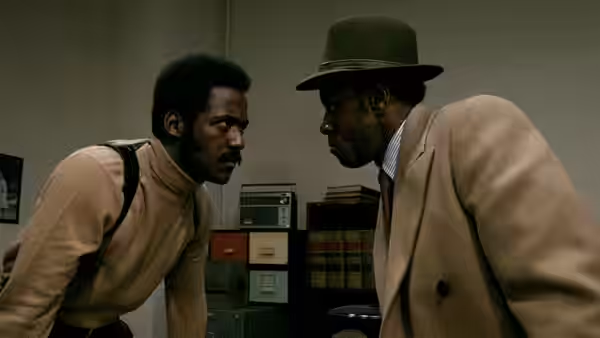
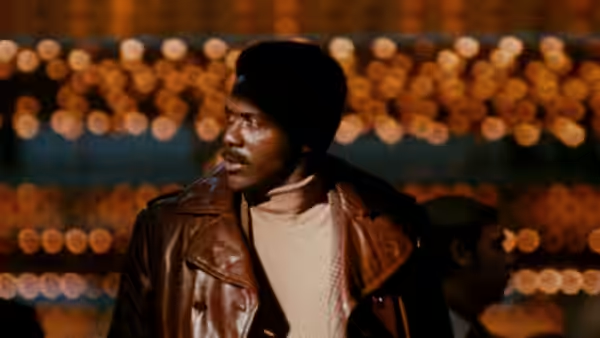
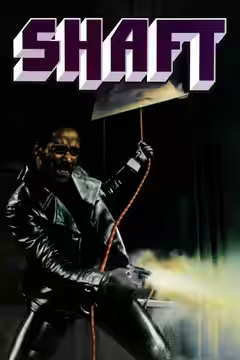
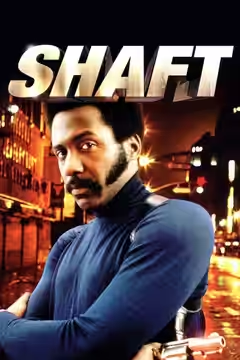
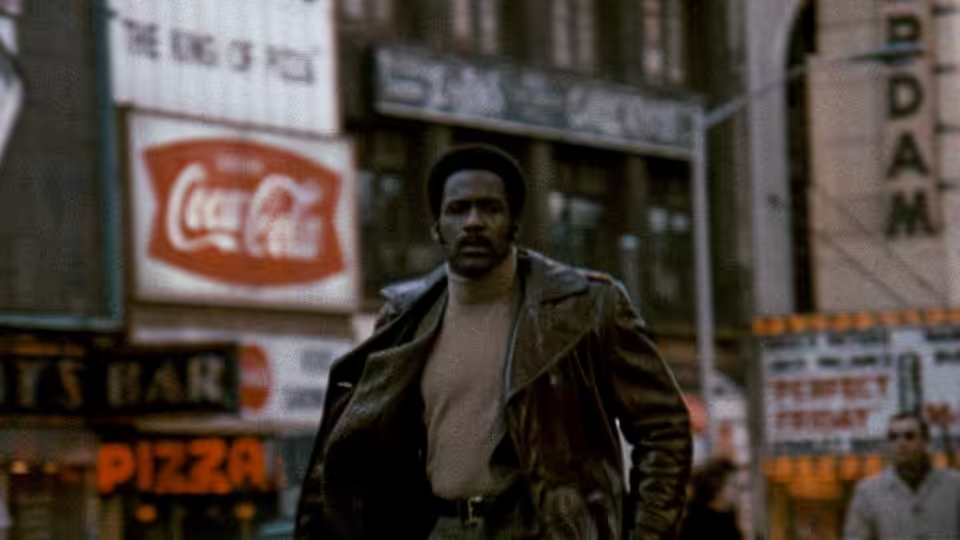
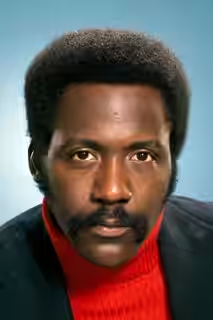
John Shaft (Richard Roundtree) walks through a city street in a leather jacket
Film review

Shaft

1971 · Directed by Gordon Parks · 1h 40m

In a sentenceRichard Roundtree looks ready for a better case, and Isaac Hayes has already supplied the music

In early-1970s New York, the mob wants Harlem back, and private detective John Shaft (Richard Roundtree) stands in its way. His story involves Bumpy Jonas (Moses Gunn), Vic Androzzi (Charles Cioffi) and Ben Buford (Christopher St. John), alongside Ellie Moore (Gwenn Mitchell) and Sergeant Tom Hannon (Lawrence Pressman). Gordon Parks directs this crime thriller, which follows a Black private eye through a struggle over Harlem. Crime, drama and action share its 100 minutes, with a screenplay by Ernest Tidyman and John D.F. Black.

Fi1m review

Gordon Parks gives Shaft a persuasive leading man and a New York worth looking at. The plot is thin, but Richard Roundtree and Isaac Hayes make this crime thriller worth an evening.

Gordon Parks’s Shaft is worth an evening for Richard Roundtree, the music and the city, with a caveat about the detective story. The mob’s claim on Harlem gives it a blunt, workable conflict, but the writing does too little to make that conflict interesting. What keeps us watching is John Shaft himself. Richard Roundtree has enough presence to make waiting for the plot to improve a reasonably agreeable occupation.

As a Black private eye, John Shaft occupies the centre of a genre that often treats the detective’s independence as his chief qualification. Richard Roundtree makes that independence convincing without asking us to find him agreeable. There is a cost to the reserve: we sometimes want more humour, or simply a less guarded response, from the man we are following. Still, the performance gives the film a steady presence, and Gordon Parks knows how much attention it can bear.

Urs Furrer’s cinematography is a substantial part of the appeal. New York feels like somewhere the film has bothered to look at, rather than a location chosen to make a familiar crime story appear tougher. There is enough interest in the city itself to keep us looking when the dialogue has ceased to surprise us. Gordon Parks allows that attention to place to count, and it gives the film a sense of ordinary life beyond its leading man.

The music does more than its fair share, too. Isaac Hayes and J.J. Johnson receive the music credits, and Isaac Hayes’s opening theme supplies an assurance the screenplay cannot always match. We were delighted by that opening: the theme makes the introduction to John Shaft feel like sufficient entertainment in itself. The music’s warmth also helps a film whose hero can seem determined not to enjoy himself. The danger is that the introduction promises an ease and excitement that the story only intermittently delivers.

Ernest Tidyman and John D.F. Black’s screenplay is the main limitation, relying on a conventional detective plot without making its familiarity especially pleasurable. We do not need a crime film to reinvent the investigation, but we do need some curiosity about what comes next. Hugh A. Robertson’s editing allows the pace to slacken as the climax approaches, precisely when that curiosity should be strongest. At 100 minutes, the film is hardly overlong, yet we notice the stretches in which neither the plotting nor the pace is helping Richard Roundtree. His presence can only do so much.

For a detective thriller, these are substantial reservations, and anyone coming chiefly for a satisfying case may find them decisive. We kept finding enough to enjoy in the performance, the music and the view of New York to stay interested. There is a good evening here for crime-film enthusiasts who do not require intricate plotting. Go for Richard Roundtree, and give the investigation some latitude.
Critical consensus AI synthesised

67
Positive
4
Mixed
2
Negative
1

Most critics regard Shaft as an entertaining film whose strongest qualities lie in its music and sense of place. Praise centres on Isaac Hayes’s score and the portrait of New York, with Gordon Parks’s handling of grit and humanity also drawing approval. The favourable reviews value its place in Black-led popular cinema, though the available comments offer more praise for atmosphere than for plotting.

The spread is wide, and the reservations mostly concern the story’s ability to sustain the appeal of its opening. The Guardian admires the city portrait but finds the script thin; Empire is more dismissive, faulting both the trite plot and Shaft’s humourless characterisation. Even Variety’s enthusiastic assessment notes a slowdown towards the climax. Slant Magazine sits at the favourable end, finding social commentary as well as period interest.

Slant Magazine
2 August 2022 · ★★★★½ · Budd Wilkins
90

The critic calls the film a quintessential blaxploitation work and a vivid snapshot of a bygone era. He praises its portrait of New York, soulful music, and social commentary.

Read the full review →
Variety
16 June 1971 · A.D. Murphy
80*

The review is strongly positive, calling the film an entertaining debut with strong box-office prospects. It praises Gordon Parks’s feel for the story’s grit and humanity, while noting that the film slows slightly toward the climax.

Read the full review →
The New York Times
11 July 1971
73*

The headline presents the film as an enjoyable Saturday-night movie. The accessible page provides no further critical verdict or specific point of praise.

Read the full review →
Time Out
· GA
70*

The review describes the film as hip, cool and entertaining. It singles out Isaac Hayes’s score and the film’s significance as a commercially successful story about a Black private eye.

Read the full review →
The New Yorker
7 August 1971 · Penelope Gilliatt
64*

The page identifies this as part of Penelope Gilliatt’s Current Cinema review, but provides no verdict. It offers no praise or criticism of the film.

Read the full review →
The Guardian
21 July 2000 · Andrew Pulver
60*

Pulver regards the original as a landmark and a fascinating snapshot, though its quality dips beyond the iconic opening song. He praises its low-budget filmmaking and depiction of early-1970s New York, while noting the script is thin.

Read the full review →

Straight answers AI written, from our review

Is Shaft worth watching?
Shaft is worth watching for crime-film enthusiasts who value a leading performance, music and location over intricate plotting; we score it 72 out of 100. Richard Roundtree, Isaac Hayes’s opening theme and Gordon Parks’s attention to New York keep us interested, but the thin detective story and slackening pace limit the pleasure.
How long is Shaft, and what is it rated?
Shaft runs 1h 40m. It is a crime and thriller film.
Where can I watch Shaft in Romania?
Shaft is not on any streaming or rental service in Romania at the moment. It is available in 1 other country; change your country at the top of the page to see where. Availability is checked daily.
How violent or frightening is Shaft, and is it suitable for children?
Shaft carries a US R certificate, which indicates adult material and makes it an unsuitable choice for children. We would treat it as an adult viewing choice rather than a family thriller; the certificate alone does not establish how graphic its violence is or how frightening it becomes.
How does Shaft compare to Le Samouraï?
Shaft is the warmer, more musically inviting choice beside Le Samouraï, but we recommend the latter for a more exacting thriller. Roundtree’s presence and the attention to New York compensate for a thin investigation, while Melville builds suspense more effectively from his killer’s guarded behaviour and the police pursuit.
Is Shaft based on a true story or a book?
Shaft is adapted from a novel by Ernest Tidyman, with a screenplay by Tidyman and John D.F. Black. We recommend approaching it as a self-contained detective thriller rather than required reading brought to the screen: its chief pleasures are Roundtree’s performance, the music and New York, not the intricacy of its case.
What should I watch after Shaft?
After Shaft, try The Harder They Come (1972, Fi1m 80): Another crime story whose music and sense of place warrant the evening. Then Le Samouraï (1967, Fi1m 88): For criminal self-possession taken somewhere colder, quieter and considerably more exacting; and Ghost Dog: The Way of the Samurai (1999, Fi1m 80): Another solitary professional whose film understands the value of the right music.

Cast

Awards

Academy Awards, 1972

Nominated
Best Original Dramatic Score

If you liked this, try…

  1. Coffy (1973) · not on Fi1m yetFor another commanding lead who makes rough crime plotting worth following.

  2. The Harder They Come (1972, Fi1m 80)Another crime story whose music and sense of place warrant the evening.

  3. Le Samouraï (1967, Fi1m 88)For criminal self-possession taken somewhere colder, quieter and considerably more exacting.

  4. Devil in a Blue Dress (1995) · not on Fi1m yetA Black private detective gets a richer mystery and a persuasive city.

  5. Ghost Dog: The Way of the Samurai (1999, Fi1m 80)Another solitary professional whose film understands the value of the right music.

Shaft (1971) review: Strong presence carries a thin crime story (Romania) | Fi1m