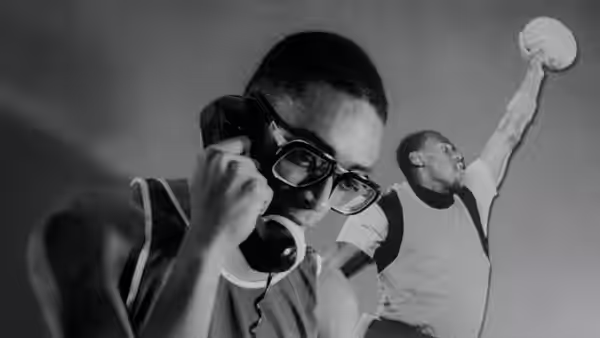
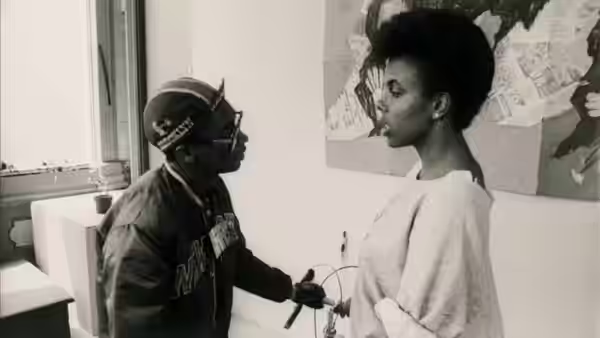
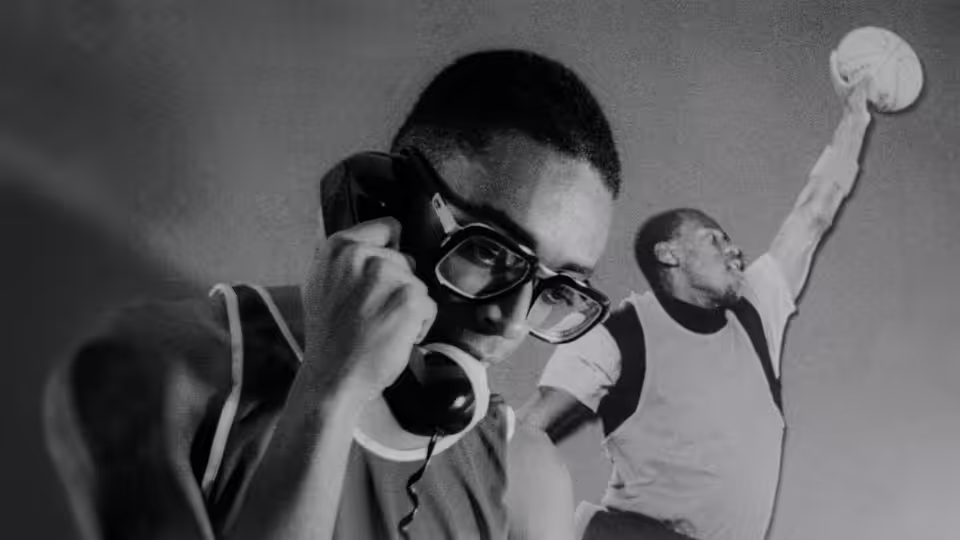
Mars Blackmon (Spike Lee) talks on the phone beneath a basketball player raising a ball
Film review

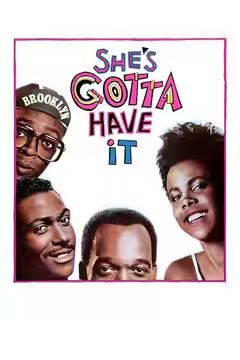
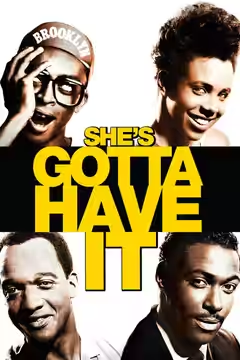
She's Gotta Have It

1986 · Directed by Spike Lee · 1h 24m

In a sentenceThree suitors plead their case to the camera; Nola lights the candles and declines to choose

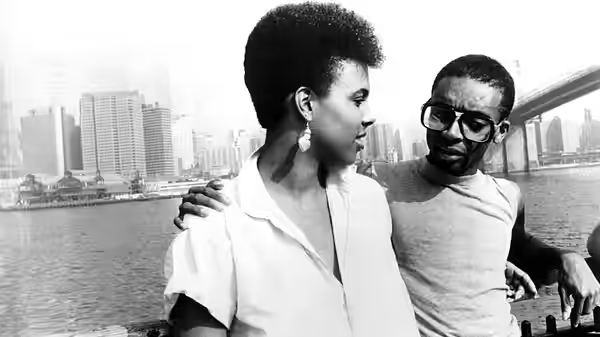
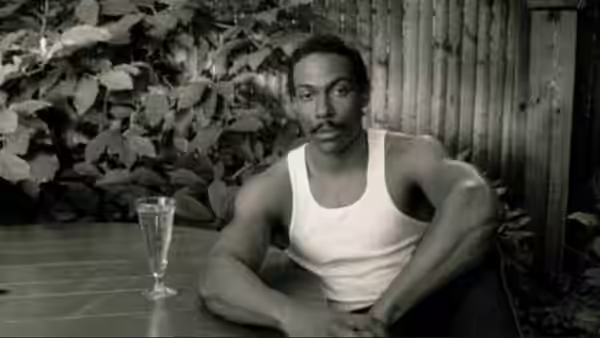
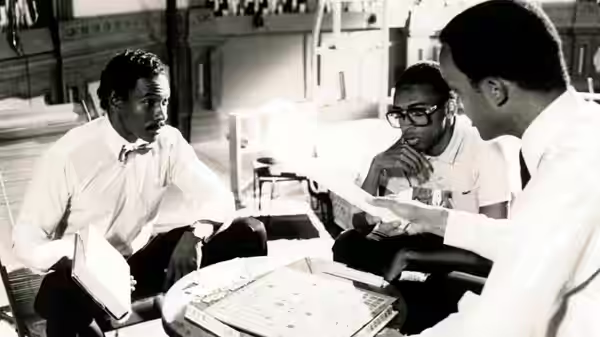
Brooklyn, the mid-1980s. Nola Darling (Tracy Camilla Johns), a young graphic artist, lives alone in a loft with a large bed and candles, and is seeing three men at once. Jamie Overstreet (Tommy Redmond Hicks) is steady, serious and wants to be the only one. Greer Childs (John Canada Terrell) is a model who admires himself more than her. Mars Blackmon (Spike Lee) is a bike messenger in thick glasses who never stops talking. Each sits and tells the camera why he is the right choice. Nola wants all three and sees no reason to apologise. Her friend Opal Gilstrap (Raye Dowell) wants her too, her old flatmate Clorinda Bradford (Joie Lee) disapproves, and a doctor (S. Epatha Merkerson) is asked whether anything is wrong with her.

Fi1m review

Spike Lee’s first feature is quick, funny and made on next to nothing, with a Brooklyn and a heroine the cinema had not shown before. It is also roughly acted, thin around its lead, and it turns ugly late on in a way it never earns.

Spike Lee’s first feature is 84 minutes long, shot in black and white, and set almost entirely in Brooklyn, where a young woman called Nola Darling has three lovers and no intention of giving any of them up. The men sit in front of the camera and explain her to us. So does she. It is a small, brisk, frequently funny film, and it shows a place and a kind of woman that American cinema had not bothered with before it. It is also unevenly acted, thinly written around the person it is about, and it contains one late scene that spoiled it for us. We would still send the curious to it.

Lee wrote it, directed it, produced it and cut it, and the cutting is where his instincts show first. People talk straight into the lens, the film freezes on a face when a point has been made, and a row of men deliver their worst chat-up lines one after another like witnesses at a trial. Ernest Dickerson shoots the brownstones and the loft in clean, high-contrast black and white, so that the candles round Nola’s bed read as points of hard light and the sheets look like paper. Wynn Thomas dresses that loft as a stage: the bed in the centre, the candles, little else. Bill Lee, the director’s father, wrote the jazz score and appears as Nola’s father Sonny Darling, sitting at a piano.

There is one sequence in colour, a dance in a park for Nola’s birthday, and it is the film’s one lapse into prettiness. Everywhere else the roughness suits it. The camera is handheld when it needs to be and still when it can afford to be, and John Michael Reefer’s costumes tell us who each man is before he opens his mouth: Greer in tailored white, Jamie in a plain shirt, Mars in a gold chain, a cycling cap and glasses he refuses to take off in bed.

Mars is the reason the film is remembered, and Lee knows it. He plays him as a small man made entirely of nerve, repeating the word please until it becomes a percussion track, and every one of his scenes is a comedy sketch that happens to have a plot attached. We laughed out loud when he explained his shoes. John Canada Terrell’s Greer folds his clothes before he gets into bed, garment by garment, while Nola waits, and the scene is a whole character in a minute. Tommy Redmond Hicks is the strongest of the three; his Jamie is decent, dull and wounded, and the film’s scenes of ordinary tenderness belong to him.

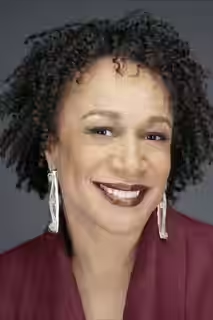
The trouble is at the centre. Tracy Camilla Johns has presence and a fine, level way of looking at a man who is lecturing her, but the script gives Nola desire and refusal and not much else. The men get the jokes and the arguments; she gets to say she is not a freak, and to say it again. Around her the acting drops away. Raye Dowell’s Opal and Joie Lee’s Clorinda have scenes that play like first readings, the sound is muddy, and lines that should land as wit arrive as statements. S. Epatha Merkerson, as the doctor Nola visits to be told she is normal, is on screen for a few minutes and is the only person in the film who seems entirely at ease.

Then there is the scene late on that we will not describe. The film treats it as a turning point in a love story. We watched it and were angry, and angrier at what followed, because Lee cuts away from it and the next scenes carry on as if a quarrel had happened and not something worse. Nothing in the rest of the film reckons with it. It is the one place where a young director’s carelessness costs more than a flat line reading, and it is why the score below is not higher.

Three years later Lee and Dickerson made Do the Right Thing (1989), and everything tried here is there in finished form: the direct address, the colour, the block full of people who each get a say. This is the sketchbook. Watch it in that spirit, for Mars and for Dickerson’s Brooklyn, and be ready for the last twenty minutes to test your goodwill. It carries an 18 certificate and it earns it.

Critical consensus AI synthesised

71
Positive
4
Mixed
2
Negative
0

Most critics like it, and the praise clusters on Spike Lee’s direction. The reviews single out the inventiveness of the style, the free-form scenes and improvisations, and the sheer energy of a film made on very little money. Several see it as a calling-card for its director rather than a finished piece of storytelling, and count that in its favour. The mix of humour and eroticism is mentioned more than once, approvingly.

The reservations gather around execution and around the woman at the centre. Technical roughness and some of the directing choices draw complaint even from admirers. Variety offers the sharpest dissent, finding Nola Darling herself fails to compel and crediting her three suitors with keeping the story moving. The AV Club, though positive, calls the premise dated and leering. The spread is wide, from warm enthusiasm to a shrug, but nobody dismisses it. One review reaches no verdict at all.

Los Angeles Times
21 August 1986 · MICHAEL WILMINGTON
85*

Wilmington finds the film refreshing, engaging, and joyfully unconventional, despite occasional flaws. He especially praises Spike Lee’s inventive direction and the film’s lively blend of humor, eroticism, and jazz-like energy.

Read the full review →
The AV Club
13 February 2008 · B+ · Noel Murray
83

Murray finds the film’s premise dated and leering, but considers it a distinctive calling-card for Spike Lee. He praises its visual style and inventive sequences, especially given its small budget.

Read the full review →
Slant Magazine
14 January 2008 · ★★★/4 · Eric Henderson
75

Henderson finds the film’s communal, unconventional style compelling, despite some narrative roughness. He particularly praises its free-form scenes and improvisations for conveying a shared experience.

Read the full review →
The New York Times
8 August 1986 · D.J.R. BRUCKNER
70*

The critic finds the film’s story powerful and its characters engaging, despite flaws in the execution. He praises the poignant exploration of love and independence, while faulting the technical problems and some directing choices.

Read the full review →
Time Out
· SGo
64*

The available metadata identifies this as a review of Spike Lee's film, but provides no critical verdict. Its description only notes Nola Darling's effort to navigate her relationships; no praise or complaint is available.

Read the full review →
Variety
31 December 1985 · Variety Staff
50*

The review finds the film worthy but flawed, with its central character failing to compel. It praises the three suitors for keeping the story moving with interest.

Read the full review →

Straight answers AI written, from our review

Is She's Gotta Have It worth watching?
She's Gotta Have It is worth watching for the curious about Spike Lee's beginnings, and we scored it 68. It is quick, funny and shot in clean black and white by Ernest Dickerson, with Lee's Mars Blackmon the reason it is remembered. It is also roughly acted around its lead, and one late scene turns ugly in a way the film never earns.
How long is She's Gotta Have It, and what is it rated?
She's Gotta Have It runs 1h 24m. It is a comedy and romance film.
Where can I watch She's Gotta Have It in Finland?
She's Gotta Have It is streaming on Netflix in Finland. Availability is checked daily; the links above go straight to each service.
How violent or frightening is She's Gotta Have It, and is it suitable for children?
She's Gotta Have It carries an 18 certificate in the UK and is not for children or younger teenagers. It is frank about sex, with much of it set around Nola's bed, and there is one late scene, which we will not describe, that turns ugly and made us angry. The rest is talk and comedy rather than violence.
How does She's Gotta Have It compare to Do the Right Thing?
She's Gotta Have It is the sketchbook and Do the Right Thing is the finished picture, made by Lee and Dickerson three years later. The direct address, the humour and the block full of people who each get a say are all tried here and completed there, in colour. The later film is the better one by a wide margin; see this one for Mars and for Dickerson's Brooklyn.
What should I watch after She's Gotta Have It?
After She's Gotta Have It, try Do the Right Thing (1989, Fi1m 93): Lee and Dickerson three years on, every idea here finished and in colour. Then Stranger Than Paradise (1984, Fi1m 82): Another cheap black-and-white New York film that made a career out of hanging about; and Frances Ha (2012, Fi1m 82): Brooklyn in black and white again, a heroine who will not settle, gentler company.

Cast

If you liked this, try…

  1. Do the Right Thing (1989, Fi1m 93)Lee and Dickerson three years on, every idea here finished and in colour.

  2. Losing Ground (1982) · not on Fi1m yetKathleen Collins’s comedy of a philosophy professor and a straying marriage, made just before this.

  3. Stranger Than Paradise (1984, Fi1m 82)Another cheap black-and-white New York film that made a career out of hanging about.

  4. Cléo from 5 to 7 (1962) · not on Fi1m yetA woman walks through a city being looked at, and looks back.

  5. Frances Ha (2012, Fi1m 82)Brooklyn in black and white again, a heroine who will not settle, gentler company.

She’s Gotta Have It (1986) review: quick, funny, careless late on (Finland) | Fi1m