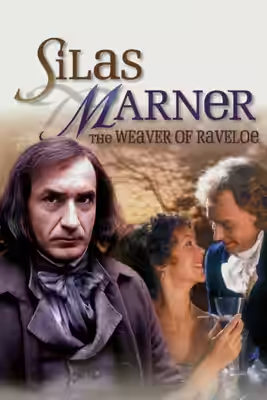
Giles Foster’s version of George Eliot’s novel is small, careful and plain, and gives Ben Kingsley a part he plays with his whole bent body. The Cass family gets hurried through in ninety minutes; the weaver’s cottage is worth the evening.
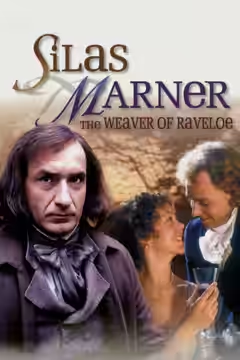
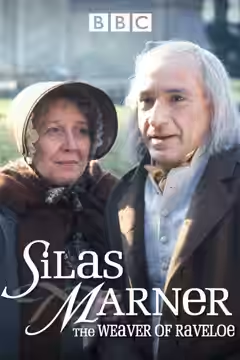
George Eliot’s shortest novel is about a man who swaps one love for another without meaning to, and Giles Foster’s 1985 film, which he wrote with its producer Louis Marks, keeps it short. Ninety minutes is not long for a story that covers decades, and the film makes its choice early: the weaver gets most of the time and everyone else gets what is left. Since the weaver is Ben Kingsley, that turns out to be the right choice. It is a modest piece, and we liked it more than we expected to.
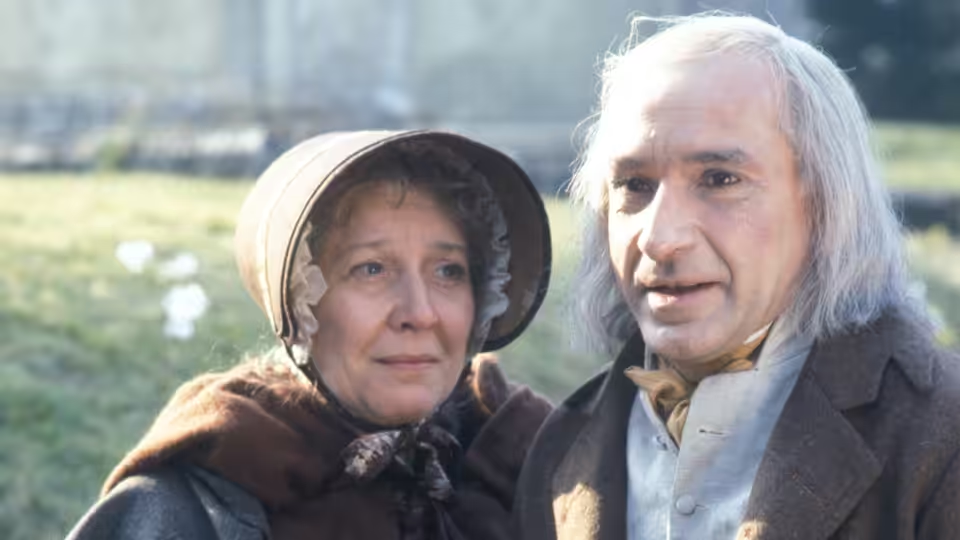
Kingsley plays Silas as a man who has closed down. He peers through a squint, holds his shoulders up near his ears, and walks as if the loom were still attached to him. When he counts the coins at night he does it with the fingers rather than the eyes, and the small smile he allows himself is the only warmth in the cottage. It would be mannered if Kingsley did not keep it so still; he barely raises his voice, and when he does it is a shock. When he finds the hiding place empty, Foster lets him stand with a brick in his hand, not understanding, for longer than most directors would allow.
Then the child comes. We will not say how; the film treats it as a surprise, and we will respect that. The moment the weaver kneels to the hearth and sees gold curls where his gold used to be moved us more than we thought a teatime period piece could, and it was Kingsley who did it, slowly understanding what his hands were telling him. Elizabeth Hoyle and Melinda Whiting share the small Eppie, and both are allowed to be a nuisance. Rosemary Martin’s Dolly Winthrop, the neighbour who shows him how to hold the thing, is the film’s second-best performance, kind without being soft.
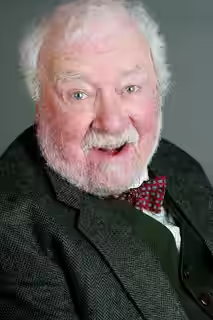
The Cass half of the story is where the ninety minutes bite. Freddie Jones gives Squire Cass a red face and a bark, Patrick Ryecart’s Godfrey is a handsome, weak man who keeps hoping things will solve themselves, and Jonathan Coy’s Dunstan has a horrible little grin whenever he has something on his brother. All three are right; none gets enough scenes. Angela Pleasence’s Molly has a handful of scenes that are among the film’s strongest and are over before they have begun. Jenny Agutter’s Nancy Lammeter is sensible and warm and, through no fault of Agutter’s, mostly waiting; the script tells us what she thinks of Godfrey rather than letting her show it.
Nat Crosby shoots the village in grey winter light and the cottage by firelight, so that the gold is the brightest thing in the frame. Gerry Scott’s Raveloe is mud, thatch and low beams, with the Cass house only a little grander, so the gap between the families is manners rather than money. Anushia Nieradzik puts Silas in the same brown coat for years and lets it fade. Carl Davis’s score is strings and a folk tune, used sparingly, though it swells once or twice at moments Kingsley had already carried on his own. Robin Sales’s editing is where the compression shows: the years pass in a cut or two, and the second half keeps arriving at scenes just as they end.
Jim Broadbent turns up as Jem Rodney, the poacher Silas first accuses, and is funny and aggrieved in four lines. Patsy Kensit, as the grown Eppie, is bright and open and has little to do except be loved; the film’s last movement, which we will not describe, asks her to carry a scene the script has not built for her, and she nearly manages it.
This does not pretend to the scale of Eliot’s big novels, and is wise not to. It is a fable, told plainly, in a village you could walk across in ten minutes. Watch it on a winter afternoon with the curtains drawn, and do not expect the Casses to add up; expect Kingsley to, and he does. It runs 90 minutes and was first shown in Britain on 30 December 1985.