Davis Guggenheim’s affectionate documentary gives Michael J. Fox space to be funny and candid about a difficult life. Inventive editing keeps the biography lively, though some harder questions go unasked.
Davis Guggenheim understands that a film about Michael J. Fox need not become solemn simply because it deals with Parkinson’s disease. STILL: A Michael J. Fox Movie is warm, funny and thoughtfully assembled, with a subject whose self-mockery makes the familiar celebrity biography feel less dutiful. The aim is to bring his remembered working life alongside the daily effort of living with illness. It succeeds well enough to make us wish the director were more willing to interrupt a good story with a difficult question.
Editor Michael Harte finds a productive use for the acting archive, fitting performed moments around the experiences Michael J. Fox recounts. These clips do more than remind us of a career: a performance can become an illustration of something private, and the connection supplies a joke or an unexpected bit of feeling. The cutting keeps that exchange between recollection and screen image lively without requiring a separate explanation each time. Occasionally the matching becomes distracting, and we notice the clever choice of a clip when we would rather stay with the speaker.
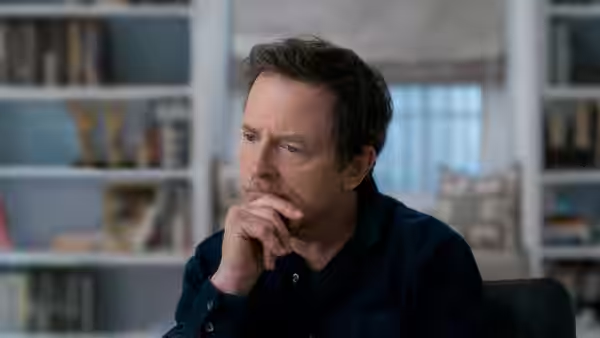
Julia Liu, Clair Popkin and C. Kim Miles share the cinematography credit, and the present-day conversations have a directness that suits this talkative subject. Keeping our attention on him proves more valuable than finding another way to illustrate his past. The re-enactments, with production design by Matthew Budgeon, give remembered episodes a convincing physical setting and help the film move between its different kinds of footage. They are useful, though the interviews have more to offer than even a carefully reconstructed memory.
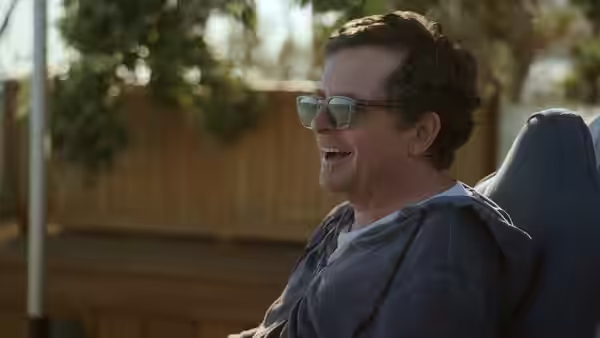
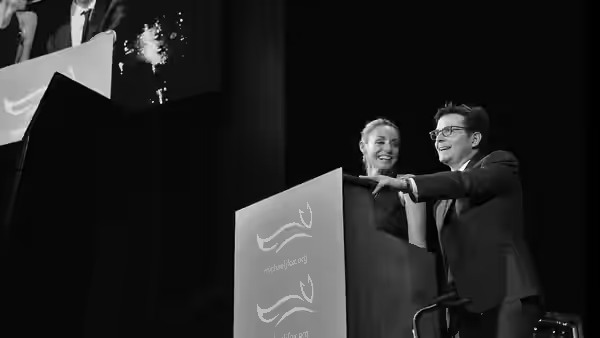
We were moved by the contrast between the quickness of Michael J. Fox’s humour and the difficulty of his movement. The jokes do not make the physical struggle disappear, and the film is clear enough about that struggle to let the laughter come without embarrassment. Tracy Pollan’s exchanges with him are particularly welcome, because the account of their marriage has room for humour as well as care. The family conversations let him be someone people know well, tease and answer back, which gives a fuller sense of him than another statement about resilience would.
The main reservation is that Davis Guggenheim could ask harder questions. Michael J. Fox is an engaging guide to his own life, but the film seldom challenges the account he offers, and some stretches of his later career pass with too little examination. At 95 minutes it is brisk, yet another ingenious combination of clips is not always what the biography needs. A longer conversation, or more time spent on an uncomfortable subject, might have told us something that the well-chosen footage cannot.
John Powell’s music supports the warmth of the film, although it sometimes adds encouragement to scenes that already carry enough feeling. By the standards of celebrity documentaries, there is still a welcome amount of space here for the subject to speak, rather than for admirers to explain his importance. The affection is earned through the conversations, particularly when humour interrupts any temptation to treat illness as the whole of a person’s character. Watch it for the conversation, rather than expecting a complete account of the career.