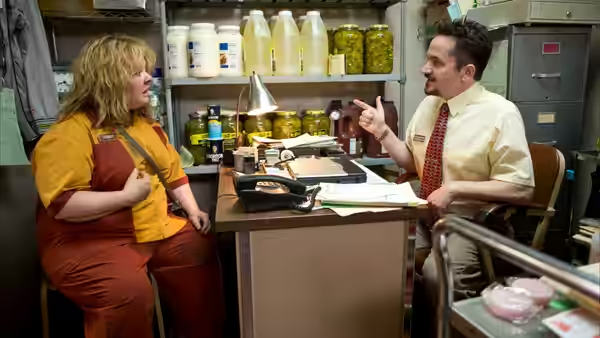
Melissa McCarthy gives Tammy more warmth than its jokes deserve, and Susan Sarandon supplies some welcome mischief. But Ben Falcone’s comedy is slack, short on laughs and too clumsy with its serious scenes to make the goodwill count.
Ben Falcone’s Tammy wants us to laugh at a difficult woman and then care about the hurt underneath. That is a reasonable ambition for a comedy, and Melissa McCarthy is an actor we would trust with both jobs. The film lets her down: it is poorly shaped and not funny often enough to justify its demands for sympathy. Written by Melissa McCarthy and Ben Falcone, it keeps changing how it asks us to regard Tammy without making those changes convincing.
Melissa McCarthy is not the problem, though the film gives her plenty of opportunities to look like it. As Tammy, she makes the brashness feel defensive, and the flashes of uncertainty are more interesting than the louder business surrounding them. We felt for her when that confidence faltered, because she made Tammy’s embarrassment recognisable rather than merely a reason to laugh at her. The difficulty is that the screenplay keeps returning to the broad behaviour without deepening our understanding of it.
Susan Sarandon, playing Pearl, brings a welcome suggestion that the comedy might become unruly. Her exchanges with Melissa McCarthy have bite, and she does not need to force a line to make her presence felt. Kathy Bates, as Lenore, provides another reminder of how useful a settled performance can be in a film unsure of its tone. Neither can make up for a script that offers the cast moments to play without giving those moments enough consequence.
Russ T. Alsobrook’s cinematography keeps the performers legible but does little to sharpen the comedy: there is not much pleasure in how a reaction is framed or how people occupy a shot. Jefferson Sage’s production design is similarly unobtrusive, with little that gives us something to notice beyond the actors. Neither is the chief reason the film fails. But in a comedy already short of good lines, the lack of interest in the image leaves the cast carrying almost everything.
Michael L. Sale’s editing does not find a persuasive rhythm between the broad comedy and the serious passages. The jokes need firmer stops, while the hurt needs time to register before the film asks for another laugh. Michael Andrews’s music offers little help in making those shifts feel earned. We grew bored by the repeated effort to restart the comedy, because the changes of tone kept interrupting what small involvement the performances had managed to build.
A character comedy does not need a relentless supply of punchlines, but it does need people whose behaviour we can follow. Here the screenplay’s sympathy for Tammy is evident, yet its treatment of her is inconsistent. We are asked to enjoy her excesses and then take her vulnerability seriously without enough connecting work. Ben Falcone’s direction allows the two kinds of scene to remain separate, and the quieter passages have to work too hard to make us care about her again.
There is kindness here, and that matters. The film does not feel contemptuous of its lead, even when it cannot decide how to write her, and the performances offer enough warmth to prevent it becoming unpleasant. At 97 minutes it still feels drawn out. Admirers of Melissa McCarthy may appreciate the tender work between the noisy stretches; anyone coming chiefly for a laugh should choose something else.