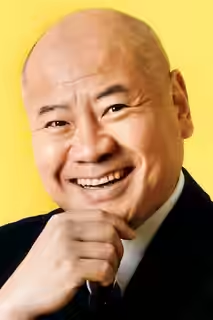
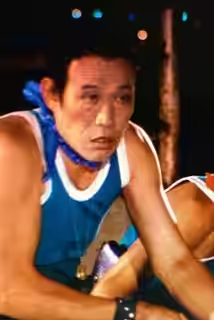
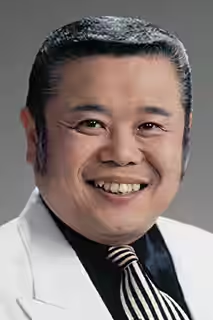
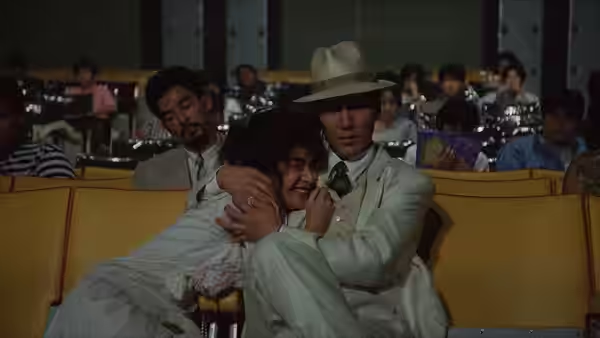
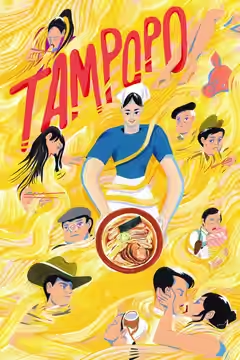
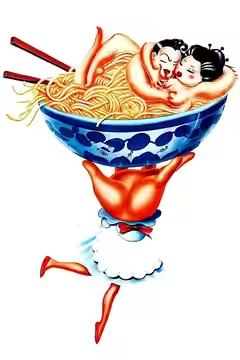
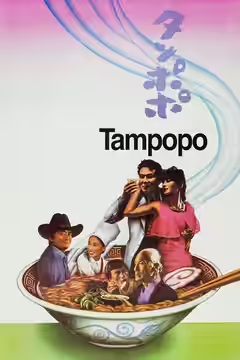
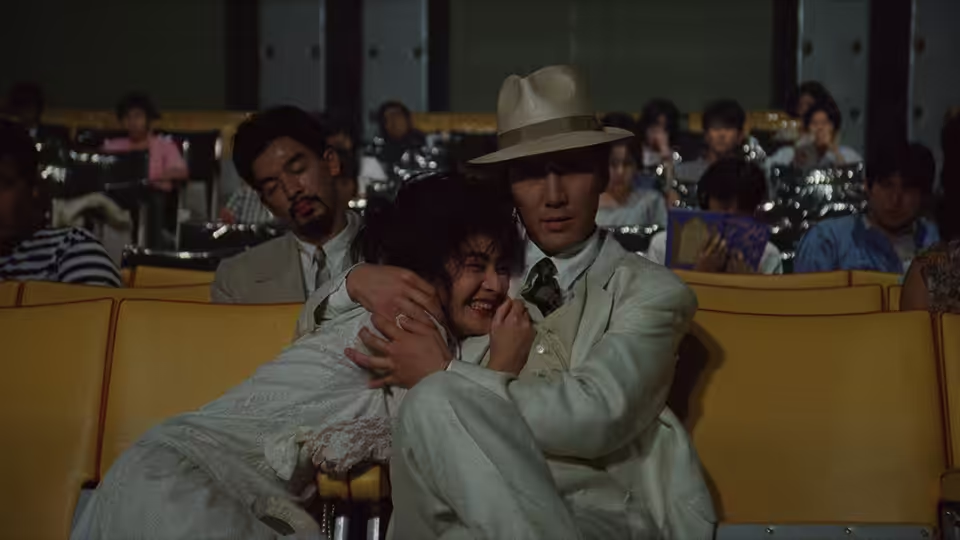
The White Suit Man (Koji Yakusho) embraces a woman in a crowded cinema
Film review

Tampopo

1985 · Directed by Jūzō Itami · 1h 55m

In a sentenceTwo hours of people eating with such attention that we got up and checked the fridge

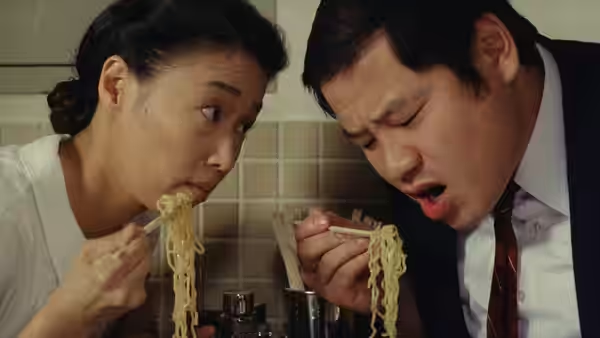
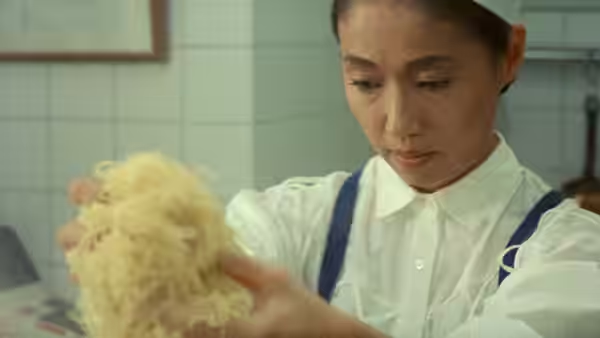
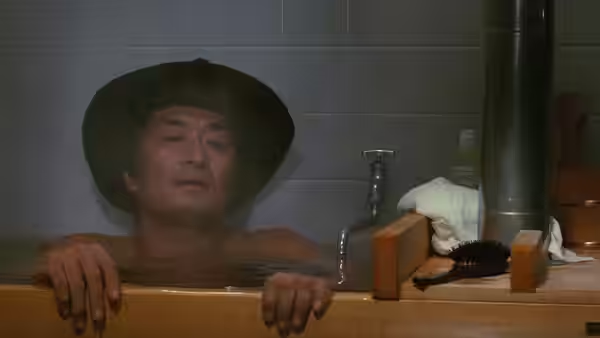
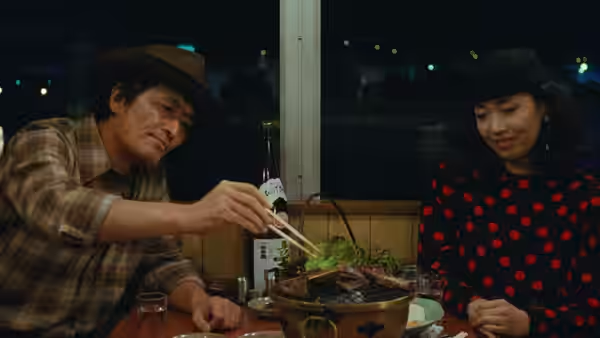
A gangster in a white suit (Koji Yakusho) settles into a cinema seat, turns to the audience and asks us not to rustle our crisps while the film plays. Then the film starts. Goro (Tsutomu Yamazaki), a lorry driver in a cowboy hat, and his young mate Gun (Ken Watanabe) pull up on a wet night at a shabby ramen shop run by Tampopo (Nobuko Miyamoto), a widow with a small son and no gift for noodles. Among her regulars is Pisken (Rikiya Yasuoka), a local heavy who fancies her and picks a fight with Goro in the car park. Tampopo asks Goro to make her a proper ramen cook. He agrees, and the lessons begin: spying on rival kitchens, tasting broth, timing the boil. In between, the film keeps wandering off to watch other people eat.

Fi1m review

Jūzō Itami’s comedy about learning to make a bowl of ramen is the happiest film about food we know, and one of the most serious. It is loose, occasionally slack, and at 115 minutes a shade long; we had forgiven it before the broth was ready.

The tagline calls it the first Japanese noodle western, and for once the tagline is accurate. Jūzō Itami, who wrote it, produced it and directed it, borrows the shape of a Western: a stranger arrives in town, in a lorry rather than on a horse, and finds a widow in trouble. The trouble is that she cannot cook. Goro (Tsutomu Yamazaki) agrees to train her, and around that thin spine Itami hangs a dozen short films about the Japanese and their food. It is funny, it is untidy in ways that occasionally cost it, and we recommend it to anyone who has ever eaten.

The digressions are most of the film. Akira Suzuki’s editing follows a passer-by out of the ramen shop and into somebody else’s story: a business lunch at a French restaurant where the most junior man at the table knows more about the menu than his bosses, while the waiter (Isao Hashizume) keeps his face still; a class of young women being taught to eat spaghetti in silence while a man at the next table slurps; an old woman (Izumi Hara) creeping through a supermarket at night, pressing her thumb into every camembert and peach she can reach. Each runs a few minutes and is cut off once it has made its joke. Some are one-liners. Some are short stories. The best of them have nothing to do with the plot.

Running alongside is Koji Yakusho’s man in the white suit, the gangster who opens the film by telling us to be quiet in the cinema and who returns with his lover for a series of scenes in which food is foreplay. Masaki Tamura shoots these in hotel rooms lit like perfume adverts, the prawns and the cream and the egg yolk in close-up. The scene where the two of them pass a raw yolk between their mouths without breaking it made us laugh and then squirm, and we could not say afterwards which came first. The 18 certificate is for these scenes, and they earn it; nothing in them is unkind.

Tamura shoots food the way other cinematographers shoot faces. Broth steams in front of the lens; a slice of pork is turned with the care of a jeweller; the noodles are lifted and lowered and the camera waits. Emiko Kogô puts the lorry drivers in Stetsons and denim and the gangster in white down to his shoes, so that the genres announce themselves before anyone speaks. Kunihiko Murai’s score swells like a romance whenever the subject is a bowl. The joke is that everyone on screen takes the eating completely seriously, and the film means it too.

Yamazaki plays Goro as a man who has eaten in every roadside shop in the country and has opinions about all of them, delivered slowly and with a cigarette. Miyamoto’s Tampopo is anxious, eager and quicker than the men around her notice. Ken Watanabe, young and gangly, is the pupil in an early scene where an old man teaches him how to approach a bowl of ramen, including an apology to the pork, and it is the funniest cookery lesson we have seen. Rikiya Yasuoka’s Pisken starts as the villain and is allowed to become something more useful.

The flaws are the flaws of an anthology. One or two of the sketches are slighter than the rest and stay a beat too long, and 115 minutes feels like a hundred with a few extra courses. Tampopo herself spends much of the film being lectured by men who have appointed themselves her teachers, and Itami sees the comedy in that without quite seeing the cost. And there is a digression late on, involving a family and a meal, which we will not describe, that lands so hard it briefly unbalances the comedy around it. We were in tears, and two minutes later we were expected to laugh again. Some viewers will find that abrupt. We found it true to how eating and grieving actually happen, at the same table, on the same evening.

It did not reach British cinemas until 4 July 1994, nine years after it was made, and it has dated less than most comedies of its decade because its subject does not date. Watch it after dinner rather than before. Before, you will not last the first twenty minutes without getting up.

Critical consensus AI synthesised

80
Positive
9
Mixed
2
Negative
0

Most critics are won over, and the praise lands in the same two places. The first is the food itself: the noodles, the broth, the care taken over every dish, which reviewers find sensuous enough to revive the appetite. The second is the structure. Itami keeps leaving his noodle-shop story for comic and surreal vignettes, and the majority read these detours as the point rather than padding, with the scene of two lovers passing an egg yolk between their mouths singled out as the boldest of them.

The reservations are of degree, not kind. Variety finds the film a little too long, and The Guardian warns that the shifts from gangster film to romantic melodrama to cookery lesson may baffle viewers who came for only one of them. The Los Angeles Times, otherwise delighted, notes that Tampopo’s training amounts to an hour of men explaining things to a woman. Nobody dislikes it; the spread runs from warm to rapturous, and the two mixed scores are mild.

Little White Lies
· Anton Bitel
90*

Bitel presents the film as an exuberant, deeply pleasurable celebration of food. He particularly praises how its playful genre-mixing and comic vignettes complement the central story.

Read the full review →
Los Angeles Times
27 October 2016 · Justin Chang
90*

Chang gives the restored film an exuberant, strongly positive review, calling it a scintillating vision that still revivifies the senses. He especially praises its sensuous food imagery and playful genre-hopping, while noting that Tampopo’s quest involves an hour of group mansplaining.

Read the full review →
Slant Magazine
26 April 2017 · ★★★★½ · Budd Wilkins
90

Wilkins praises the film as an inventive, satisfying blend of communal warmth and darker, surreal digressions. He singles out its anarchic food-related vignettes, especially the outrageous scene of lovers passing an egg yolk between their mouths.

Read the full review →
The New York Times
22 May 1987 · Vincent Canby
85*

Canby gives the film a strongly positive verdict, celebrating its playful approach to food and storytelling. He singles out its inventive blend of comic episodes and noodle-making quest.

Read the full review →
Film Comment
· Michael Sragow
79*

The standfirst presents Itami’s film as a sensual, savory classic returning in a new restoration. The available text does not reveal what the critic specifically praises beyond that description.

Read the full review →
Empire
1 January 2000 · David Parkinson
75*

Parkinson finds the film charming, touching, and an enduring cult favorite. He praises its playful movie pastiches and sumptuous food, while highlighting its defense of Japanese culinary traditions.

Read the full review →

Straight answers AI written, from our review

Is Tampopo worth watching?
Tampopo is worth watching for anyone who has ever enjoyed a meal, and we scored it 84. Jūzō Itami's comedy about a lorry driver teaching a widow to make ramen is mostly digressions, some slighter than others, and 115 minutes is a shade long. Watch it after dinner, not before.
How long is Tampopo, and what is it rated?
Tampopo runs 1h 55m. It is a comedy film.
Where can I watch Tampopo in Ukraine?
Tampopo is not on any streaming or rental service in Ukraine at the moment. It is available in 7 other countries; change your country at the top of the page to see where. Availability is checked daily.
How violent or frightening is Tampopo, and is it suitable for children?
Tampopo carries a UK 18 certificate for a series of scenes in which a gangster and his lover treat food as foreplay, shot in close-up and meant to be both funny and squirming. There is a car-park fight and nothing we would call frightening, but the sex scenes make it unsuitable for children. Adults and older teenagers who can take frank comedy will be fine.
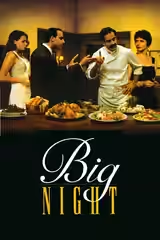
How does Tampopo compare to Big Night?
Tampopo is the looser and stranger of the two, a Japanese comedy that keeps wandering away from its ramen shop to watch other people eat, while Big Night stays with two brothers and one restaurant for an evening. Itami's film is the funnier and the more surprising; Tucci and Shalhoub's is the warmer and the more tightly told. Choose Tampopo for range, Big Night for company.
What should I watch after Tampopo?
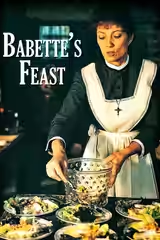
After Tampopo, try Babette's Feast (1987, Fi1m 86): One long dinner in a cold Danish village, cooked as an act of grace. Then Big Night (1996, Fi1m 84): Two brothers, one restaurant, one risotto that takes all evening and deserves to.

Cast

If you liked this, try…

  1. Babette's Feast (1987, Fi1m 86)One long dinner in a cold Danish village, cooked as an act of grace.

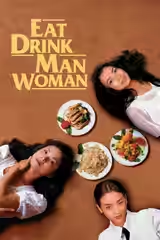
  2. Eat Drink Man Woman (1994) · not on Fi1m yetAng Lee’s Taipei chef says everything he cannot say through Sunday lunch.

  3. Big Night (1996, Fi1m 84)Two brothers, one restaurant, one risotto that takes all evening and deserves to.

  4. A Taxing Woman (1987) · not on Fi1m yetItami and Miyamoto again, this time with a tax inspector instead of a ladle.

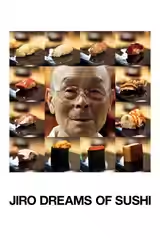
  5. Jiro Dreams of Sushi (2011) · not on Fi1m yetThe documentary version of Goro’s lessons: one man, one counter, decades of practice.