Shirley Clarke’s Harlem film, shot in the streets with a cast almost nobody had seen before, still feels found rather than staged. Baird Bryant’s camera and Mal Waldron’s score do most of the work; the plot she borrowed from the novel sometimes gets in their way.
Shirley Clarke made The Connection in one room, a film about junkies waiting for a dealer, and for her second feature she went as far the other way as she could. The Cool World was shot on the pavements of Harlem, from Warren Miller’s novel, in a script Clarke wrote with Carl Lee, and Frederick Wiseman produced it. The story is small. A boy wants a gun, a gun costs fifty dollars, and he has to get the money. Clarke takes 105 minutes over that, and spends most of them not on the story but on the stoops, windows and street corners around it. That is the right decision, and it is why the film has lasted.
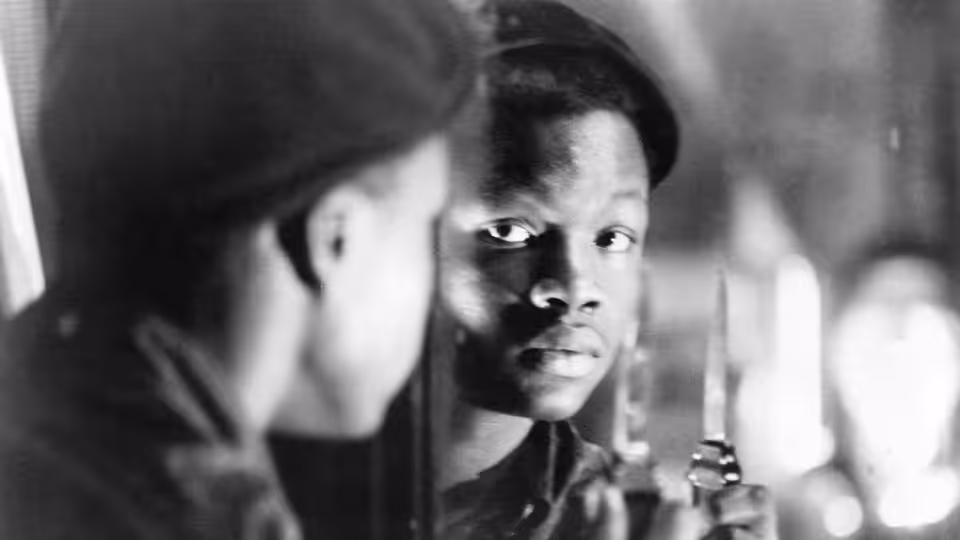
Baird Bryant’s camera walks. It follows Duke down 125th Street among real crowds, some of whom turn and look straight into the lens, and Clarke leaves those looks in. The daylight is harsh and grainy; the doorways go to solid black. The opening, a street speaker (Richard Ward) telling a crowd what the white man has done to them while Bryant picks out faces one at a time, tells you how the film will behave before anyone in the cast has spoken. Clarke edited it herself and cuts like a soloist, holding a face past the point of comfort and then jumping away mid-sentence. Mal Waldron’s small-group jazz runs under the walking and stops at the door of nearly every room.
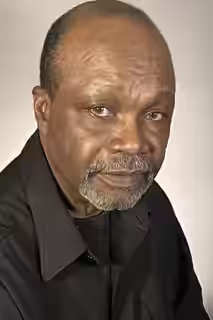
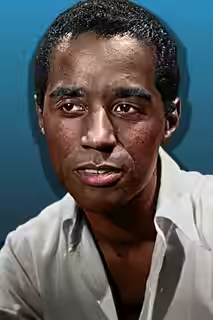
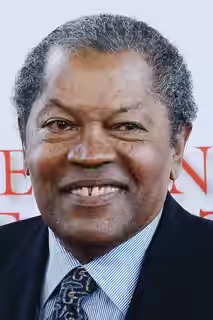
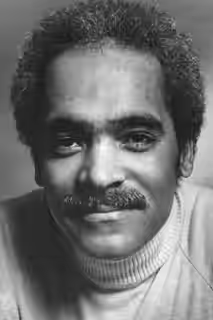
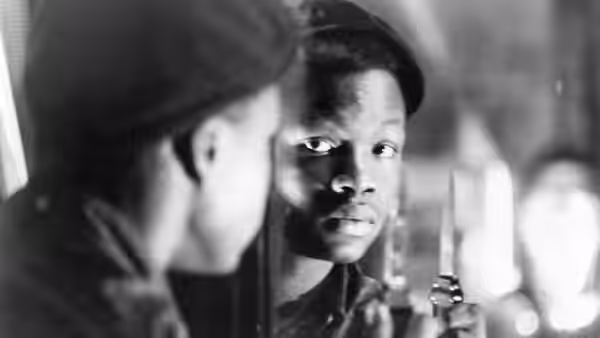
Rony Clanton, as Duke, has a face that does more than the words he is given. The film puts his thoughts on the soundtrack in a voice-over lifted from the novel, and too often it is a writer’s prose rather than a boy’s; Clanton sitting on a kerb tells us more than the narration does. Carl Lee, as Priest, gives himself the best lines and delivers them softly, with a pleasant smile that never reaches his eyes. The most alive person on screen is Clarence Williams III as Blood, the leader who nods out mid-sentence and then comes back mean. He plays a man who has stopped being frightening and does not know it yet.
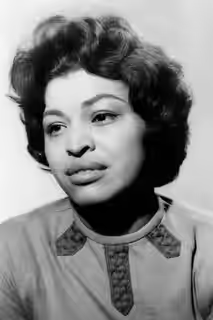
The scene we have carried out of the film is not a fight. Duke takes Luanne (Yolanda Rodríguez) on the subway to Coney Island, and she stands at the edge of the water and says she has never seen the ocean. Bryant keeps a few feet behind them, the beach nearly empty, the sound mostly wind. It moved us more than anything in the film with a blade in it, because the two of them are children for about four minutes and the film has spent an hour making sure we know how rare that is. Gloria Foster, as Duke’s mother, gets two or three scenes and a lover (Ted Butler) in the kitchen, and she makes a whole life out of not quite looking at her son.
The novel’s plot is the problem. Once Duke has his errand, the film has to run a gang picture underneath its documentary, and the two do not always agree. The rumble with the Wolves, the war council, the boys practising their hard talk in the clubhouse: some of this is stiff, non-actors reading lines that were written for them, and the last reel goes where every film about a boy and a gun goes. We will not describe it, except to say that Clarke knows the road and takes it anyway. The white characters, Marilyn Cox’s prostitute among them, are drawn with a thick pencil, and the school trip downtown makes its point twice.
Against the studio gang films of the same years, with their scrubbed knife fights and boys who look thirty, this is another order of thing. Against Clarke’s own The Connection, it is looser and better, because the world outside the frame keeps pushing in. The sound is rough throughout, voices dropping under traffic, and it is worth turning up rather than giving up; the film is talking at the edges as much as in the centre.
Watch it at home if you must, but with the lights off and no phone in reach. It rewards looking at the background, where people who did not know they were in a film are getting on with their day.