Delaporte and de La Patellière’s Dumas is handsome, brisk for its length, and held together by Pierre Niney, who plays revenge as a long illness. The second half is all schemes and the villains are thin, but go.
Alexandre Dumas’s novel is long, and so is this. Matthieu Delaporte and Alexandre de La Patellière, who wrote and directed the recent pair of Three Musketeers films, have taken 178 minutes over Edmond Dantès and they play it straight: no winking, no modern irony, a sailor betrayed, buried and returned. The film is handsome, it moves faster than its length suggests, and Pierre Niney holds it together. In its second half it cares more about schemes than about people, and there we part a little from most of the reviews so far.
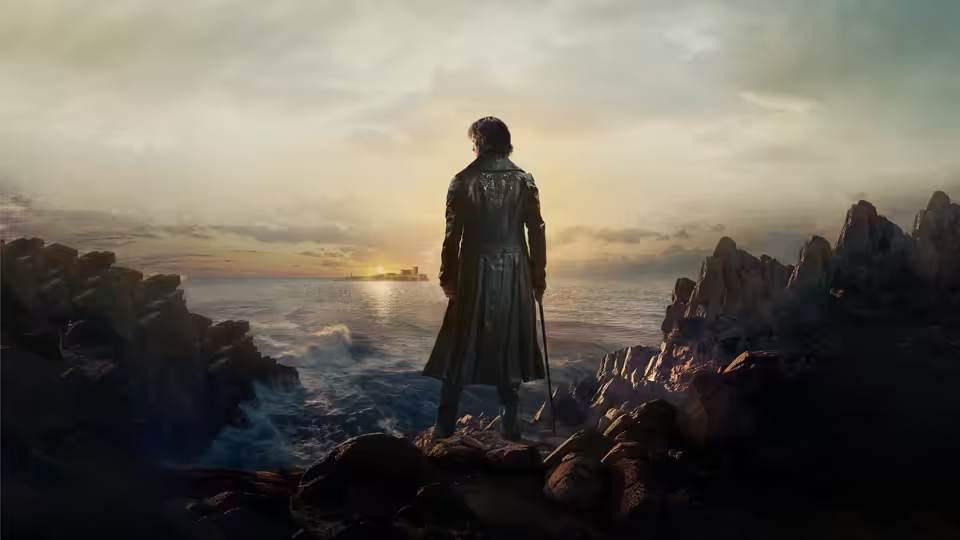
The first hour is the best of it. Nicolas Bolduc opens on a storm at sea, black water and a ship breaking up, and Edmond going over the side after a woman (Adèle Simphal) nobody else will go in for. Ashore in Marseille the light turns warm and low, and Niney plays the young Edmond as a man who has not yet been given a reason to be careful. Bastien Bouillon’s Fernand watches Mercédès (Anaïs Demoustier) with the wrong kind of attention, and Laurent Lafitte’s Villefort signs the paper that puts Edmond away without once raising his voice.
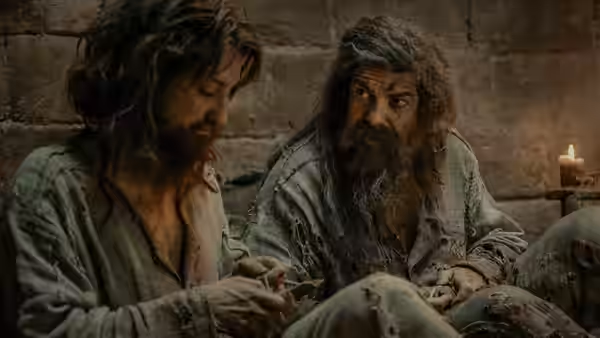
Then the cell. Stéphane Taillasson’s prison is stone, damp and one high slit of window, and Bolduc shoots it so dark that Niney’s face is often the only thing on screen. Time passes in beards and in the light moving across the wall. When another voice finally comes through the stone, that of Pierfrancesco Favino’s Abbé Faria, we were moved more than we expected to be, and it was Niney who did it: a man who has forgotten how to be spoken to, trying to remember. Favino plays the priest as a teacher first and a conspirator second. The film is quieter and kinder here than anywhere else in it.
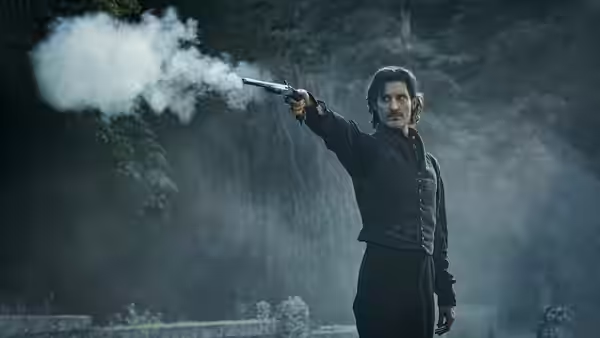
The Count, when he arrives, is a different performance. Thierry Delettre dresses him in black, high collars and gloves, and Niney drops his voice and his shoulders and more or less stops blinking. He is not fun, and he is not meant to be. Jérôme Rebotier’s score gives him brass and low strings every time he enters a room, and by the fourth entrance we wished it would let him walk in on his own. Anamaria Vartolomei’s Haydée and Julien de Saint Jean’s Andrea are the young companions he brings to Paris, and Vartolomei makes her few scenes count. She has her own reasons to be in that house.
The trouble is the machinery. Once the Count is in Paris the film becomes a set of plans being carried out, and Célia Lafitedupont cuts between them briskly enough that we never lost the thread. But the men on the receiving end have been given almost nothing to be. Patrick Mille’s Danglars is a banker who is greedy, Bouillon’s Fernand is a general who is proud, Lafitte’s Villefort is a prosecutor who is cold, and that is the whole of them. Each gets what is coming, and each time we felt less than we had in the cell. Vassili Schneider’s Albert, Fernand’s son, is the exception, a decent boy who has no idea what his father did, and the Count’s scenes with him are the ones in the second half with a pulse.
The film knows this is a problem, or at least a question. Its tagline insists that this is justice, not vengeance, and its last hour asks whether Edmond still believes that. Demoustier’s Mercédès, older now, gets the scenes that put it to him, and she plays them without pleading. We will not say where it comes out, except that the film is braver about the cost than its poster.
Set against the directors’ own Musketeers films it is grander and less playful, and most critics have said so. Set against the earlier screen versions of the book it is the fullest we have seen, and it treats the prison as years rather than as a montage. It is a 12A and a long one. It was built for a large screen and a full room; on a sofa the second half turns into a handsome serial about a rich man who is always right, and you may find yourself checking how much is left. In the cinema we did not.