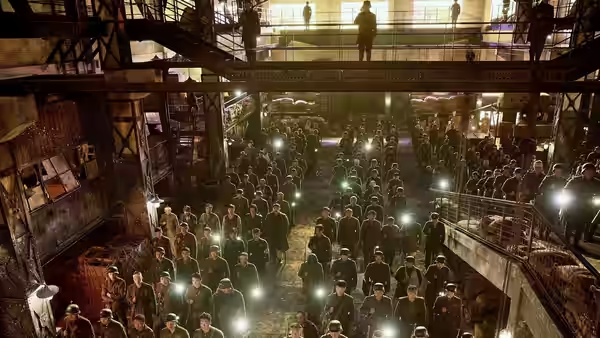
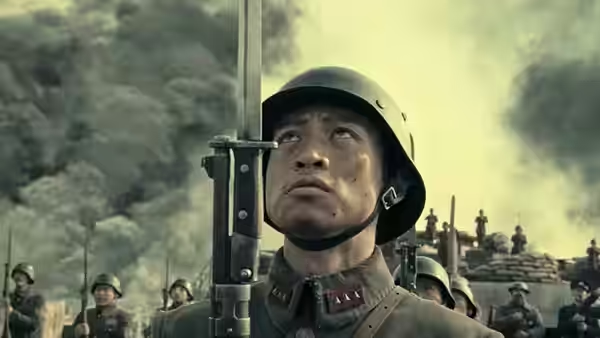
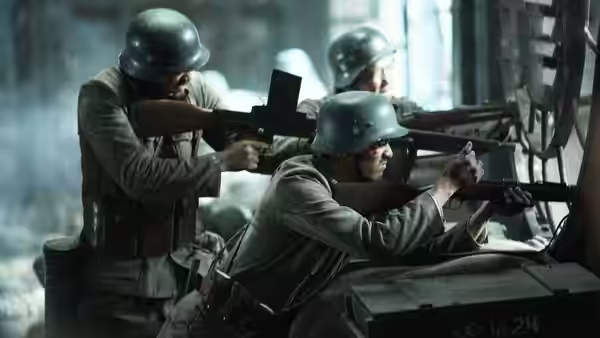
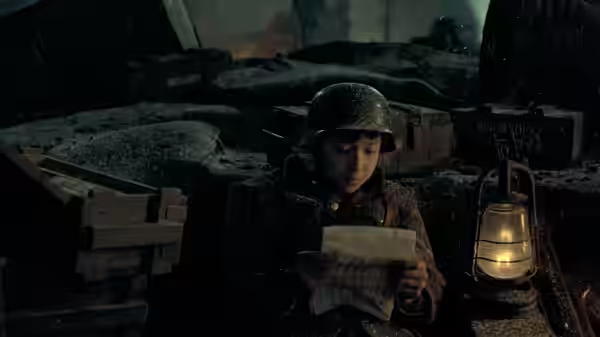
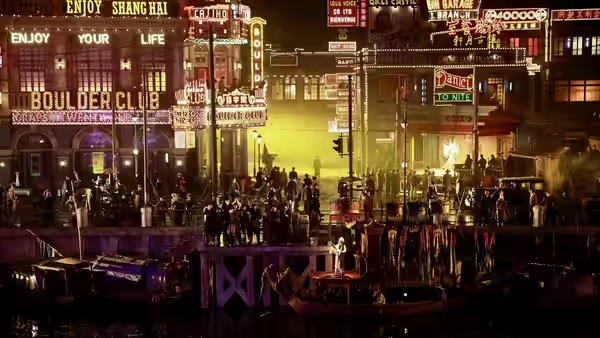
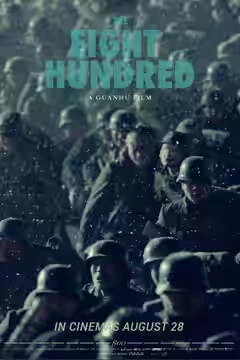
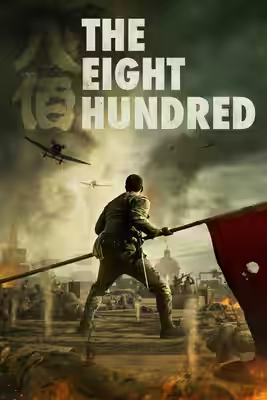
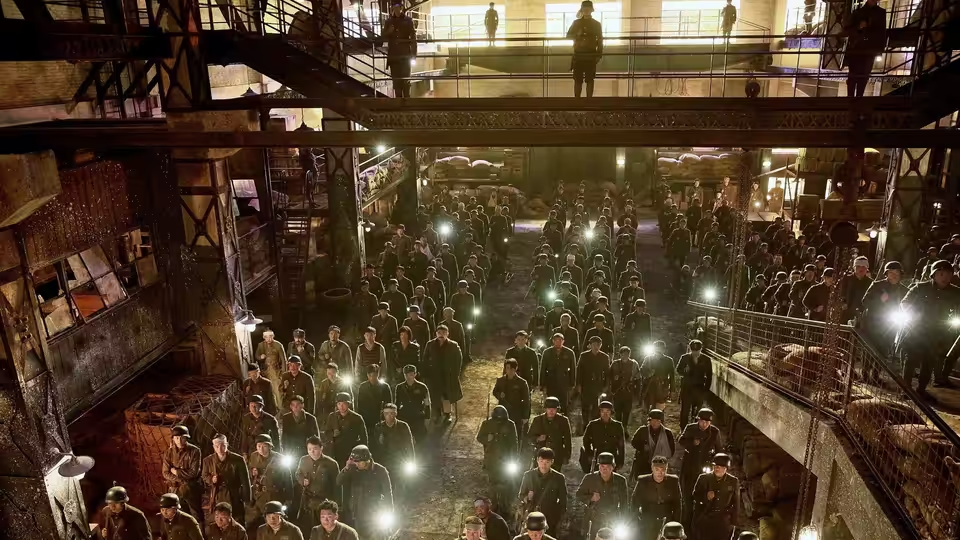
Chinese soldiers crowd a dim warehouse beneath a lone figure on an overhead walkway
Film review

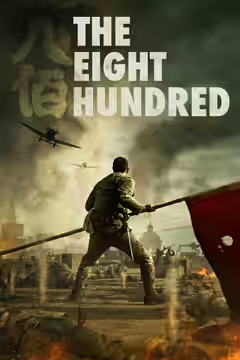
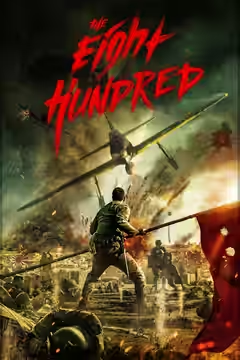
The Eight Hundred

2020 · Directed by Guan Hu · 2h 27m

In a sentenceThe soldiers have a warehouse to defend and a score determined to do the shouting for them

Chinese soldiers defend a warehouse against successive attacks while people across the river watch the fighting. The opening battle throws inexperienced men into combat they struggle to understand. Yang Guai (Wang Qianyuan), Old Abacus (Zhang Yi) and Lao Tie (Jiang Wu) are among those caught in the siege. Lieutenant Colonel Xie Jinyuan (Du Chun) faces the task of holding the warehouse. As the soldiers try to survive and keep their position, the fighting becomes a spectacle for the onlookers across the water.

Fi1m review

Guan Hu stages the warehouse siege with force and clarity, but the crowded cast never acquires enough depth. The battle scenes justify interest; the insistent music and patriotic urging make 147 minutes feel longer.

Guan Hu’s The Eight Hundred is a forceful war film worth seeing for its combat, with substantial reservations about the characters and the patriotic insistence. Chinese soldiers defend a warehouse against successive attacks, and the confined setting gives the action a clear purpose. We understand what has to be held and how difficult that will be. Across 147 minutes, though, the film spends too long telling us to admire men it has barely allowed us to know.

The opening battle is the strongest reason to stay. Cao Yu’s cinematography makes the violence clear enough to follow while allowing the inexperienced soldiers’ confusion to remain frightening. We were shaken by the rookies’ disorientation amid fighting too brutal for them to take in. The images give us a clearer view of the danger than the men seem to have themselves. That difference keeps the sequence tense without requiring much explanation from the dialogue.

Lin Mu’s production design is most useful in making the warehouse a place whose defence we can follow. The building provides a fixed point when the cast threatens to become unmanageable, while the people watching across the river allow the film to consider how civilians respond to combat. Their curiosity is an uncomfortable response to men fighting for their lives. These scenes make something of the civilians’ distance from the danger and give the film something to do besides mount another attack.

The crowded cast is harder to defend. Wang Qianyuan’s Yang Guai, Zhang Yi’s Old Abacus and Jiang Wu’s Lao Tie belong to an ensemble that the writing keeps struggling to distinguish. Guan Hu and his co-writers leave too many men with too little life beyond their place in the fighting. There are quieter passages, and the change of pace is welcome, but they do not consistently give these soldiers enough individuality for the emotion being demanded.

Editors He Yongyi and Tu Yiran keep the attacks moving, and their work on the opening makes confusion feel deliberate rather than careless. The larger structure is less assured. As attention spreads between soldiers, spectators and political concerns, the film becomes overfilled without becoming richer in character. A siege supplies its own pressure, yet the repeated detours make us conscious of the running time when we should be anxious about the next assault.

Rupert Gregson-Williams and Andrew Kawczynski’s music is the most persistent obstacle. The score demands emotions that the thinly written characters have not earned, adding noise to battle scenes that already have plenty. We wanted it to quieten down and let the violence register without further encouragement. Its force can suit the spectacle, but the repeated emotional prompting makes the suffering feel arranged for our approval.

A siege film needs us to understand the space and care about the people trapped inside it. This one manages the first requirement much more reliably, and its fascination with heroic sacrifice makes the second harder. The frightened soldiers in the opening are affecting enough without the film repeatedly directing us towards national pride. See it for the battle staging, provided thin characters and an overbearing score are frustrations we can agree to live with for an evening.
Critical consensus AI synthesised

59
Positive
3
Mixed
3
Negative
2

The reviews are divided, with praise clustering around the scale and staging of the combat rather than the soldiers themselves. Several critics find the battle sequences gripping, brutal and clearly organised, even when the wider story feels crowded. The shifts between large-scale action and quieter passages earn approval, as does the cinematography. The more favourable reviews find enough force in the warehouse siege to carry its sprawling cast and political detours.

The main reservations concern thin characterisation, uneven pacing and nationalism, with verdicts ranging from enthusiastic to strongly negative. Variety finds the film emotionally compelling despite its crowded storytelling, while other reviews describe spectacle that offers too little character depth. The Los Angeles Times objects particularly to the nationalism and treatment of martyrdom, while acknowledging the appeal of the combat spectacle. The disagreement is substantial: technical accomplishment draws fairly broad respect, but emotional impact and political emphasis divide the critics.

Variety
26 August 2020 · Critics Pick · Maggie Lee
85*

Lee finds the war epic imposing and emotionally compelling, though its sprawling cast and political detours sometimes weigh it down. She praises the propulsive opening battle sequence for conveying the rookies’ disorientation and the brutality of combat.

Read the full review →
Radio Times
★★★★ · Jamie Healy
80

Healy gives the film a positive four-star verdict. He singles out its epic siege premise, with Chinese soldiers defending a warehouse against successive attacks.

Read the full review →
Empire
18 September 2020 · Ian Freer
75*

Freer finds the film sprawling and overstuffed, but consistently gripping. He praises its epic scale and its skillful shifts between spectacular action and quieter moments.

Read the full review →
Screen Daily
18 September 2020 · John Berra
64*

The page identifies this as a review, but its verdict is not visible in the accessible text. No specific praise or complaint can be determined from the available content.

Read the full review →
The Guardian
16 September 2020 · Cath Clarke
60*

Clarke finds the war epic thrilling but emotionally thin. She praises its breathtaking, thunderous battle scenes while faulting the lack of character depth and the assaultive score.

Read the full review →
The Hollywood Reporter
31 August 2020 · Elizabeth Kerr
50*

Kerr finds the war epic technically impressive but ultimately short of glory. She praises its clear, gruesome battle sequences and striking cinematography, while faulting its thin characterization and rote war-film clichés.

Read the full review →

Straight answers AI written, from our review

Is The Eight Hundred worth watching?
The Eight Hundred is worth considering for its forceful, clearly staged combat, and we score it 64, with substantial reservations. It suits viewers drawn to siege warfare, but the thinly drawn soldiers, insistent patriotic urging and overbearing music make its 147 minutes feel longer than they should.
How long is The Eight Hundred, and what is it rated?
The Eight Hundred runs 2h 27m. It is a war and history film.
Where can I watch The Eight Hundred in India?
The Eight Hundred is not on any streaming or rental service in India at the moment. It is available in 18 other countries; change your country at the top of the page to see where. Availability is checked daily.
How violent or frightening is The Eight Hundred, and is it suitable for children?
The Eight Hundred has a UK 15 certificate and contains brutal, frightening combat, making it unsuitable for children under 15. We find the opening particularly disturbing because inexperienced soldiers struggle to understand the violence around them; older teenagers and adults sensitive to war violence should approach with caution.
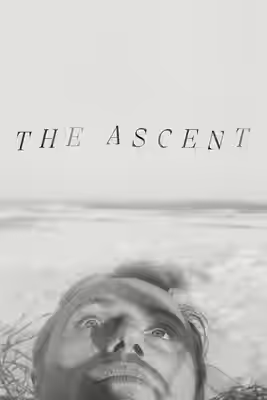
How does The Eight Hundred compare to The Ascent?
The Eight Hundred offers forceful battle spectacle, but we recommend The Ascent as the stronger choice for a searching examination of courage, fear and conscience. The warehouse siege prioritises combat staging and patriotic sacrifice; The Ascent is harsher and more exact about moral pressure, though its gruelling severity makes it a demanding evening.
What should I watch after The Eight Hundred?
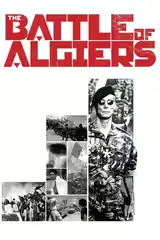
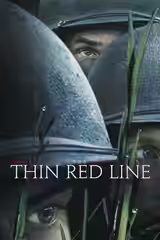
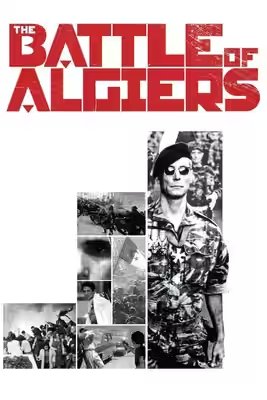
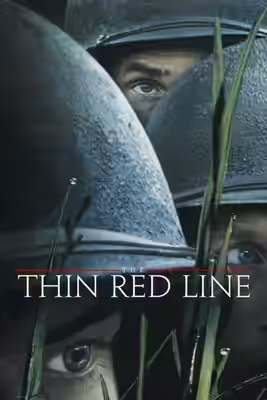
After The Eight Hundred, try The Ascent (1977, Fi1m 88): For a harsher examination of courage, fear and the pressure to betray. Then The Battle of Algiers (1966, Fi1m 93): Street fighting and civilian witnesses, with political questions the action cannot settle; and The Thin Red Line (1998, Fi1m 84): Large-scale combat interrupted by the private thoughts this crowded siege rarely permits.

Cast

If you liked this, try…

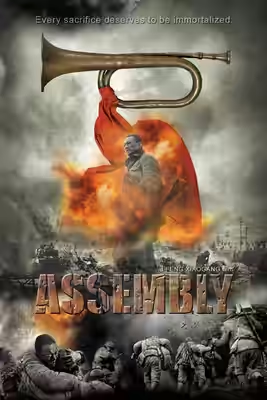
  1. Assembly (2007) · not reviewed yetAnother Chinese war drama, with more room for memory and the individual soldier.

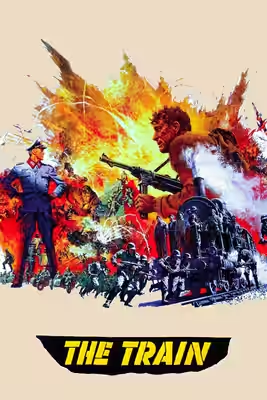
  2. The Train (1964) · not reviewed yetA tightly organised wartime thriller that makes buildings, machinery and distance matter.

  3. The Ascent (1977, Fi1m 88)For a harsher examination of courage, fear and the pressure to betray.

  4. The Battle of Algiers (1966, Fi1m 93)Street fighting and civilian witnesses, with political questions the action cannot settle.

  5. The Thin Red Line (1998, Fi1m 84)Large-scale combat interrupted by the private thoughts this crowded siege rarely permits.

Free account

Know what to watch tonight

Two lists that know where things are streaming, collections you can share, your own score beside ours, and Discover that remembers what you have seen.

  • Want to see, sorted by what is streaming now
  • Seen, with your score out of ten
  • No adverts, ever