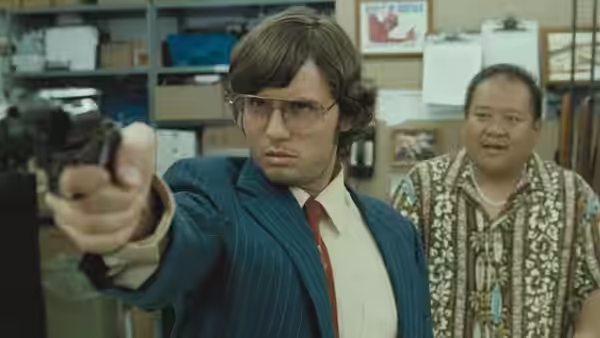
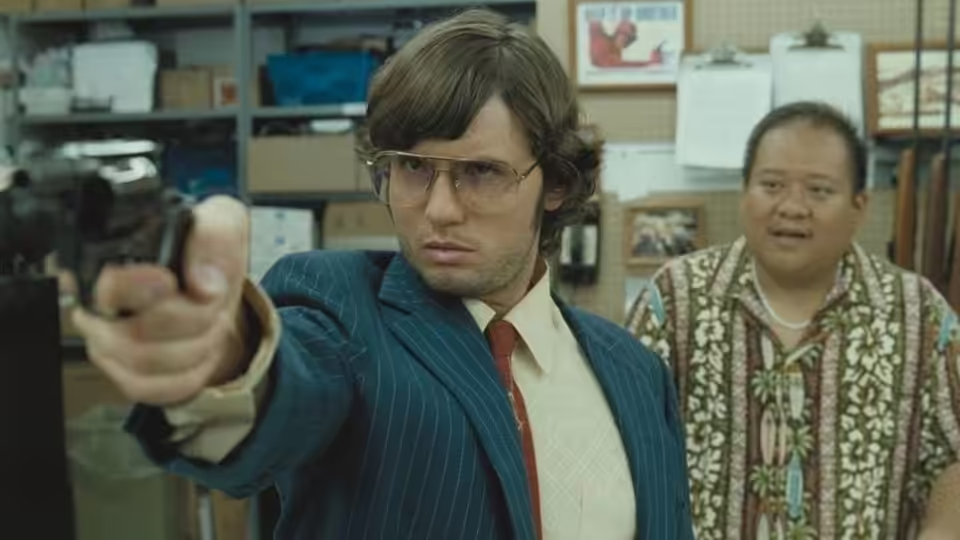
Mark Chapman (Jonas Ball) points a handgun inside a cluttered shop as a man watches
Film review

The Killing of John Lennon

2007 · Directed by Andrew Piddington · 1h 54m

In a sentenceA hundred and fourteen minutes inside the head of a man who had nothing in it

Honolulu, autumn 1980. Mark Chapman (Jonas Ball) is a security guard with a wife, Gloria (Mie Omori), a mother (Krisha Fairchild) he telephones at odd hours, and a paperback copy of The Catcher in the Rye he reads as if it were scripture. He has decided that John Lennon is a phoney and that killing him will turn Mark Chapman into somebody. He buys a revolver, tells Gloria he is going away for a while, and flies to New York, where he takes a cheap room, walks up to the Dakota building on West 72nd Street and waits at the gate with the fans. A taxi driver (Joe Abbate) gets an earful. The film follows him through the city, in his own words, in the days before 8 December.

Fi1m review

Andrew Piddington’s reconstruction of Mark Chapman’s road to the Dakota is carefully made, and Jonas Ball is unsettlingly good as a man rehearsing his own importance. But after nearly two hours of the killer’s own words, we knew exactly what he did and nothing more about why.

Andrew Piddington’s film does what its title says and not much else. It takes Mark Chapman from a security hut in Honolulu to the gate of the Dakota in the first week of December 1980, and it does so almost entirely in Chapman’s voice, which Jonas Ball speaks over the pictures from the opening minute to close to the last. The film presents these as Chapman’s own words, taken from his statements and interviews. We have no way to check that, and the question of whether it matters turns out to be the whole review.

Ball is the reason to watch. He has the soft face and the small, waiting eyes, and he keeps the voice flat and reasonable throughout, as if explaining a parking ticket. He plays Chapman as a man who has decided to be significant and is slightly impatient for the world to catch up. The Honolulu scenes are his best, sitting across a kitchen table from Gloria (Mie Omori) with a secret he is plainly enjoying. Omori has little to say and does a good deal with the silences. Krisha Fairchild, as the mother on the end of the telephone, gets one scene of real warmth and then the film forgets her.

Roger Eaton shoots it grainy and handheld, the Hawaiian light bleached nearly white and New York drained to brown and grey, with Chapman alone and sharp in the middle of the frame while the crowds around him blur. Tora Peterson’s 1980 is done on what is clearly a small budget and done well: the record shop, the hotel room with its one chair, the Dakota’s gate and its lamps. Tony Palmer cuts to the rhythm of the voiceover rather than the action, letting shots run until the words are finished. For long stretches that is the right call, and the walk up Central Park West, on the afternoon we all know about, made us feel properly sick, because the film is patient enough to let us count the steps.

The trouble is the voice. Two hours of a man explaining himself ought to add up to a man, and what we are given is Holden Caulfield recited by someone who has missed the point. Piddington, who also wrote the script, has trusted Chapman’s account of Chapman, and so the film knows what Chapman wanted the world to know and nothing he did not. The encounters along the way, a Scientologist (James Hadde), a prostitute (Vera Felice), a girl called Jude (Sofia Dubrawsky), are presented as evidence and play as anecdotes. They happened, we are told. Fine. What did they mean? The film does not say, and we suspect it does not know.

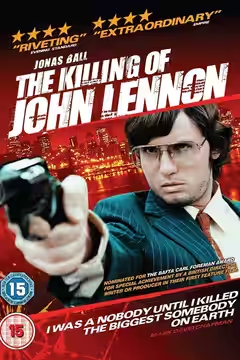
Around the eighty-minute mark we realised we were bored, and then we were angry about it, because the subject does not permit boredom and the film had found a way. Part of the anger was for Lennon. He is in the film only as a photograph on a sleeve and a figure at the edge of frame, which is a defensible choice, except that it leaves the whole evening to the man who shot him, and that man, on this evidence, had almost nothing to say. The film’s own tagline puts the words in his mouth: he was nobody until he killed the biggest somebody on earth. The film agrees, and then spends 114 minutes with the nobody.

The last stretch moves into rooms we will not describe. It is the one place where the film could have stepped outside Chapman’s head and looked at him from across a table, and it declines, keeping the voiceover going as if it had no other register. Robert C. Kirk’s Detective John Sullivan and Gail Kay Bell’s psychiatrist are given lines; they are not given a point of view.

Films about killers have managed this before. Taxi Driver gave Travis Bickle a diary and then showed us the city that made him. Elephant refused explanation altogether and was honest about refusing. Piddington wants the authority of the record and the intimacy of the confession, and the two cancel out: a man’s own account of why he did something is the least reliable document in the file, and the film treats it as the only one.

See it for Ball, who deserved a script that argued back, and for Eaton’s New York. Do not expect to understand anything on the way out that you did not understand on the way in. It runs 114 minutes and carries a 15.
Critical consensus AI synthesised

59
Positive
3
Mixed
1
Negative
3
Variety
15 May 2007 · festival review · Eddie Cockrell
90*

Cockrell gives the film a strongly positive verdict, calling it a harrowing, propulsive character study. He especially praises Jonas Ball’s commanding performance and Piddington’s intense visual approach.

Read the full review →
Empire
30 November 2007 · David Parkinson
85*

The critic calls the film a transfixing recreation of the events surrounding Lennon’s murder. Jonas Bell’s performance, drawing on Chapman’s own words, is singled out as extraordinary and chilling.

Read the full review →
The Guardian
9 December 2007 · Philip French
70*

French gives a positive assessment of the film, highlighting its striking central performance. He also notes its grainy documentary-like look and the apparent use of authentic records.

Read the full review →
Slant Magazine
26 December 2007 · ★★/4 · Ed Gonzalez
50

Gonzalez finds the film’s psychological portrait of Chapman unconvincing and overly detached. He faults its trivia-like details and staged scenes for avoiding any real diagnosis of Chapman’s rage.

Read the full review →
Time Out
3 December 2007 · ★★ · Derek Adams
40

The critic has several issues with the film’s reconstruction of the days before Lennon’s murder. They acknowledge its style, while questioning its claimed accuracy.

Read the full review →
The Hollywood Reporter
31 December 2007 · The Associated Press
35*

The review finds the film technically proficient and historically authentic but ultimately exploitative and lacking sufficient depth. It praises Jonas Ball’s restrained, unsettling performance as Mark David Chapman.

Read the full review →

Straight answers AI written, from our review

Is The Killing of John Lennon worth watching?
The Killing of John Lennon is worth watching only for Jonas Ball’s performance as Mark Chapman and Roger Eaton’s drained, grainy New York, and we scored it 57. Nearly two hours of the killer’s own words tell you exactly what he did and nothing about why. We were bored by the eighty-minute mark, and the subject does not permit boredom.
How long is The Killing of John Lennon, and what is it rated?
The Killing of John Lennon runs 1h 54m. It is a crime and drama film.
Where can I watch The Killing of John Lennon in the US?
The Killing of John Lennon is not on any streaming or rental service in the US at the moment. It is available in 1 other country; change your country at the top of the page to see where. Availability is checked daily.
How violent or frightening is The Killing of John Lennon, and is it suitable for children?
The Killing of John Lennon carries a 15 certificate in the UK and is not for children. The violence is a single killing we all know is coming, and the film is patient enough to make the walk towards it feel sick-making rather than graphic. The real discomfort is spending 114 minutes inside a murderer’s flat, reasonable voice.
How does The Killing of John Lennon compare to Taxi Driver?
The Killing of John Lennon follows the same shape as Taxi Driver, a lonely man with a diary and a gun, but Scorsese’s film shows us the city that made Travis Bickle and Piddington’s shows us only what Chapman wanted the world to know. Taxi Driver is much the better film and the one to choose. Watch Piddington’s only if the case itself holds you.
What should I watch after The Killing of John Lennon?
After The Killing of John Lennon, try Taxi Driver (1976, Fi1m 92): The lonely man with a diary and a gun, and a city that explains him. Then Elephant (2003, Fi1m 84): Van Sant walks the corridors before a killing and refuses, honestly, to explain it.

Cast

If you liked this, try…

  1. Taxi Driver (1976, Fi1m 92)The lonely man with a diary and a gun, and a city that explains him.

  2. Elephant (2003, Fi1m 84)Van Sant walks the corridors before a killing and refuses, honestly, to explain it.

  3. Chapter 27 (2007) · not on Fi1m yetThe same three days from the same man’s point of view, with Jared Leto; compare and argue.

  4. I Shot Andy Warhol (1996) · not on Fi1m yetLili Taylor’s Valerie Solanas has ideas, which is more than most screen assassins get.

  5. Snowtown (2011) · not on Fi1m yetAustralian true crime that shows how an ordinary street makes room for a murderer.