Stephen Chow turns The Little Mermaid into an assassination comedy, and for an hour it is as silly and as precisely timed as anything he has made. Then it remembers it is an environmental fable, turns grim, and the two halves never shake hands.
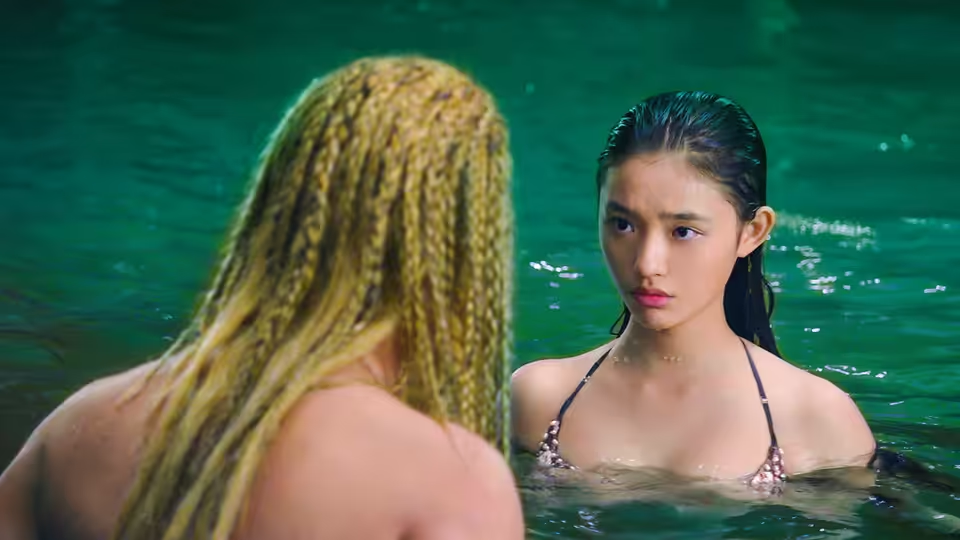
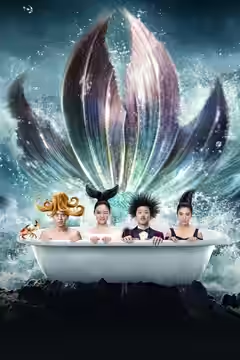
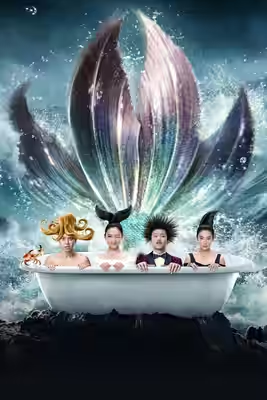
Stephen Chow has taken the oldest mermaid story there is and given the mermaid a knife. In The Mermaid, a tycoon buys a bay, the merpeople who live in it decide to kill him, and the one they send is a girl who has only just learned to walk. Chow writes and directs and, for once, stays behind the camera. The result is 94 minutes that are a joy for about sixty of them and a puzzle for the rest, and we recommend it on the strength of the sixty.
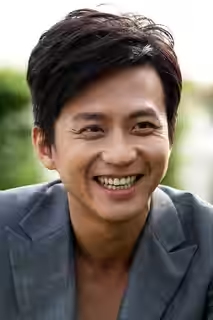
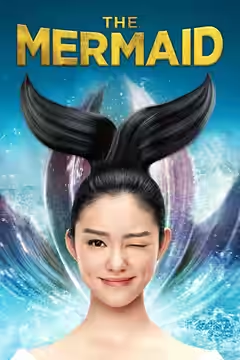
The joy is mostly Lin Yun. She plays Shan with the stiff, rolling waddle of someone whose feet are a disguise, and she holds her face in a smile of fixed terror that she clearly believes is seduction. Deng Chao’s Liu Xuan has never been refused anything, and he treats a woman trying to poison him as the most interesting thing that has happened in years. Their first date, in a roast chicken restaurant inside an amusement park, is the film’s best stretch: Shan produces poisoned sea urchins from her handbag, misses, misses again, and the urchins end up in the head of Show Lo’s Brother Eight, who has come along in a wig to help. Chow builds the sequence like a man stacking plates, one on top of the last, and does not stop when any sensible director would.
Bruce Yu gives the merpeople a home in a beached hull, lit green and gold from inside, with the fish-folk slung from the rafters like laundry. Choi Sung-Fai shoots the bay above water in flat postcard blue and the tycoon’s world in glass, chrome and white leather, so that Shan always looks as if she has walked into a showroom. Jack Tang Man-To and Cheung Ka-Fai cut the gags the Chow way: hold the shot a beat past the point where it feels safe, then hold it one more. The music by Wendyz Zheng and Raymond Wong is cheerful and old-fashioned, and when Deng Chao and Lin Yun sing a duet to each other with his bodyguards swaying behind them, the song does more to make the romance believable than the script does.
The scene we will remember is in a police station. Liu Xuan, having survived the date, tries to report an attempt on his life by a mermaid, and two constables, Wen Zhang’s Mo and Lee Sheung-Ching’s Shi, take down his description and begin to draw. Each sketch is wronger than the last, and each is presented to him with complete professional seriousness. We laughed until it hurt, and we laughed because Chow never once cuts to anyone acknowledging the joke; the constables are simply doing their job, and their job is to draw a fish with a woman’s head.
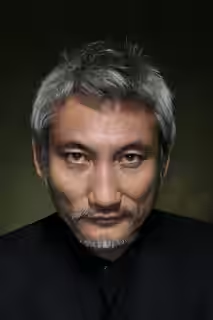
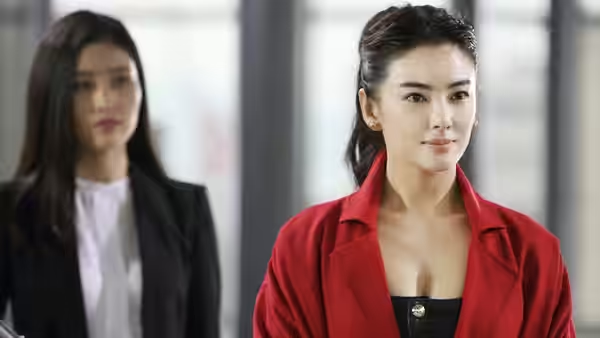
The trouble is what the film does with its message. Chow wants us to care about the dolphins, and he is right to, and the way he goes about it is to stop the comedy, show us what the sonar does, and start it again. The gear change grinds every time. Zhang Yuqi’s Ruolan is given nothing to play but greed in heels, Kris Wu turns up with a water jetpack for one gag, and Tsui Hark, as a rival tycoon called Uncle Rich, is on screen long enough for us to notice him and no longer. Then the last half hour takes a turn we will not describe, except to say that it is not funny and does not seem to want to be, and that we sat through it with our shoulders up around our ears.
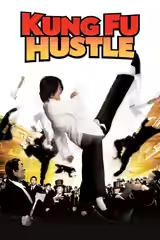
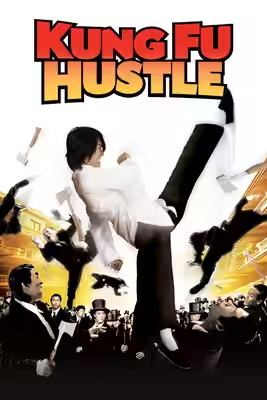
We laughed for an hour and then we winced for twenty minutes, and we are still not sure Chow meant us to feel both. In Kung Fu Hustle (2004) he could put slapstick and real pain in the same frame and make them one thing; here they take turns, and the pain is asked to carry a lesson the jokes had already taught.
See it, with subtitles and someone who likes to laugh out loud. Treat the roast chicken restaurant and the police station as the main event, and when the weather changes, remember that it is a short film and the weather was lovely while it lasted.