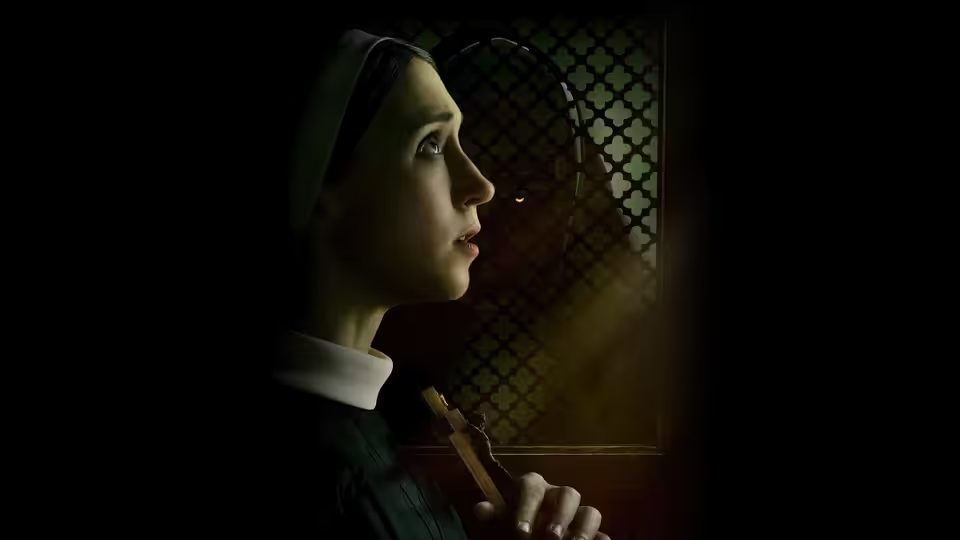
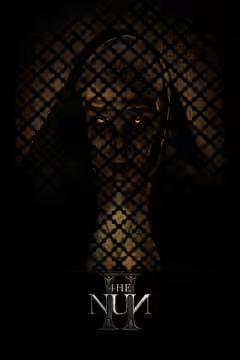
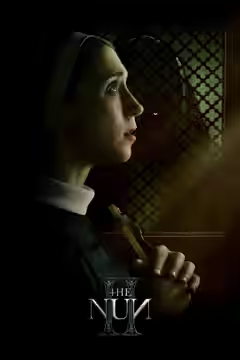
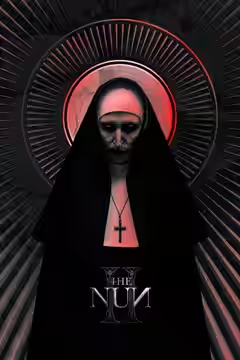
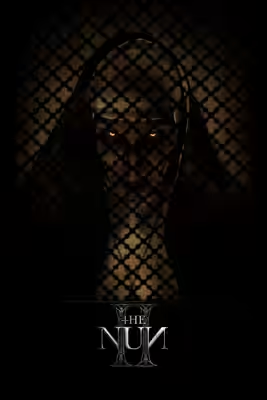
Michael Chaves’s sequel is handsomer and steadier than the first Nun, and it has one scene we will be thinking about for a while. It also has a middle stretch that repeats one scare in different rooms, and a demon who cannot stop showing up.
The first Nun, from 2018, was the weakest film in the Conjuring series, so a sequel had somewhere to go. Michael Chaves, who directed The Conjuring: The Devil Made Me Do It in 2021, has made a tidier and better-looking film than Corin Hardy’s original. He has also made one with a single properly frightening scene, a great many loud ones, and a middle hour that stands in a corridor waiting for something to knock.
The scene comes early, so we can describe it. Sister Irene (Taissa Farmiga) is alone in a French town square at night, and behind her is a newsstand with magazines pinned in rows. The wind starts to turn the pages. Tristan Nyby holds the camera still and lets the covers flip one at a time until the pictures on them line up into a face, and the face is the nun’s. Marco Beltrami, who spends most of the film hitting us with brass, goes almost silent. We sat very still and did not breathe properly until it was over, because Chaves had trusted us to watch something build slowly instead of telling us when to jump. Nothing else in the film trusts us that much.
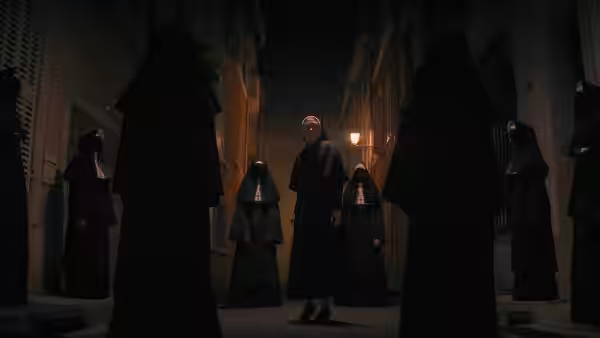
Stéphane Cressend’s boarding school is the other reason to keep watching. It is stone corridors, a chapel, a cellar and a dormitory of iron beds, lit by Nyby in browns and candle yellow so the dark parts of the frame look as if they could hold anything. Agnès Beziers puts the girls in grey pinafores and the nuns in black, and when a figure in a habit stands at the end of a hall you cannot tell, for a second, whether it is staff. Suzanne Bertish runs the place as Madame Laurent with the air of a woman who has seen worse.
Farmiga is good again. She plays Irene as a woman tired of being right about the devil, and she gives the exposition scenes, of which there are many, some weight. Storm Reid’s Sister Debra is the sceptic sent along to ask questions, and Reid makes her funny and slightly rude, which the film could use more of. Jonas Bloquet plays Maurice straight, as a decent man who does not know what is wrong with him. Anna Popplewell and Katelyn Rose Downey, as Kate and her daughter Sophie, are given a strand that mostly consists of waiting to be threatened.
The trouble is the hour in between. Ian B. Goldberg, Richard Naing and Akela Cooper’s script runs two stories side by side, Irene in archives reading about a relic and the school where doors rattle and the older girls pick on Sophie, and cuts between them without either gaining much. Every scare is built the same way: a dark room, a slow walk, a figure at the edge of the frame, then Beltrami’s orchestra arrives to confirm that was the frightening bit. Gregory Plotkin cuts these cleanly, but there are a dozen of them and by the sixth we had stopped flinching. We were bored, and then cross about being bored, because the newsstand had shown us the film knew a better way.
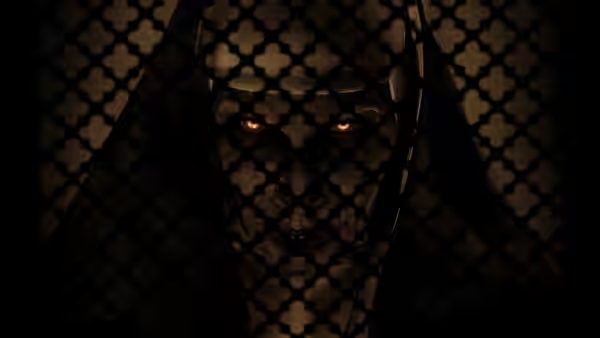
Bonnie Aarons’s nun is also on screen far too often. The face worked in The Conjuring 2 in 2016 because James Wan showed it for a second and took it away; here Chaves gives us the full costume, from the front, in good light, and a rubber face does less the longer you look at it. Cooper wrote M3GAN, and in the last stretch, which we will not describe, her taste for the ridiculous gets loose and the film turns into something wilder and more enjoyable. It is a relief when it does. It is also an admission that the film should have loosened up an hour earlier.
Most critics landed near the middle, split between those who called it a step up and those who called it a retread, and we are with the first group by a short distance. Go for the newsstand, which comes early enough that you can spend the rest of the 110 minutes waiting for the school to catch up. At home with the lights off, Cressend’s corridors work harder and Beltrami’s brass hurts less. The 15 certificate is about right: there is blood, but not much, and the film’s idea of a shock is mostly volume.