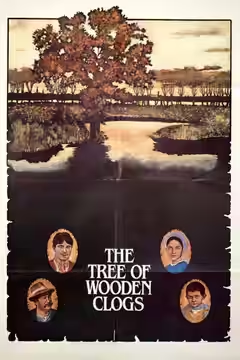
Ermanno Olmi’s three-hour account of a year among sharecroppers near Bergamo, shot and cut by Olmi himself and acted by farming families, is as fine as its reputation. It is slow, it repeats itself for a while, and it will stay with you for years.
Ermanno Olmi’s film is set in the countryside around Bergamo at the end of the nineteenth century, in a farmhouse shared by four peasant families who work a landowner’s fields and hand him two thirds of everything they grow. Olmi wrote, directed, photographed and edited it himself. The people in it are farming families from the district, speaking their own dialect, and it runs 187 minutes. It is as good as its admirers say. We would send a stranger to see it, with one warning: nothing in it hurries.
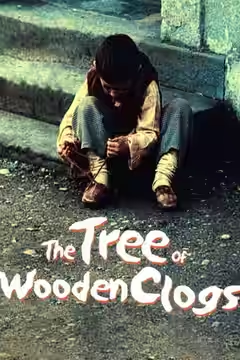
There is no plot in the usual sense. There is a year, autumn to autumn, and a few strands running through it. Batistì (Luigi Ornaghi) and Batistina (Francesca Moriggi) are told by the priest that their son Minec (Omar Brignoli) should go to school, six kilometres away on foot, which nobody in the yard thinks wise. The Widow Runk (Teresa Brescianini) takes in washing to feed her children, and her father-in-law Anselmo (Giuseppe Brignoli) works on a secret for growing tomatoes early, with his granddaughter Bettina (Maria Grazia Caroli) as his only confidant. Il Finard (Battista Trevaini) quarrels with his grown sons and finds a coin he would have done better to leave where it lay.
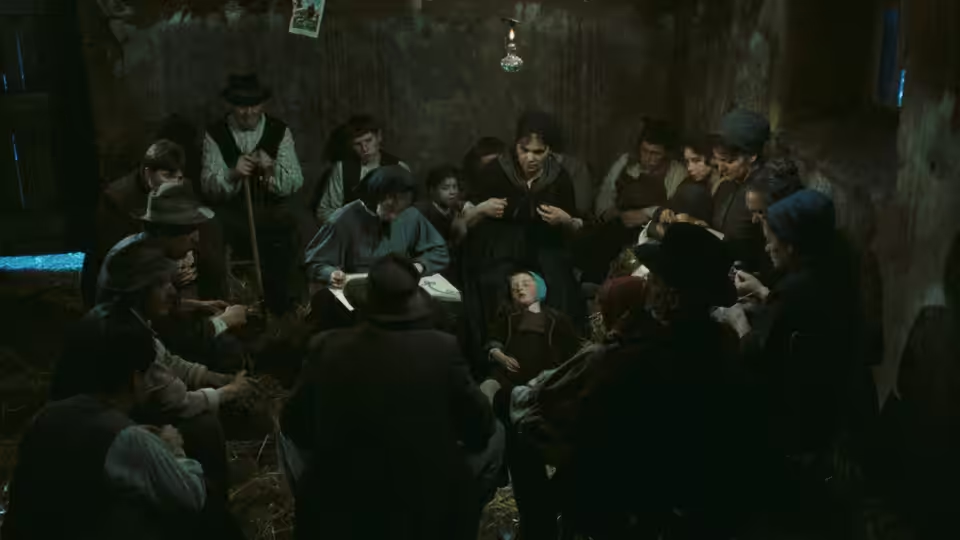
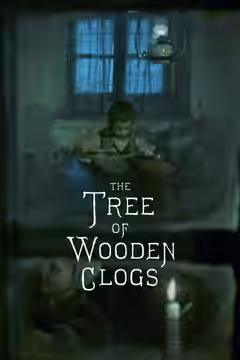
Olmi shot it on 16mm and the grain is part of it. Winter is grey-brown, mud and mist and a low sky, and the stable at night, where the families sit together for the warmth of the animals, is lit as if by the one lamp we can see. He never moves the camera to admire anything. Enrico Tovaglieri’s farmhouse is a working place, a long two-storey building round a yard with a well, a pigsty and hens under everyone’s feet. Francesca Zucchelli’s clothes are wool and coarse cotton, patched at the knees, and nobody’s fit. As editor, Olmi cuts to the length of the job: a scene of stripping maize ends when the maize is stripped. The only music is Bach, on an organ, laid over the fields.
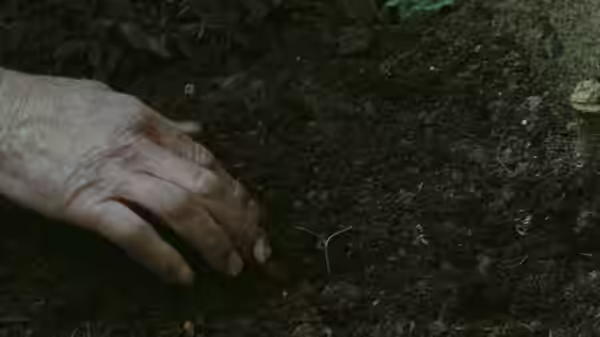
Then there is the pig. A pig is killed in the yard, on camera, and Olmi shows all of it: the rope, the men holding it down, the knife, the noise, the children watching. We looked away, then made ourselves look back, because nobody in the yard looks away and this is the winter’s meat. It is why the 12 certificate is fair rather than generous. What moved us most was smaller. Anselmo out before dawn with Bettina, spreading his secret on the tomato bed and swearing her to silence, made us grin at an old man’s vanity and then go quiet, because it is the only thing he has to leave her.
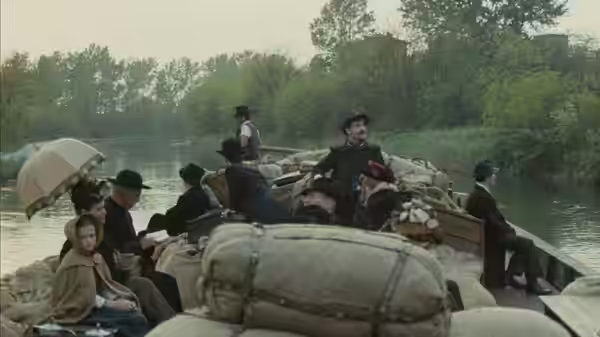
It is not faultless. The one strand that leaves the farm, when a young couple travel by river boat to Milan and walk into a city of soldiers, shuttered shops and a crowd being marched off, is staged more stiffly than anything in the yard, and it is only there to tell us the century is turning. Widow Runk’s sick cow tips the film towards the holy picture; we forgave it because Brescianini plays a woman who believes, not a woman being blessed. And at 187 minutes there is perhaps half an hour in the middle that repeats a rhythm already set. We did not resent it. We noticed it.
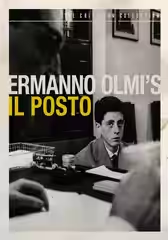
Olmi had made Il Posto in 1961, and the two films share a habit of watching people at work and saying nothing. This one has the casting and the patience of late-1940s neorealism. The title tells you a tree will be cut down and a pair of clogs made from it. When, and what follows, is the second half of the film, and we will not describe it beyond saying that the ending is quiet and we have not stopped thinking about it.
Watch it at home in one sitting, subtitles on, lights off. The dialect is thick and the subtitles sparing, so lines go missing. Nothing that matters goes with them. If anyone squeamish is on the sofa, the pig gives a few seconds’ notice. Use them.