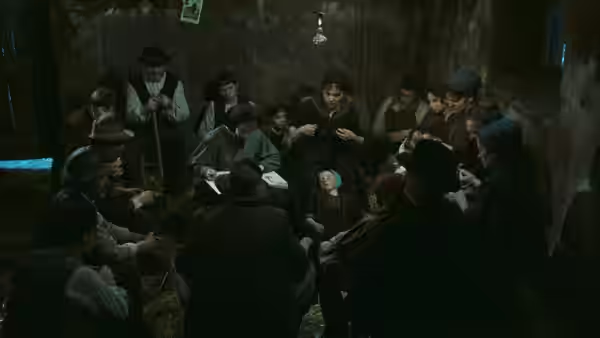
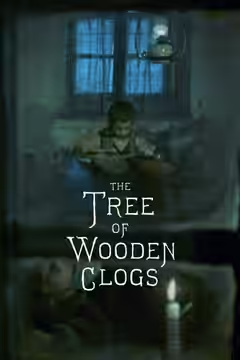
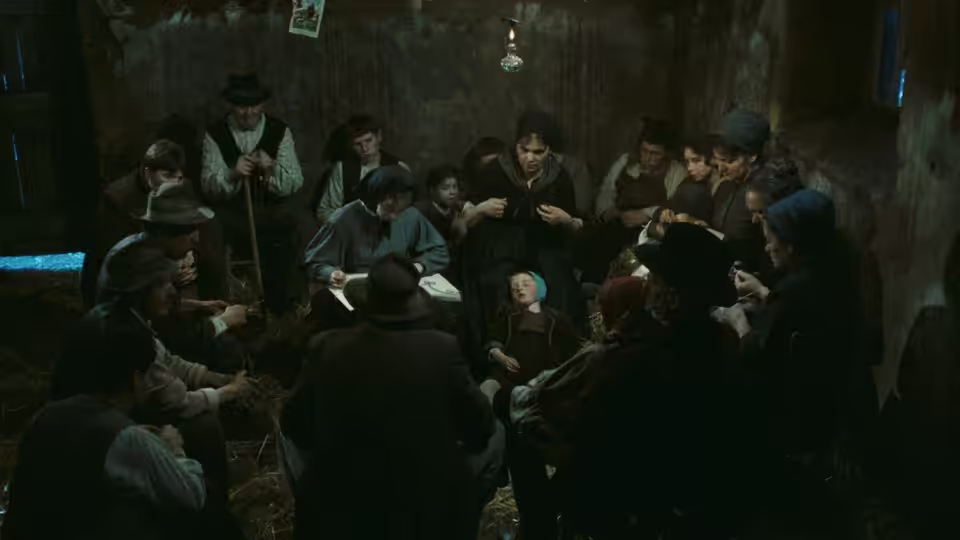
Farmers gather around a woman lying in bed inside a dim farmhouse room
Film review

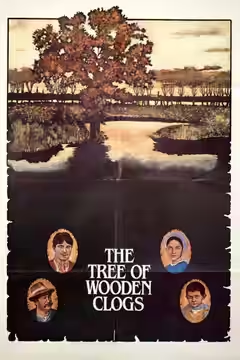
The Tree of Wooden Clogs

1978 · Directed by Ermanno Olmi · 3h 07m

In a sentencePaced by the seasons and the landlord, and nobody in it ever looks at a clock

The countryside around Bergamo, at the end of the nineteenth century. Four peasant families share one long farmhouse on a landowner’s estate, work his fields and hand over two thirds of everything they grow. Batistì (Luigi Ornaghi) and his wife Batistina (Francesca Moriggi) are told by the priest that their son Minec (Omar Brignoli) is clever and should go to school, six kilometres away on foot, though no child from the yard has gone before. The Widow Runk (Teresa Brescianini) takes in washing to feed her children while her father-in-law Anselmo (Giuseppe Brignoli) tends a secret tomato bed with his granddaughter Bettina (Maria Grazia Caroli). Il Finard (Battista Trevaini) quarrels with his grown sons over money. The maize is stripped, a pig is killed, the families gather in the stable at night for warmth and stories, and winter comes.

Plays from YouTube when you press play; nothing loads from them until then.

Fi1m review

Ermanno Olmi’s three-hour account of a year among sharecroppers near Bergamo, shot and cut by Olmi himself and acted by farming families, is as fine as its reputation. It is slow, it repeats itself for a while, and it will stay with you for years.

Ermanno Olmi’s film is set in the countryside around Bergamo at the end of the nineteenth century, in a farmhouse shared by four peasant families who work a landowner’s fields and hand him two thirds of everything they grow. Olmi wrote, directed, photographed and edited it himself. The people in it are farming families from the district, speaking their own dialect, and it runs 187 minutes. It is as good as its admirers say. We would send a stranger to see it, with one warning: nothing in it hurries.

There is no plot in the usual sense. There is a year, autumn to autumn, and a few strands running through it. Batistì (Luigi Ornaghi) and Batistina (Francesca Moriggi) are told by the priest that their son Minec (Omar Brignoli) should go to school, six kilometres away on foot, which nobody in the yard thinks wise. The Widow Runk (Teresa Brescianini) takes in washing to feed her children, and her father-in-law Anselmo (Giuseppe Brignoli) works on a secret for growing tomatoes early, with his granddaughter Bettina (Maria Grazia Caroli) as his only confidant. Il Finard (Battista Trevaini) quarrels with his grown sons and finds a coin he would have done better to leave where it lay.

Olmi shot it on 16mm and the grain is part of it. Winter is grey-brown, mud and mist and a low sky, and the stable at night, where the families sit together for the warmth of the animals, is lit as if by the one lamp we can see. He never moves the camera to admire anything. Enrico Tovaglieri’s farmhouse is a working place, a long two-storey building round a yard with a well, a pigsty and hens under everyone’s feet. Francesca Zucchelli’s clothes are wool and coarse cotton, patched at the knees, and nobody’s fit. As editor, Olmi cuts to the length of the job: a scene of stripping maize ends when the maize is stripped. The only music is Bach, on an organ, laid over the fields.

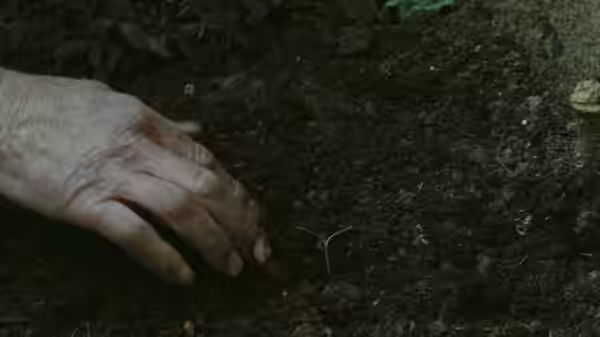
Then there is the pig. A pig is killed in the yard, on camera, and Olmi shows all of it: the rope, the men holding it down, the knife, the noise, the children watching. We looked away, then made ourselves look back, because nobody in the yard looks away and this is the winter’s meat. It is why the 12 certificate is fair rather than generous. What moved us most was smaller. Anselmo out before dawn with Bettina, spreading his secret on the tomato bed and swearing her to silence, made us grin at an old man’s vanity and then go quiet, because it is the only thing he has to leave her.

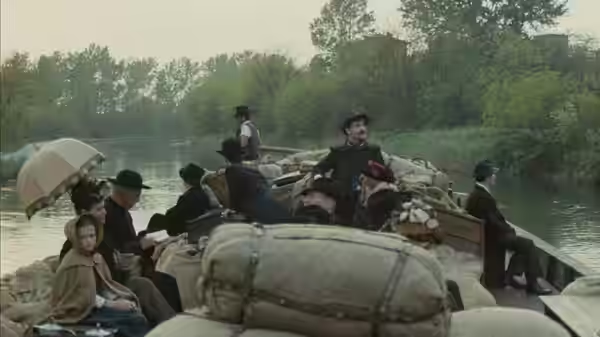
It is not faultless. The one strand that leaves the farm, when a young couple travel by river boat to Milan and walk into a city of soldiers, shuttered shops and a crowd being marched off, is staged more stiffly than anything in the yard, and it is only there to tell us the century is turning. Widow Runk’s sick cow tips the film towards the holy picture; we forgave it because Brescianini plays a woman who believes, not a woman being blessed. And at 187 minutes there is perhaps half an hour in the middle that repeats a rhythm already set. We did not resent it. We noticed it.

Olmi had made Il Posto in 1961, and the two films share a habit of watching people at work and saying nothing. This one has the casting and the patience of late-1940s neorealism. The title tells you a tree will be cut down and a pair of clogs made from it. When, and what follows, is the second half of the film, and we will not describe it beyond saying that the ending is quiet and we have not stopped thinking about it.

Watch it at home in one sitting, subtitles on, lights off. The dialect is thick and the subtitles sparing, so lines go missing. Nothing that matters goes with them. If anyone squeamish is on the sofa, the pig gives a few seconds’ notice. Use them.
Critical consensus AI synthesised

78
Positive
5
Mixed
4
Negative
0

Most critics admire Olmi’s film, and the praise gathers around the same quality: the patience with which it accumulates small details of peasant life until they carry real emotional weight. Reviews describe it as humanist and unsentimental, hopeful without denying hardship, and they credit the non-professional cast, the costumes, the dialect and the locations for making the period feel lived in rather than staged. Slant, reviewing the restoration, singles out the recovered colour and depth of field in the outdoor scenes.

The reservations are slight. Sight and Sound finds occasional sentimentality and a few misjudged effects in a film it otherwise calls tranquil and restrained, and more than one critic warns that the emotional power arrives slowly. Beyond that the spread is narrow. The mixed count owes more to older notices from the New York Times, the New Yorker and Roger Ebert, whose full verdicts we could not read, than to any genuine dissent; nobody who has written about it at length has written it off.

Little White Lies
7 July 2017 · 4/5/5 · Glenn Heath Jr
100

The critic calls the film a hypnotic, hopeful work that balances aching joy with melancholy. They praise its intimate, humanist portrayal of peasant community and everyday life.

Read the full review →
Empire
3 July 2006 · David Parkinson
90*

The critic calls it an overlooked Italian masterwork and finds it deeply moving. He singles out the meticulous accumulation of detail for giving the film both its power and heart.

Read the full review →
The Guardian
7 July 2017 · Peter Bradshaw
90*

Bradshaw calls the film a magnificent, authentic masterpiece, though it takes time to reveal its emotional power. He especially praises the convincing performances, costumes, language and locations that make peasant life feel vividly of its time.

Read the full review →
Sight and Sound
5 July 2017 · John Pym
80*

The critic finds the film a haunting testament to the bonds between people and the land, and to religious faith. They praise its tranquil imagery and unsentimental approach, while noting occasional sentimentality and misjudged effects.

Read the full review →
Slant Magazine
15 February 2017 · ★★★★ · Clayton Dillard
80

Dillard praises the film’s vivid, unsentimental attention to peasant life and finds the Criterion Blu-ray restoration faithful to Olmi’s intent. He singles out the restored color and depth of field, especially in the outdoor scenes.

Read the full review →
Time Out
· JD
66*

The available description presents Olmi’s film as an uncompromising reconstruction of peasant life. It singles out the film’s return to neorealism and non-professional casts, but the critic’s full verdict is unavailable.

Read the full review →

Straight answers AI written, from our review

Is The Tree of Wooden Clogs worth watching?
The Tree of Wooden Clogs is worth watching for anyone who can give three unhurried hours to a year among Italian sharecroppers, and we scored it 89. Olmi shot, cut and cast it from farming families, and nothing in it hurries; there is perhaps half an hour in the middle that repeats a rhythm already set. It stays with you for years.
How long is The Tree of Wooden Clogs, and what is it rated?
The Tree of Wooden Clogs runs 3h 07m. It is a drama film.
Where can I watch The Tree of Wooden Clogs in Saudi Arabia?
The Tree of Wooden Clogs is not on any streaming or rental service in Saudi Arabia at the moment. It is available in 22 other countries; change your country at the top of the page to see where. Availability is checked daily.
How violent or frightening is The Tree of Wooden Clogs, and is it suitable for children?
The Tree of Wooden Clogs is rated 12A in the UK, and the certificate is fair rather than generous because a pig is killed in the farmyard on camera, with the rope, the knife and the children watching. There is no other violence and nothing frightening. Younger children and the squeamish should be warned; the scene gives a few seconds' notice.
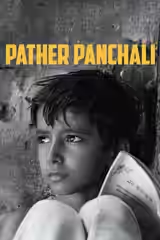
How does The Tree of Wooden Clogs compare to Pather Panchali?
The Tree of Wooden Clogs and Pather Panchali are both patient, exact films about poor rural families, and both let their pace drift. Ray's film follows one household and a childhood, and is the funnier and more openly moving of the two; Olmi's spreads across four families and a whole farming year, watches people work and says almost nothing. Start with Ray if three hours daunts you.
What should I watch after The Tree of Wooden Clogs?
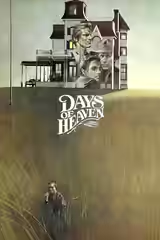
After The Tree of Wooden Clogs, try Pather Panchali (1955, Fi1m 93): A Bengali village childhood, poor and exact, and the rain is a character. Then Days of Heaven (1978, Fi1m 85): Malick’s farm labourers under a Texas sky, same year, far prettier, less honest.

Cast

Awards

Cannes Film Festival, 1978

Won
Palme d'Or

If you liked this, try…

  1. Il Posto (1961) · not on Fi1m yetOlmi’s earlier film, an office boy in Milan, watched with the same patience.

  2. Pather Panchali (1955, Fi1m 93)A Bengali village childhood, poor and exact, and the rain is a character.

  3. Days of Heaven (1978, Fi1m 85)Malick’s farm labourers under a Texas sky, same year, far prettier, less honest.

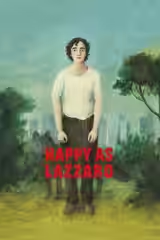
  4. Happy as Lazzaro (2018) · not on Fi1m yetRohrwacher’s Italian sharecroppers, cheated for decades, then the film does something strange.

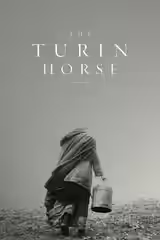
  5. The Turin Horse (2011) · not on Fi1m yetTarr’s father and daughter, potatoes and wind, for anyone who wanted it bleaker.

The Tree of Wooden Clogs (1978) review: a slow year on the farm, worth (Saudi Arabia) | Fi1m