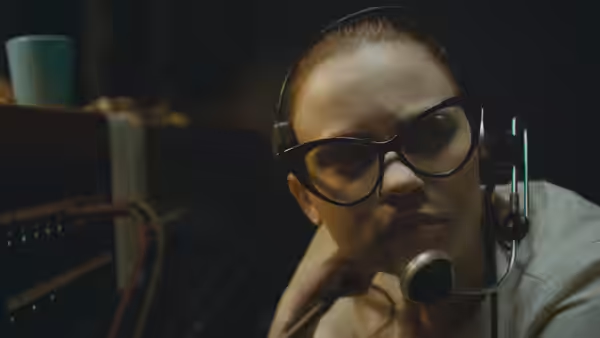
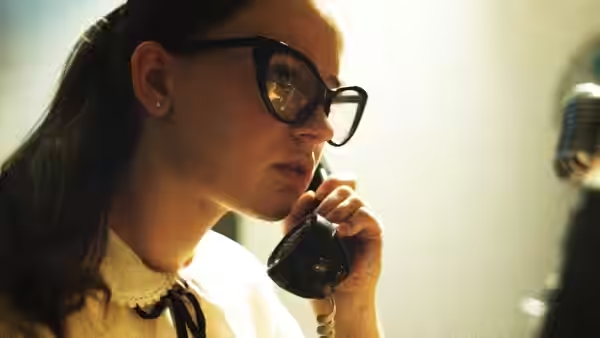
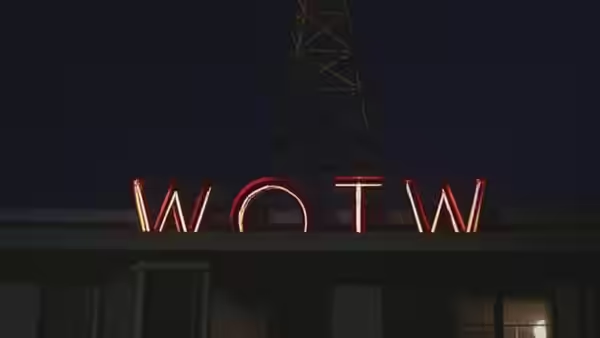
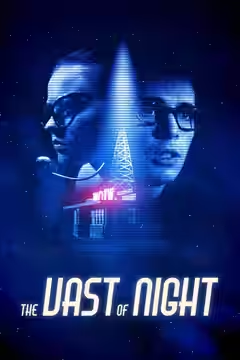
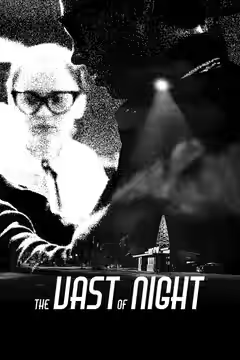
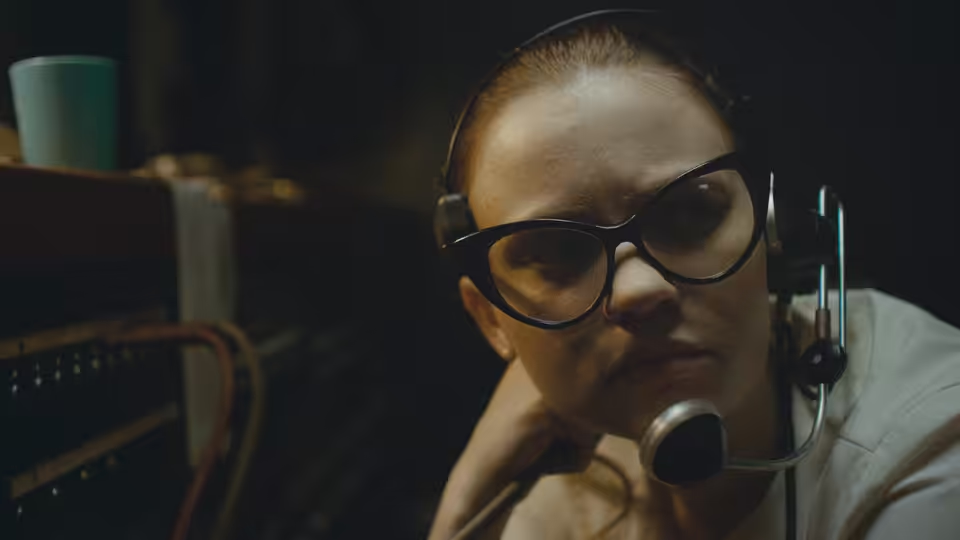
Fay Crocker (Sierra McCormick) wears a headset at the radio console
Film review

The Vast of Night

2019 · Directed by Andrew Patterson · 1h 31m

In a sentenceTwo kids, a switchboard, a radio booth and a whole town watching basketball while the sky makes phone calls

Cayuga, New Mexico, one night in the 1950s. Nearly the whole town is packed into the school gym for a basketball game. Fay Crocker (Sierra McCormick), a schoolgirl who works the telephone switchboard, has bought a new portable tape recorder and follows Everett (Jake Horowitz), the fast-talking presenter at the local radio station, across the car park while he shows her how to use it. Then they go to work, Fay to her board and Everett to his late show. A sound comes down one of Fay’s lines that she cannot place, a low pulsing hum, and calls begin dropping out. She patches it through to Everett, who plays it on air and asks whether anybody listening has heard it before. Someone has, and he rings in.

Plays from YouTube when you press play; nothing loads from them until then.

Fi1m review

Andrew Patterson’s first film is a 1950s alien-visitation story told almost entirely down telephone lines and over the airwaves, and for eighty minutes it is one of the most confident debuts we have seen. Then it shows us what it should have kept hidden.

Andrew Patterson’s first film opens on an old television set. A black-and-white anthology programme is starting, an announcer promises a tale of the strange, and the camera pushes into the screen until the picture fills the frame and turns to colour. It is a nod to The Twilight Zone, and a warning: this is the sort of story that used to be told in half an hour, stretched by Patterson and co-writer Craig W. Sanger to 91 minutes and set almost entirely in two small rooms and the telephone lines between them.

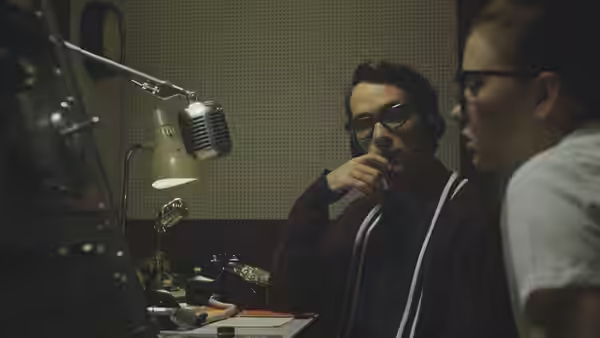
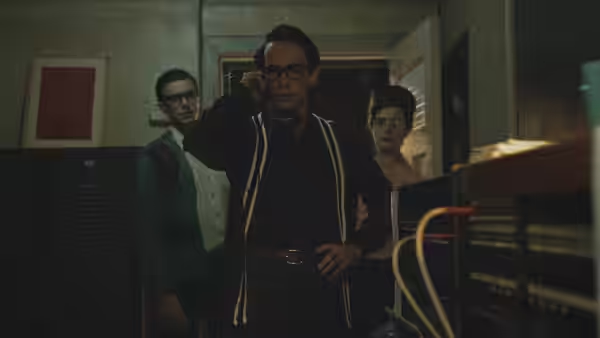
The rooms are a switchboard and a radio booth in Cayuga, New Mexico, on a night in the 1950s when the rest of the town is at the basketball game. Fay Crocker (Sierra McCormick) is a schoolgirl who runs the telephones. Everett (Jake Horowitz) runs the radio station, or at least its late shift. They talk fast and over each other, and Horowitz has Everett’s patter exactly, a young man who has learned how to be a person from the wireless. McCormick is the film’s centre. Watch her at the board with the headset on, cords in both hands, as a sound comes down a line that should not carry one. She listens, and Patterson lets us watch her listen.

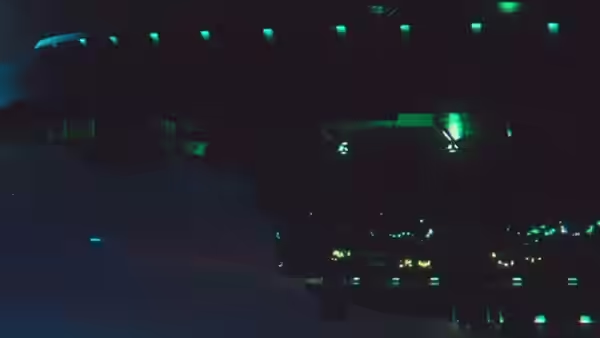
Then the camera leaves. The most talked-about shot, from cinematographer M.I. Littin-Menz, starts at the switchboard, drops to ground level and travels across the whole town in the dark, past parked cars and dim porches, into the gym where the crowd is roaring, and out again to the radio station, without a visible cut. We sat up. It is showing off, and it earns it, because it tells us how small the town is, how empty it is tonight, and how far Fay’s voice has to travel to reach Everett’s.

The middle of the film is people on the telephone, and it is the best part. Everett plays Fay’s sound on air and asks whether anyone recognises it. A man called Billy rings in. We never see him; Bruce Davis is a voice on a bad line, talking slowly about something he was made to do years ago, and Patterson, who cut the film himself, takes the picture to black for long stretches while he speaks. We sat in the dark listening the way Everett does, and we did not want the picture back. Erick Alexander and Jared Bulmer’s score stays under the voices, a low electric hum that is hard to tell from the sound on the line, which we take to be the point. A second caller, Mabel Blanche (Gail Cronauer), asks the pair round to her house and gets a long speech from an armchair in one held shot. Some critics found the monologues strain. Cronauer’s did not, for us. She plays a woman who has waited a long time to be asked, and it moved us more than a film about a noise in the sky has any right to.

Adam Dietrich, who produced the film and designed it, builds the fifties out of things that work: the switchboard’s jacks and lights, the booth’s reel-to-reel machines, Fay’s new portable tape recorder. Nothing glows the way the decade usually glows on screen. The town looks like a place people would like to leave, which is what Everett keeps saying about it.

Two things hold it back. The framing device keeps returning. Every so often the picture shrinks into that fuzzy television screen, the sound goes tinny, and we are reminded that we are watching a pastiche, which we had noticed. It puts a pane of glass between us and two people we were happy to be close to. And Fay and Everett are not given much to want. He wants out of Cayuga; she wants to keep up with him; that is about it, and by the last act we found we cared more about the callers than about the pair who took the calls.

Then there is the ending, which we will not describe except to say that after eighty minutes of showing us nothing, the film shows us something, and it is roughly the something we had been picturing. We were let down, and then slightly cross about it, because the black screen had been braver. Most critics forgive it and, on balance, so do we. It is a first film made on a small budget, and it is more confident than most tenth films. Watch it at night with the sound up and the phone off. The best minutes are the ones with nothing on the screen.

Critical consensus AI synthesised

79
Positive
21
Mixed
4
Negative
0

Most critics like the film, and none of the twenty-five reviews is negative. The praise gathers around the camerawork, above all a long tracking shot that travels the town at night, and around a sound design that carries much of the tension. The two leads draw repeated notice for their chemistry, and several reviewers admire the 1950s setting for feeling lived-in rather than nostalgic. More than one treats it as a debut that announces a director worth following.

The reservations cluster at the ending. Several find the final reveal predictable or a let-down, and one or two think the closing effects unnecessary. A couple object to the framing device, saying it holds the story at an ironic distance. The spread is narrow, with only four mixed notices. Collider is the coolest, finding the film stylish but shallow, with a mystery that cannot sustain interest. The Hollywood Reporter, writing from an early festival screening, finds it obscure and abrupt. Even the doubters praise the direction.

Evening Standard
29 May 2020 · ★★★★★ · Charlotte O'Sullivan
100

O’Sullivan says the film deserves the hype, while noting its quieter, wonkier style. She particularly praises its extraordinary tracking shots, which give the town and story a thrilling sense of urgency.

Read the full review →
The New Yorker
28 May 2020 · Anthony Lane
90*

Lane calls the film an absorbing, carefully crafted piece of small-scale science fiction. He especially praises its patient storytelling and a remarkable tracking shot that tours the town, though he finds the concluding effects unnecessary.

Read the full review →
Vulture
29 May 2020 · Alison Willmore
90*

Willmore praises the film as a thrilling, fresh discovery that balances retro sci-fi with a modern sensibility. She singles out its audacious long take and sound-driven filmmaking, while noting one monologue strains for gravitas.

Read the full review →
Empire
2 July 2020 · Ian Freer
85*

Freer finds the film an assured, original, and moving piece of sci-fi that announces a singular talent. He particularly praises its fluid camera work and evocative, non-nostalgic recreation of the 1950s.

Read the full review →
Little White Lies
festival review · Josh Slater-Williams
85*

The critic finds the film riveting and ultimately heartbreaking, praising its formal inventiveness. They also single out the fully realised, lived-in Americana and the leads’ magnetic performances.

Read the full review →
IndieWire
28 May 2020 · B+ · Ryan Lattanzio
83

Lattanzio finds the film a charming, confident, and genuinely spooky debut, despite a disappointing reveal in its final act. He praises the lead actors’ buoyant chemistry and the director’s assured visual craft.

Read the full review →

Straight answers AI written, from our review

Is The Vast of Night worth watching?
The Vast of Night is worth watching for anyone who likes slow, talk-led science fiction, and we scored it 78. For eighty minutes Andrew Patterson's debut holds its nerve, keeping the visitors to voices on a bad telephone line; then the ending shows us something it should have kept hidden. Watch it at night with the sound up.
How long is The Vast of Night, and what is it rated?
The Vast of Night runs 1h 31m. It is a drama and mystery film.
Where can I watch The Vast of Night in India?
The Vast of Night is not on any streaming or rental service in India at the moment. It is available in 3 other countries; change your country at the top of the page to see where. Availability is checked daily.
How does The Vast of Night compare to The Twilight Zone?
The Vast of Night is a feature-length homage to The Twilight Zone, and the half-hour programme it quotes remains the sharper of the two. Rod Serling's stories are disciplined and finish when they should; Patterson's film stretches one idea to 91 minutes and stumbles at the close. Choose the film if you want a slow build in two small rooms, the series if you want the idea done cleanly.
What should I watch after The Vast of Night?
After The Vast of Night, try The Twilight Zone (1959, Fi1m 84): The half-hour programme this film is quoting, still sharper than most imitations. Then Close Encounters of the Third Kind (1977, Fi1m 85): Ordinary Americans, a signal nobody can explain, and Spielberg taking his time; and Berberian Sound Studio (2012, Fi1m 78): Peter Strickland’s horror about sound itself, told from inside a recording booth.

Cast

If you liked this, try…

  1. Pontypool (2008) · not on Fi1m yetA Canadian radio host locked in his booth while the town outside goes wrong.

  2. The Twilight Zone (1959, Fi1m 84)The half-hour programme this film is quoting, still sharper than most imitations.

  3. Close Encounters of the Third Kind (1977, Fi1m 85)Ordinary Americans, a signal nobody can explain, and Spielberg taking his time.

  4. Coherence (2013) · not on Fi1m yetA dinner party, a comet overhead, and a whole thriller shot in one house.

  5. Berberian Sound Studio (2012, Fi1m 78)Peter Strickland’s horror about sound itself, told from inside a recording booth.

The Vast of Night (2019) review: a long night, mostly well spent (India) | Fi1m