Michael Mohan’s erotic thriller makes spying feel tempting, helped by Sydney Sweeney and Justice Smith. The visual invention earns some patience, but thin character writing and increasingly contrived plotting make this one for genre enthusiasts.
Michael Mohan’s The Voyeurs is a watchable erotic thriller with more appetite than judgement. It makes spying seem tempting and gives its leads enough warmth to make their curiosity engaging. Then the plotting becomes busier and the characters become harder to care about. We would recommend it to enthusiasts of the genre, provided they can accept a good deal of contrivance in exchange for some enjoyable misbehaviour.
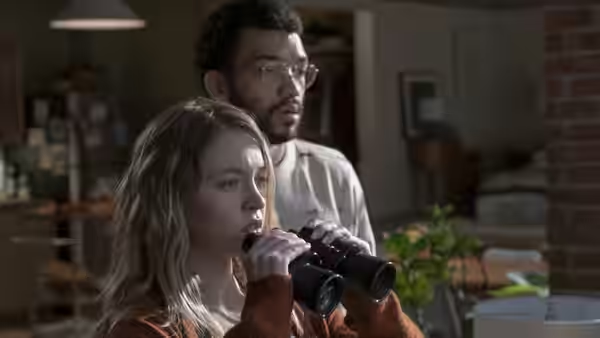
Pippa (Sydney Sweeney) and Thomas (Justice Smith) give the film its most useful asset: the feeling that curiosity can be something people enjoy together. The laser-assisted eavesdropping makes that pleasure unusually concrete. We were amused, then slightly ashamed of ourselves, because the practical business of listening to the neighbours makes an invasion of privacy feel like a small achievement. For a while, following the mechanics is enough to distract us from asking what right anyone has to listen.
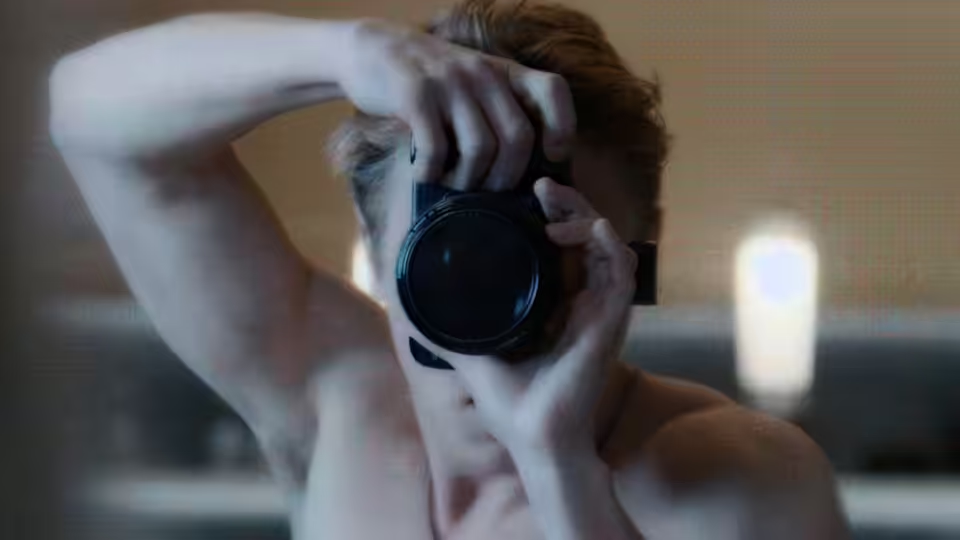
Elisha Christian’s cinematography encourages that willingness to look, and Adam Reamer’s production design contributes to the visual appeal. The images are inviting enough to make the film’s interest in voyeurism credible, even when the writing begins to labour it. Christian Masini’s match cuts are particularly effective, giving us connections to notice instead of more dialogue to absorb. These passages have a fluency the rest of the film does not sustain, and they help carry some fairly thin material.
The sex scenes work because Michael Mohan gives desire some attention of its own. They are allowed to be pleasurable, which matters in a film that needs us to understand the wish to keep watching. Sydney Sweeney and Justice Smith are better served by shared curiosity than by dialogue that keeps explaining what we can already grasp. We wanted more time with that chemistry, but the screenplay, also by Michael Mohan, keeps finding reasons to make everything more complicated.
Will Bates’s score supplies unease without solving the central problem: the people remain underwritten. As the complications accumulate, the film needs stronger attachments than it has built, and music cannot provide them. The dialogue and insistent symbolism also leave little for us to work out about what the film thinks of watching other people. At 117 minutes, it spends too long making points that were clear earlier, with Christian Masini’s neat visual transitions offering only intermittent relief.
The return to the erotic thrillers of the 1980s and 1990s is welcome in itself, though this one borrows their weaknesses along with their pleasures. A thriller can survive improbable behaviour when desire makes that behaviour convincing. Here the later plotting repeatedly asks us to accept developments because another surprise is due, and the emotional consequences receive too little attention. We will leave those developments undescribed; the objection is to how hard the screenplay works to arrange them.
There is still enough mischief here to keep a forgiving viewer interested. The visual storytelling, the eavesdropping and the leads’ early rapport suggest a more satisfying film than the script eventually permits. Its thinness matters most when it asks us to take the complications seriously. Choose it for the spying, and be prepared to forgive much of what the script does afterwards.