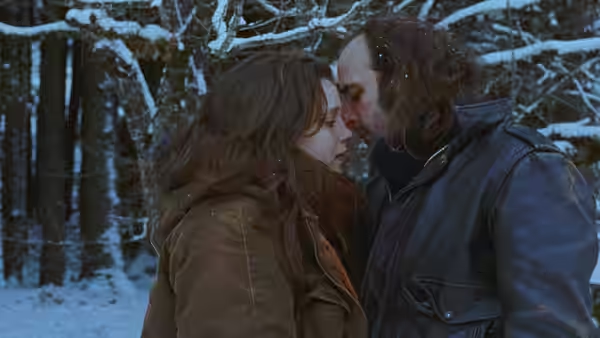
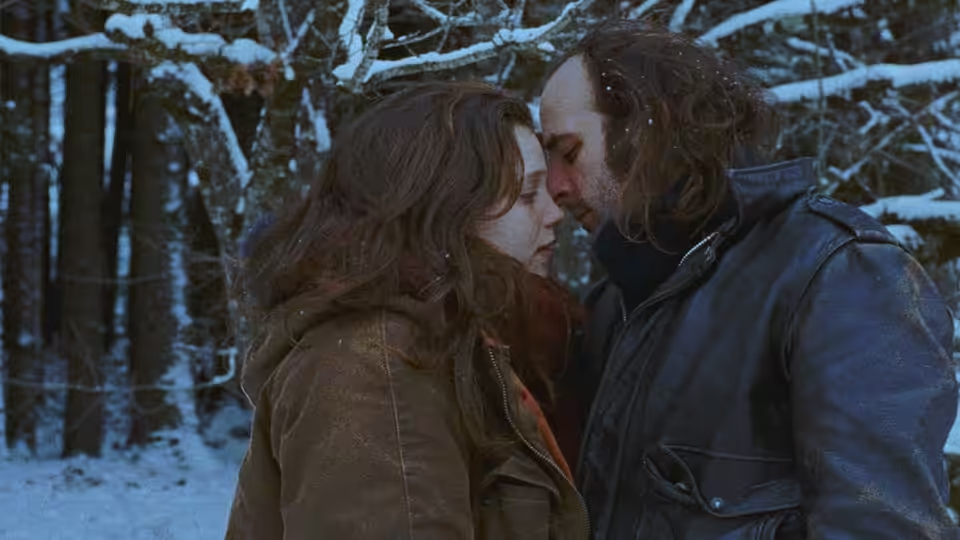
Mélodie (Solène Rigot) and Maxime (Vincent Macaigne) with foreheads touching in snow
Film review

Tonnerre

2014 · Directed by Guillaume Brac · 1h 46m

In a sentenceVincent Macaigne falls in love the way other men fall down stairs

Winter in Tonnerre, a small town in Burgundy. Maxime (Vincent Macaigne), a rock musician in his thirties whose one moment of success is behind him, moves back into his father’s house to write new songs and lick his wounds. His father (Bernard Ménez) is a widower of a different temperament entirely: he plays cards, teases the local winegrowers at the bar and cannot let a quiet moment pass without a joke. When the local paper sends a journalist to interview the returning minor celebrity, Maxime meets Mélodie (Solène Rigot), a young woman years his junior with a stillness he cannot read. They walk, they talk, they fall into something. Ivan (Jonas Bloquet), a boy her own age, keeps turning up. Then Mélodie stops answering her phone.

Fi1m review

Guillaume Brac’s first feature is a small, exact, funny film about a failed musician wintering with his father, and then it becomes a different film about the same man. The first is better than the second, and Vincent Macaigne holds both together.

Guillaume Brac’s first full-length film, written with Hélène Ruault, sends a man home. Maxime is a rock musician in his thirties who had a record people liked and has not had another, and he retreats to Tonnerre, the small Burgundy town he grew up in, to sleep in his father’s spare room and write songs nobody is waiting for. The title is the name of the town and also the French for thunder, and for most of its 106 minutes the film is far more the first than the second. That is the film’s plan, and it is also where the trouble lies.

The first hour is close to lovely. Vincent Macaigne plays Maxime as a large, soft, embarrassed man, forever apologising for taking up room, and he is funny without once asking to be. Bernard Ménez, as the father, is his opposite: quick, needling, delighted by his own jokes, the sort of man who cheats at cards for the pleasure of being caught. Their scenes together in the kitchen, in which neither says the thing that matters and both know it, are the best writing in the film. Brac fills the town with real people rather than actors, winegrowers at a counter, a man selling Christmas trees, a dance teacher, and they give the place a weight no set could.

Tom Harari shoots all of this in the flat grey light of a Burgundy December, no sun, snow on the fields, breath visible in every exterior. The house Héléna Cisterne dresses for the father is cluttered with a dead wife’s furniture and a living man’s mess, and it tells us more about the family than the dialogue does. Rover and Julien Roig supply the music, and the songs Maxime plays are good enough to make his failure plausible, which is a harder trick than it sounds.

Solène Rigot’s Mélodie is the film’s puzzle, by design. She is cool where he is warm, guarded where he is helpless, and Rigot plays her so that we never know whether she is bored, frightened or simply young. The romance, when it comes, is filmed with care: a walk by the river, a first night handled in a couple of shots, a morning after in which Maxime cannot stop grinning and she is already looking at the door. We liked them together and we did not believe in them for a second, and we think that is exactly what Brac wanted.

The second half takes a turn we will not describe. What we can say is that the light comedy of the first hour is not a misdirection; it is the point, because the man we have been laughing at has been drowning the whole time and the film has let us enjoy ourselves rather than tell us. We were disarmed by a card game and laughing at Ménez, and then a scene of Maxime sitting in his car outside somebody’s house in the dark made us properly uncomfortable, and we realised the film had stopped being funny some time before we noticed. That is a real achievement and Brac should be proud of it.

What follows is less sure of itself. Once the film has changed its register it does not seem to know how long to stay there, and Damien Maestraggi’s editing, unhurried and precise in the first half, starts to skip. Scenes that need a minute get thirty seconds. Jonas Bloquet’s Ivan is asked to carry more than the script has given him. The final stretch resolves matters quickly, as if Brac had lost his nerve about how dark he was prepared to go, and a film that had spent an hour refusing to hurry suddenly hurries.

The reviews so far have split, with one calling it thin and the rest calling it promising, and we sit nearer the second camp. There is a long tradition in French cinema of the man who talks too much to a woman who says too little, and Brac knows it and works inside it honestly. Where he goes further than most is in taking the man’s wanting seriously as something that could hurt somebody, and he gets most of the way there.

See it for Macaigne, who is one of the most watchable sad men in European cinema, and for Ménez, who steals every scene he is in and then hands it back. Watch it on a cold night, since the film will not warm you up. And do not let the first hour persuade you that you know what kind of film you are in.
Critical consensus AI synthesised

64
Positive
3
Mixed
1
Negative
1
Time Out
17 January 2014 · ★★★★ · Yves Czerczuk
80

The film shifts effectively from light romance to darker territory, with Macaigne's performance anchoring the story and non-professional actors adding spontaneity. It ends on a strong note despite a slightly rushed finale and occasional sentimentality.

Read the full review →
Variety
27 March 2014 · festival review · Ronnie Scheib
70*

The film is an engrossingly nuanced character study of a rock musician's downward spiral after returning to his small hometown. It signals Brac as a director to watch while noting the story's radical tone shifts and questioning whether one can truly go home again.

Read the full review →
The Hollywood Reporter
9 October 2013 · festival review · Jordan Mintzer
65*

The critic finds the debut feature an intriguing though somewhat uneven character study of romantic obsession. Strong performances, especially from Vincent Macaigne, and a naturalistic setting are praised, while tonal inconsistency is noted as a drawback.

Read the full review →
Screen Daily
14 August 2013 · festival review
30*

The characters and plot lack sufficient substance, with uncertain performances from the leads, though Bernard Menez stands out as the father. Atmospheric winter landscapes provide some visual interest but little else.

Read the full review →
Eye for Film
14 August 2013 · festival review · Richard Mowe
80*

The critic praises Guillaume Brac as an exciting new French director for his intimate portrayal of small-town life and emotional turmoil in the story of a musician's return home and obsessive romance. They single out the lead actor Vincent Macaigne's charismatic performance and the detailed depiction of the claustrophobic town.

Read the full review →

Straight answers AI written, from our review

Is Tonnerre worth watching?
Tonnerre is worth watching for anyone who likes small French films about hopeless men, and we scored it 66. The first hour, with Vincent Macaigne and Bernard Ménez circling each other in a cluttered Burgundy kitchen, is close to lovely; the darker second half is bolder but less sure of itself, and it hurries to a close.
How long is Tonnerre, and what is it rated?
Tonnerre runs 1h 46m. It is a drama and romance film.
Where can I watch Tonnerre in Panama?
Tonnerre is not on any streaming or rental service in Panama at the moment. It is available in 1 other country; change your country at the top of the page to see where. Availability is checked daily.
How does Tonnerre compare to Frances Ha?
Tonnerre is the colder and more unsettling of the two, while Frances Ha is the funnier and warmer film about a grown-up who has not arrived. Brac's film starts as light comedy and turns into something that could hurt somebody; Baumbach's stays affectionate throughout. Frances Ha is the more assured piece, and the easier one to recommend.
What should I watch after Tonnerre?
After Tonnerre, try Frances Ha (2012, Fi1m 82): A hopeless grown-up in black and white, funnier and warmer about failing to arrive. Then Sightseers (2012, Fi1m 78): A gentle British romance that turns dark, played for laughs right up to the edge.

Cast

If you liked this, try…

  1. Eden (2014) · not on Fi1m yetAnother French musician’s long slow slide, told with patience and without judgement.

  2. The Green Ray (1986) · not on Fi1m yetRohmer’s lonely woman talks her way through a summer; the loneliness is the same.

  3. Frances Ha (2012, Fi1m 82)A hopeless grown-up in black and white, funnier and warmer about failing to arrive.

  4. Mid-August Lunch (2008) · not on Fi1m yetA middle-aged son, an elderly parent, meals and small talk in a hot Roman flat.

  5. Sightseers (2012, Fi1m 78)A gentle British romance that turns dark, played for laughs right up to the edge.

Tonnerre (2014) review: small-town romance that turns dark (Panama) | Fi1m