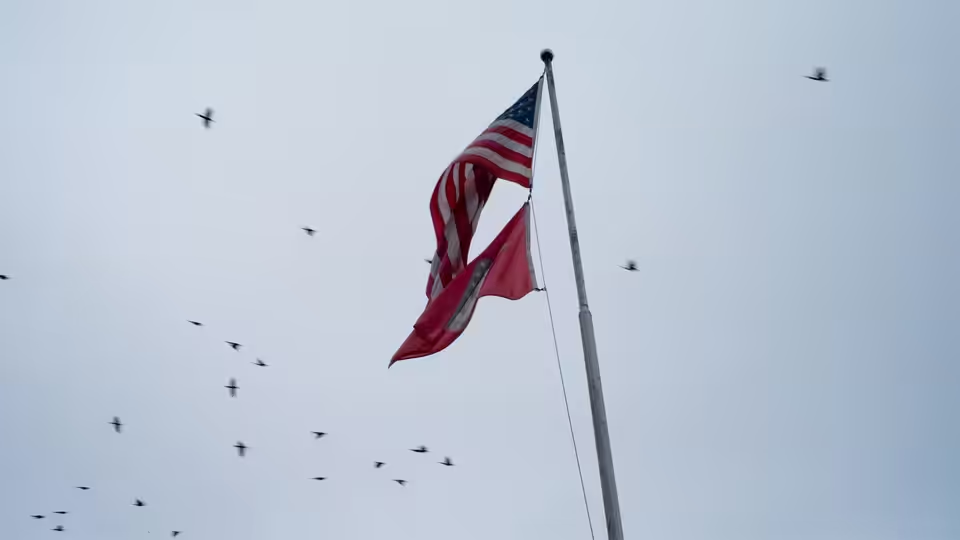
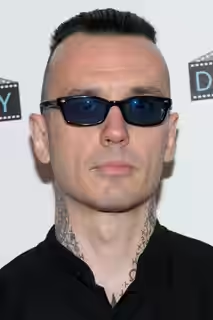
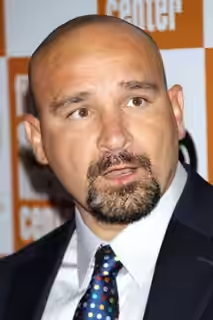
Amy J. Berg builds a gripping, methodical challenge to a failure of justice in Arkansas. The evidence commands attention, though the people sometimes recede behind the campaign and the film can press too hard for agreement.
West of Memphis is a persuasive, often upsetting documentary whose commitment sometimes makes it too certain of its own conclusions. Amy J. Berg examines a failure of justice in Arkansas through the campaign surrounding Damien Echols, Jessie Misskelley Jr. and Jason Baldwin. The purpose is to make the case heard again, with enough detail that outrage has something solid behind it. At 150 minutes, the film asks for sustained attention, and for much of that time it earns it.
The forensic material gives that purpose its force. Tests challenge the evidence behind the original convictions, and the gap between what was believed and what can be supported becomes difficult to bear. We were angry at the certainty those tests call into question. The film makes us sit with the work required to challenge an official account, without rushing on to the next discovery.
Billy McMillin’s editing makes interviews, archive footage and forensic tests readable alongside one another. The material is dense, but we can follow the examination without needing every point reduced to a slogan. Maryse Alberti and Ronan Killeen give the interview photography a useful directness, keeping our attention on the people speaking. That matters because so much of the film depends on listening closely to accounts that the surrounding material may support or challenge.
The music by Nick Cave and Warren Ellis adds weight, though we occasionally wished it would leave that work to the testimony. The film hardly needs help establishing the seriousness of what it is discussing. Its closeness to the campaign is more consequential: Lorri Davis, Damien Echols’s wife, is among the participants and also a producer, alongside Peter Jackson and Fran Walsh. That involvement helps explain the strength of feeling, but it also gives us a reason to keep asking what the film has chosen to emphasise.
The treatment of family photographs is where that caution becomes necessary. Giving an ordinary photograph a threatening air encourages us to read a face as evidence, a method this subject ought to make any filmmaker wary of using. It does not undo the forensic work, but it is a lapse in judgement that matters when someone’s reputation is involved. Those photographs cannot establish what the people pictured have done, however unsettling the film makes them seem.
There is also less room for lives beyond the case than the running time might lead us to expect. The quieter passages about grief are moving because they allow people to matter without making every moment another reason to support the campaign. We wanted more of that attention, and more sense of the political circumstances surrounding the legal failure. Over two and a half hours, the concentration on advancing the case can become wearing, even when the individual pieces of evidence remain compelling.
Give it an evening when there is time to concentrate. The forensic detail deserves that much, even where the film’s way of directing suspicion deserves resistance. Watch it with someone who will discuss the evidence rather than just share the anger.