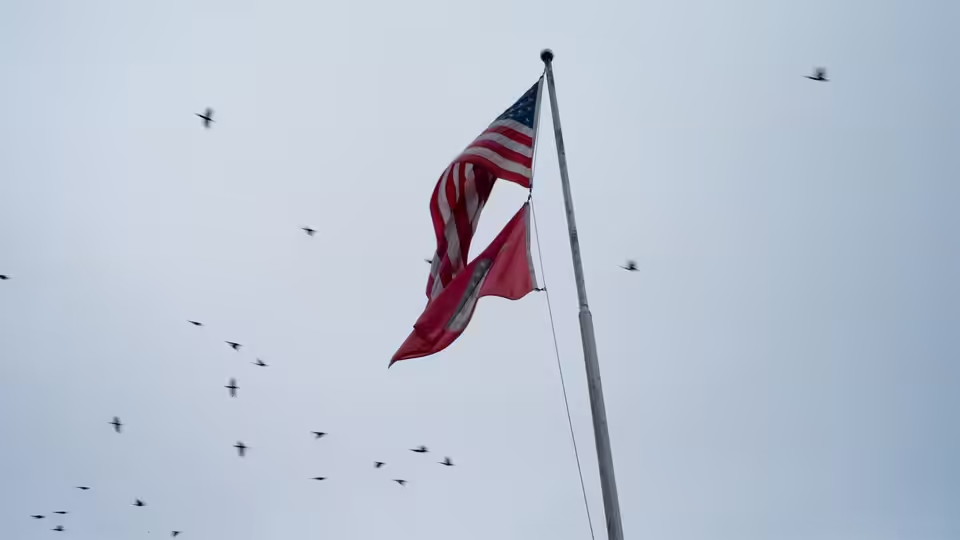
An American flag flies from a tall pole as birds circle across the overcast sky
Film review

West of Memphis

2012 · Directed by Amy J. Berg · 2h 30m

In a sentenceForensic tests and patient interviews make shouting at the screen seem an increasingly reasonable response

In Arkansas, Damien Echols, Jessie Misskelley Jr. and Jason Baldwin are at the centre of an effort to challenge their convictions. Amy J. Berg follows the campaign through interviews, archive footage and forensic tests, examining the evidence behind the original case. Participants include Pam Hobbs, Stevie Branch’s mother, and Lorri Davis, Damien Echols’s wife. Former deputy prosecutor John Fogleman and Dan Stidham, defence attorney for Jessie Misskelley Jr., also appear as themselves. The campaign seeks to have the evidence examined again, while those connected to the case live with its consequences. The question is how a failure of justice becomes so difficult to correct.

Plays from YouTube when you press play; nothing loads from them until then.

Fi1m review

Amy J. Berg builds a gripping, methodical challenge to a failure of justice in Arkansas. The evidence commands attention, though the people sometimes recede behind the campaign and the film can press too hard for agreement.

West of Memphis is a persuasive, often upsetting documentary whose commitment sometimes makes it too certain of its own conclusions. Amy J. Berg examines a failure of justice in Arkansas through the campaign surrounding Damien Echols, Jessie Misskelley Jr. and Jason Baldwin. The purpose is to make the case heard again, with enough detail that outrage has something solid behind it. At 150 minutes, the film asks for sustained attention, and for much of that time it earns it.

The forensic material gives that purpose its force. Tests challenge the evidence behind the original convictions, and the gap between what was believed and what can be supported becomes difficult to bear. We were angry at the certainty those tests call into question. The film makes us sit with the work required to challenge an official account, without rushing on to the next discovery.

Billy McMillin’s editing makes interviews, archive footage and forensic tests readable alongside one another. The material is dense, but we can follow the examination without needing every point reduced to a slogan. Maryse Alberti and Ronan Killeen give the interview photography a useful directness, keeping our attention on the people speaking. That matters because so much of the film depends on listening closely to accounts that the surrounding material may support or challenge.

The music by Nick Cave and Warren Ellis adds weight, though we occasionally wished it would leave that work to the testimony. The film hardly needs help establishing the seriousness of what it is discussing. Its closeness to the campaign is more consequential: Lorri Davis, Damien Echols’s wife, is among the participants and also a producer, alongside Peter Jackson and Fran Walsh. That involvement helps explain the strength of feeling, but it also gives us a reason to keep asking what the film has chosen to emphasise.

The treatment of family photographs is where that caution becomes necessary. Giving an ordinary photograph a threatening air encourages us to read a face as evidence, a method this subject ought to make any filmmaker wary of using. It does not undo the forensic work, but it is a lapse in judgement that matters when someone’s reputation is involved. Those photographs cannot establish what the people pictured have done, however unsettling the film makes them seem.

There is also less room for lives beyond the case than the running time might lead us to expect. The quieter passages about grief are moving because they allow people to matter without making every moment another reason to support the campaign. We wanted more of that attention, and more sense of the political circumstances surrounding the legal failure. Over two and a half hours, the concentration on advancing the case can become wearing, even when the individual pieces of evidence remain compelling.

Give it an evening when there is time to concentrate. The forensic detail deserves that much, even where the film’s way of directing suspicion deserves resistance. Watch it with someone who will discuss the evidence rather than just share the anger.

Critical consensus AI synthesised

75
Positive
11
Mixed
4
Negative
0

Most critics respond warmly to West of Memphis, praising a gripping, methodical examination of the case and the campaign surrounding the West Memphis Three. The strongest agreement concerns its investigative work: newly gathered evidence, forensic tests, archive material and access to witnesses make a complicated history clear and persuasive. Several reviews also value its account of the justice system’s failures, while quieter passages about grief draw praise for giving the investigation emotional weight.

The reservations concern how thoroughly the film serves its cause, and what it leaves out. Some critics find the characterisation and political context thin; others question the familiar material, celebrity involvement or suggestive presentation of a suspect. Opinion ranges from enthusiastic to mixed, with no outright negative verdicts. /Film regards it as definitive and stronger than earlier films about the case, whereas Little White Lies finds it overly committed to its argument and stops short of calling it definitive.

Variety
20 January 2012 · festival review · John Anderson
90*

The critic calls the documentary first-rate, captivating, and a significant contribution to criminal-justice cinema. They praise its new revelations and particularly its deeper examination of Terry Hobbs.

Read the full review →
The Hollywood Reporter
20 January 2012 · festival review · Olivia Hamel
85*

The critic finds the documentary gripping, essential, and deserving of a theatrical release. She particularly praises its detailed investigation of the case and the forensic discoveries that challenge the original convictions.

Read the full review →
Radio Times
★★★★ · Adam Smith
80

Smith presents it as a sober addition to documentaries examining the case. He singles out its resemblance to Errol Morris’s The Thin Blue Line and notes Peter Jackson’s active involvement.

Read the full review →
Time Out
11 October 2012 · ★★★★ · Trevor Johnston
80

The available page metadata does not reveal the critic’s verdict in their own words. It also does not identify what the critic singled out for praise or complaint.

Read the full review →
The AV Club
24 December 2012 · B · Noel Murray
77

Murray finds the documentary well assembled and persuasive, though less rich in character and context than the earlier films. He praises its clear examination of the evidence and its argument that the justice system failed the accused men.

Read the full review →
Empire
4 December 2012 · David Hughes
75*

Hughes finds the documentary spellbinding and deeply disturbing, while stressing that the case remains unresolved. He praises its thorough re-examination of the evidence, including new interviews, archive footage and forensic tests.

Read the full review →

Straight answers AI written, from our review

Is West of Memphis worth watching?
West of Memphis is worth watching for its patient examination of forensic evidence and a failure of justice; we score it 77 out of 100. We recommend it to documentary viewers prepared to concentrate for 150 minutes, though its closeness to the campaign sometimes leads it to press for agreement where greater caution would serve it better.
How long is West of Memphis, and what is it rated?
West of Memphis runs 2h 30m. It is a documentary film.
Where can I watch West of Memphis in Romania?
West of Memphis is not on any streaming or rental service in Romania at the moment. It is available in 42 other countries; change your country at the top of the page to see where. Availability is checked daily.
How violent or frightening is West of Memphis, and is it suitable for children?
West of Memphis carries a UK 15 certificate and is not suitable for children under 15; we find its examination of a failure of justice often upsetting. The forensic material and accounts of grief make it emotionally demanding, rather than something to approach as light true-crime entertainment, and sensitive older teenagers may find the subject difficult.
How does West of Memphis compare to The Thin Blue Line?
West of Memphis is a gripping examination of a conviction, but we recommend The Thin Blue Line first as the stronger example of this kind of documentary. Berg builds her challenge through forensic tests, interviews and archive footage, while Morris uses re-enactments to question competing accounts; Berg’s film is persuasive, though its campaign commitments sometimes make it too certain.
What should I watch after West of Memphis?
After West of Memphis, try The Thin Blue Line (1988, Fi1m 90): Another patient examination of a conviction, attentive to how competing stories become accepted evidence. Then Collective (2019, Fi1m 88): A Romanian investigation following reporters as they test official explanations against stubborn facts.

Cast

If you liked this, try…

  1. The Thin Blue Line (1988, Fi1m 90)Another patient examination of a conviction, attentive to how competing stories become accepted evidence.

  2. The Staircase (2004) · not on Fi1m yetA longer stay with legal procedure, defence strategy and the difficulty of knowing.

  3. The Confession (1970) · not on Fi1m yetA political drama about interrogations that turn the required answer into official truth.

  4. Court (2014) · not on Fi1m yetAn Indian courtroom drama attentive to the everyday routines that sustain institutional cruelty.

  5. Collective (2019, Fi1m 88)A Romanian investigation following reporters as they test official explanations against stubborn facts.