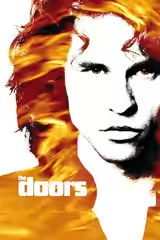
Tom DiCillo has found footage of the Doors almost nobody has seen, and it is worth an evening on its own. Then he has Johnny Depp explain it, slowly, and the explaining is where the film goes wrong.
Tom DiCillo’s film about the Doors runs 86 minutes and contains nothing shot after 1971. There are no interviews with the surviving members, no actors in wigs. There is film the band and their friends shot, film from concerts and television, newsreel of the decade around them, and over all of it the voice of Johnny Depp reading a script DiCillo wrote. The footage is the reason to see it. The script is the reason you may not want to.
The opening is the best idea in the film. Morrison, bearded and heavy, drives a car through the desert, and a radio bulletin announces that Jim Morrison has been found dead in Paris. It is a trick, since the bulletin has been laid over film made before the death, and it is a good one, because for a minute we do not know what we are watching or when. Then Depp arrives, Los Angeles 1965 comes up in a caption, and the film settles into the order the record sleeves already know.
What Kevin Krasny and Micky Blythe have to cut with is remarkable. There is Morrison in a rehearsal room, listening to Ray Manzarek work out a bass line on the organ with his left hand. There is a 1967 concert in New Haven where the police walk onto the stage mid-song, and the camera is close enough to catch the moment Morrison realises he is about to be arrested and decides to keep talking. We sat forward at that, because the shot is handheld from the lip of the stage, the house lights are coming up, and the band carry on playing behind him as though none of it is their business. It is the clearest account we have seen of what this group was like in a room, and no amount of narration can undo it.
The narration tries. Depp speaks slowly and with the gravity of a man reading a will, and the lines he is given tell us what we are looking at. When the band write a long song, he explains that it is long. When Morrison drinks, he explains that drink was a problem. The 1960s are covered by John F. Kennedy, Martin Luther King Jr. and Lyndon B. Johnson in short bursts of television between songs, as if the decade were a weather report. We wished, more than once, that the sound mix had simply let the Doors’ own music carry a scene, since it is doing so anyway.
The other three are the film’s missing piece. Manzarek, Robby Krieger and John Densmore are on screen constantly and are hardly ever the subject. Krieger wrote some of the band’s best-known songs and is treated as a quiet man with a guitar. Pamela Courson appears in fragments of film shot at home and is identified in passing. Jim Ladd, the only new voice besides Depp, turns up as a radio announcer and is gone. This is Morrison’s film, but it means the band’s music is explained as the outpouring of one man when the footage keeps showing four.
DiCillo made Living in Oblivion, a sharp comedy about a film shoot falling apart, and we expected some of that mischief here. Instead the film is reverent, and reverence is the one thing this footage does not need. Oliver Stone’s The Doors, from 1991, had Val Kilmer and a great deal of invention, and this film is plainly meant as the sober corrective. It is more accurate. It is also, for stretches, duller, which is a strange thing to say about a film that has Morrison walking into a crowd of policemen.
Most critics sit about where we do, split between the footage and the voice over it, and the advice depends on who is on the sofa. If you know the records, this is an hour and a half with the band in rooms you have never been allowed into, and that is worth putting up with the commentary. If you do not know them, the film will tell you a great deal about the Doors and give you no particular reason to care.