Wu Jing’s athletic combat makes Wolf Warrior 2 worth an action fan’s evening. The varied set pieces keep it entertaining, though the overcrowded story and heavy-handed nationalism test our patience.
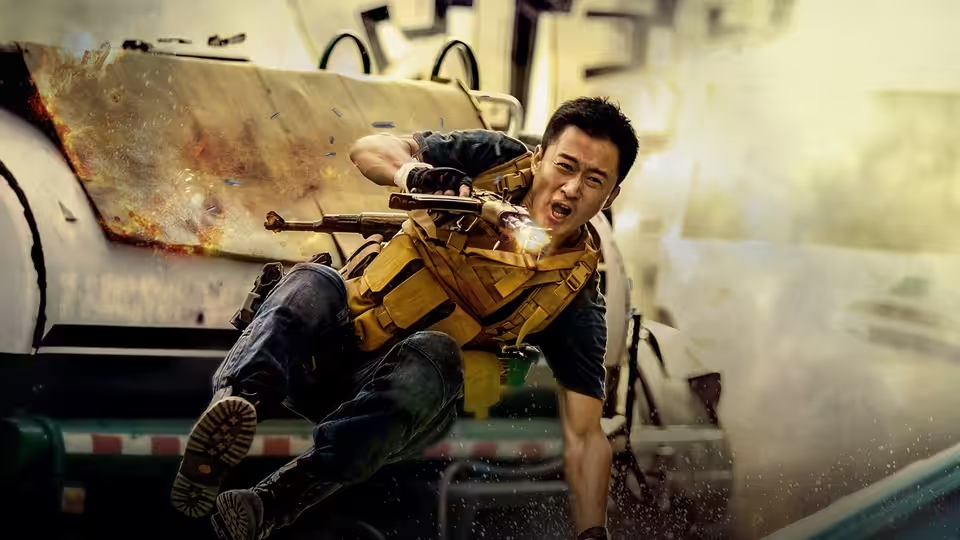
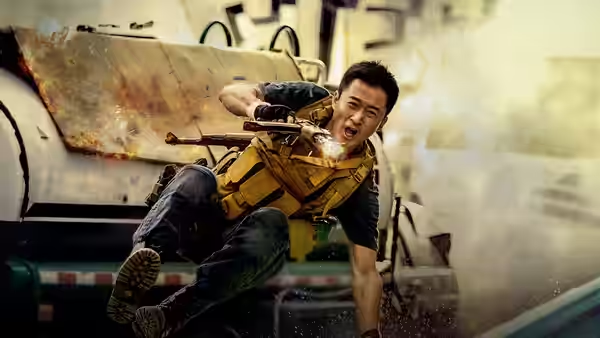
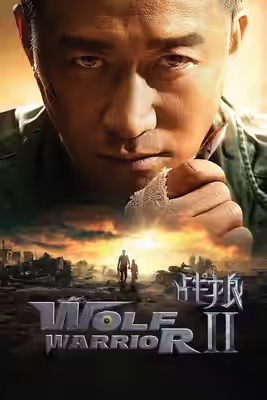
Wolf Warrior 2 is worth an action fan’s evening, although its patriotic insistence can make that evening feel longer. Wu Jing directs and stars as Leng Feng, and his athletic presence gives us a good reason to watch before the writing becomes a concern. The film offers elaborate action with considerable confidence in the man performing it. That confidence is justified; the thin story, with too much crammed into it, requires rather more generosity from us.
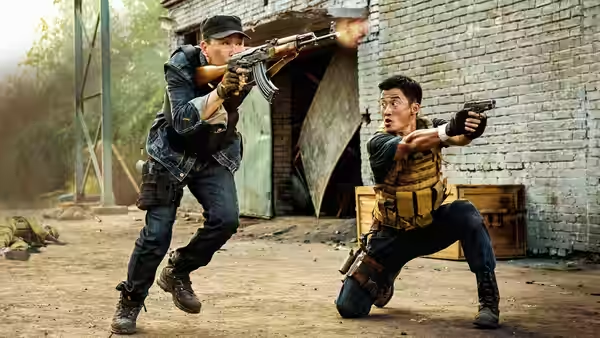
We were properly exhilarated by the hand-to-hand fighting. Wu Jing’s athleticism is the reason: watching him work gives these encounters an excitement that the surrounding story cannot manufacture simply by raising the stakes. The choreography has enough invention to sustain our interest, and the variety of the set pieces stops the action becoming one encounter repeated with greater force. We kept looking forward to the next fight, even when our interest in the plot had begun to wander.
Peter Ngor handles the cinematography and Cheung Ka-Fai the editing, and the hand-to-hand combat gives their work its most persuasive purpose. These sequences have choreography worth following and a performer capable of making the effort count. Across the film, though, the accumulation becomes tiring, and the editing cannot quite make an overfilled story feel lean. At 124 minutes, there is time for the film to wear down some of the goodwill its action earns, particularly when another complication demands attention without making us care more.
The elaborate set pieces also make a case for the production design by Raymond Lee King-Man and Wang Ligang. Joseph Trapanese supplies the music, although Wu Jing’s physical performance makes the strongest impression. There is pleasure in the sheer amount of spectacle, and we would not ask this sort of action film to become modest or apologetic about entertaining us. More selectivity would help, particularly when the film treats scale as sufficient reason to keep adding to an already crowded evening.
The screenplay is credited to Dong Qun, Gao Yan, Wu Jing and Liu Yi, and its overcrowding is the larger weakness. A simple plot can serve an action film well, giving performers room and allowing a good confrontation to develop without too much explanation. Here, too much competes for attention while the story has too little substance to reward the effort. The writing repeatedly benefits from the excitement of the combat, but it leaves the action carrying more of our interest than it should have to.
The nationalism presents a separate difficulty. We can accept an action hero’s patriotic purpose without welcoming quite so much pressure to applaud it, and the film’s heavy-handedness becomes wearing. Wu Jing has already done the difficult work of making us want to watch him; the insistence on national pride adds little to that pleasure. It also makes the film less relaxed company than its energetic fighting might suggest, particularly for anyone who came primarily to enjoy the choreography.
Against the straightforward pleasures of action cinema, this has enough skill, variety and star presence to earn a recommendation. The weak story matters, but it does not cancel the enjoyment of watching Wu Jing in combat. Our reservation is specific: the film expects considerable patience between those rewards, and considerable sympathy with its patriotic enthusiasm. If national pride is the last thing you want alongside a fight sequence, choose another film.