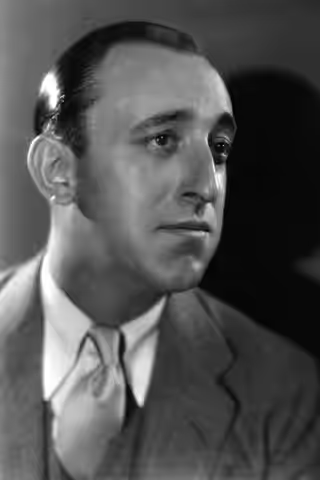
A gloomy face, a voice from the side of the mouth, and forty years of crooks, coppers and stooges. Allen Jenkins never carried a film and rarely needed to; his job was to make the man beside him believable, and he was good at it.
Fi1m perspective
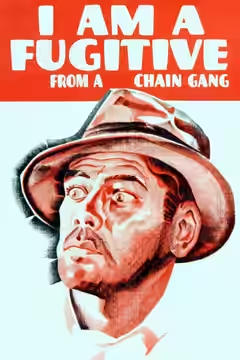
He is usually standing a little behind someone. In I Am a Fugitive from a Chain Gang (1932) he is Barney Sykes, one of the lifers who tell Paul Muni how the camp works, and he does it without raising his voice or expecting thanks. The face is long and set, the delivery flat, and the effect is of a man who found out the score years ago and sees no reason to make a fuss about it now. That was the Jenkins manner, and he would spend the next four decades being asked for it.
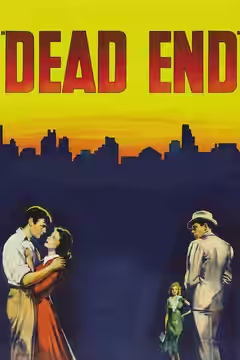
He came to acting late, after shipyard work and a spell as a stage mechanic, and trained at the American Academy of Dramatic Arts before going on stage in 1922. Broadway gave him The Front Page in 1928 and the job of replacing Spencer Tracy in The Last Mile. Films took him in 1931, and a Warner Bros. contract from 1932 settled the matter: he became one of the studio's stock of faces, wheeled out for gangster pictures, comedies and musicals alike. He is Mac Elroy in 42nd Street (1933) and Hunk in Dead End (1937), alongside Humphrey Bogart. He could dance, which the studio occasionally remembered.
The cost of being useful is that nobody thinks to use you differently. Jenkins was typed early as the comic roughneck or the dim thug, and the type followed him into smaller parts as he got older: Harry the elevator operator in Pillow Talk (1959), the voice of the put-upon Officer Dibble in Top Cat (1961 to 1962), a telegrapher in the 1974 film of The Front Page, the same play he had done on Broadway forty-six years before. That last one was released after his death, which gives the career a neatness he would probably have raised an eyebrow at.
What he did well is easy to miss because it was designed to be. We were more moved by Barney Sykes than we expected, and it was because Jenkins refuses to ask for it: he lays out the rules of the chain gang the way another man would read a bus timetable, and the flatness is what tells you how long he has been there. Edward Ellis does the same beside him, and the two of them give the camp scenes a settled hopelessness that the film's speeches never manage. In 42nd Street he is one face among many and we did not single him out, which is the other side of the same coin. A man built to hold up the middle of the frame can vanish into it.
Start with Fugitive, where he is given something to do and does it without fuss. Then put on almost anything Warner Bros. made in the thirties and wait for the gloomy face at the edge of the shot. It will be there, and it will be working.
Biography
Allen Jenkins (born Allen Curtis Jenkins, also credited as Alfred McGonegal and Allen Curtis Jenkins) was an American character actor who worked in theatre, film and television. Born on 9 April 1900 in Staten Island, New York, he trained at the American Academy of Dramatic Arts and began his stage career in the 1920s, appearing in numerous Broadway productions including The Front Page (1928). He replaced Spencer Tracy in the Broadway play The Last Mile.
In 1932 he signed with Warner Bros. and became a familiar face in films of the 1930s and 1940s, often cast as comic henchmen, stooges or policemen. His film credits include Barney Sykes in I Am a Fugitive from a Chain Gang (1932) and Mac Elroy in 42nd Street (1933). He later voiced Officer Dibble in the animated series Top Cat (1961–1962) and appeared in television shows such as Hey, Jeannie! (1956–1957), I Love Lucy and Batman (1966). Jenkins died on 20 July 1974 in Santa Monica, California.