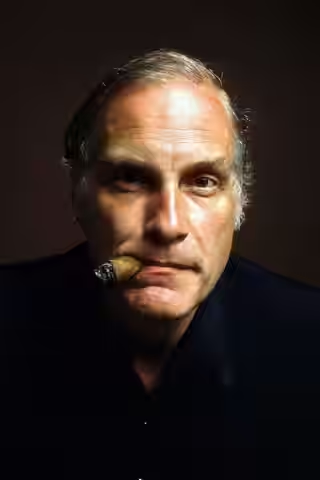
Barbet Schroeder gives difficult people time to explain themselves, often past the point of comfort. We value his patient, unsentimental attention, though the same restraint can leave his fiction feeling remote.
Fi1m perspective
Barbet Schroeder lets people speak without immediately explaining how we ought to feel. In General Idi Amin Dada: A Self Portrait (1974), extended access gives Amin ample opportunity to present himself. We found that exposure disturbing: Schroeder offers little of the reassurance that comes from a director announcing his disapproval. His patience is worth taking seriously, even when it makes the watching unpleasant.
More (1969), his first feature, established his interest in countercultural extremes and featured a Pink Floyd score. The move into American studio filmmaking with Barfly (1987) did not mean abandoning people at the edge of society. Its concern with alcoholism and outsider existence belongs comfortably beside the earlier film’s heroin addiction. Recurring collaborators include cinematographer Luciano Tovoli and actress Bulle Ogier, providing some continuity through the changes between fiction and documentary.
Reversal of Fortune (1990) makes a persuasive case for his precision with psychological drama. Single White Female (1992) puts obsession inside a commercial thriller, another suitable setting for his interest in extreme behaviour. But the deliberate pacing and emotional distance of La Vallée (1972) show where his approach can become a problem. We can spend a long time watching his characters without coming to care enough about them.
Mad Men (2007) offers a useful point of contact, although Schroeder directed only one episode, in 2009. We admire the series for its exact performances and patient storytelling, which make its advertising world funny, ugly and absorbing. Its occasional smugness about the past does not much diminish that pleasure, and its patience fits his preference for letting people reveal themselves. Credit for the programme’s achievements cannot, however, sensibly be handed to a single guest director.
He later returned to smaller-scale fiction and documentaries, including Terror’s Advocate (2007) and The Venerable W. (2017). Giving disturbing subjects room to speak remains a strength, but also carries the risk of leaving too much unchallenged. A more forceful challenge would sometimes help. For a first encounter, we would choose Reversal of Fortune, where his reserve is well suited to psychological drama.
Biography
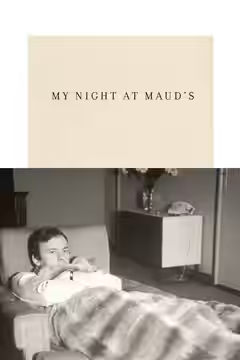
Barbet Schroeder is a Swiss film director and producer born in Tehran, Iran, in 1941. He began his career in the 1960s producing films associated with the French New Wave, including works by Éric Rohmer, Jean-Luc Godard and Jacques Rivette.
Schroeder directed his debut feature More (1969) and later films including Barfly (1987), Reversal of Fortune (1990) — for which he was nominated for the Academy Award for Best Director — Single White Female (1992), Kiss of Death (1995) and Murder by Numbers (2002). He has also directed documentaries such as General Idi Amin Dada: A Self Portrait (1974) and an episode of the series Mad Men (2009).