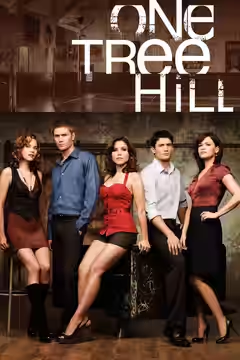
Billy Dickson favours rich colour and natural lighting, with room for a programme to change its tone. We rate his television craft, though One Tree Hill also shows the limits of handsome pictures when the writing grows repetitive.
Fi1m perspective
On the basketball court, One Tree Hill (2003) finds the energy its family quarrels sometimes lack. Its attractive North Carolina photography gives a modest setting enough interest to hold our attention. We felt more involved during the sports scenes, because their energy gave us a welcome break from the familiar disputes. Dickson is one of the credited cinematographers alongside Stephen Thompson and Peter B. Kowalski, so the programme’s handsome appearance should not be credited to him alone.
He began as director of photography on Zebra Force (1976), but the long television runs are more useful when considering his approach. On Ally McBeal (1997–2002), he shot more than 100 episodes and also directed several. His preference for rich, saturated colours and natural lighting leaves room for changes of tone. On that programme, broader comedy lighting could give way to harsher light and handheld camerawork for heavier episodes. Keeping that flexibility over a long run strikes us as a more useful skill than making every scene announce the cinematographer’s presence.
In One Tree Hill, the handsome presentation does not make the teenagers seem too remote from ordinary life. That matters because believable hurt is one of the programme’s chief reasons to keep watching. Yet the photography cannot supply the humour the programme so often lacks, or make familiar family quarrels consistently involving. We would give Dickson and his fellow cinematographers credit for helping the drama remain approachable, without asking their pictures to excuse the shortcomings of the scripts.
A different phase arrives with IQ-145 (2008), the web series he created, wrote, directed, shot and edited. The feature Believe (2016) likewise gave him responsibility for the writing, direction and cinematography. Start with One Tree Hill if teenage soaps are your sort of evening; his lighting is not a reason to acquire the habit.
Biography
Billy Dickson is an American cinematographer and television director. He began working as a director of photography in the 1970s and has contributed to numerous television films and series.
As a cinematographer he is known for his work on the series Ally McBeal (1997–2002), for which he received two Primetime Emmy Award nominations. He has also served as director of photography on series including The Big Easy and One Tree Hill (2003). Dickson has directed episodes of Ally McBeal, One Tree Hill (2004–2006) and other programmes, and created the web series IQ-145 (2008), on which he also directed, photographed and wrote episodes. He directed the feature film Believe (2016).