Brad Davis played men whose charm was the first thing to go. In Midnight Express he lets it drain away scene by scene, and that one performance is most of what the screen has of him. The rest is glimpses.
Fi1m perspective
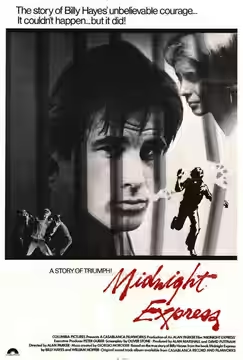
For the first stretch of Midnight Express (1978), Billy Hayes is a boy who thinks charm will get him out. Brad Davis plays that belief straight, without a wink to the audience, and then spends the rest of the film letting it be taken from him. He does not mark the change with one big scene. It goes a piece at a time, a smile that arrives a beat later each time it is needed, until it stops arriving. That is the performance, and it is a large part of why the film grips even when we would rather it did not.
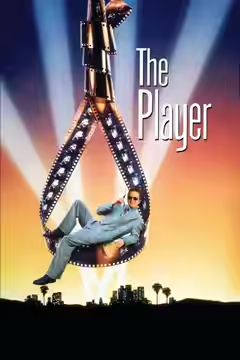
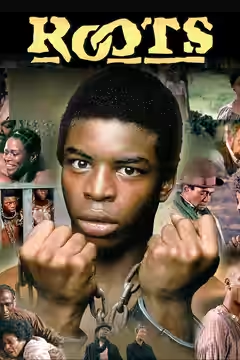
It was his first film. Davis had trained in New York and worked Off-Broadway and in television, in Sybil (1976) and Roots (1977), before Alan Parker cast him. What followed was shorter than it should have been. He played the runner Jackson Scholz in Chariots of Fire (1981), a supporting part he fits without strain, and the title role in Querelle (1982), Rainer Werner Fassbinder's last film, as a sailor whose appeal is the engine of the picture. On stage he was Ned Weeks in Larry Kramer's The Normal Heart (1985). After that the roles came sporadically. He died in 1991, and a cameo as himself in Robert Altman's The Player (1992) was among the last things he put on screen.
So the case rests on one film, and it is a film we scored 61. Oliver Stone's script paints every Turk in the same dark shade and asks us to feel for Billy more than it has earned, and Davis is the one who has to carry that debt. Around him the richer parts go elsewhere: John Hurt's Max, the film's finest hour, a wreck of an Englishman who has made peace with his own ruin; Randy Quaid's Jimmy, all rage; Paolo Bonacelli's Rifki, all smiles and ledgers. Davis's job is to be the man the film happens to, which is a hard job and a thankless one, and he does it. In the later stretches we found we did not want to look at him, not because the acting had failed but because it had worked: the likeable boy of the opening was gone and Davis had not softened his going.
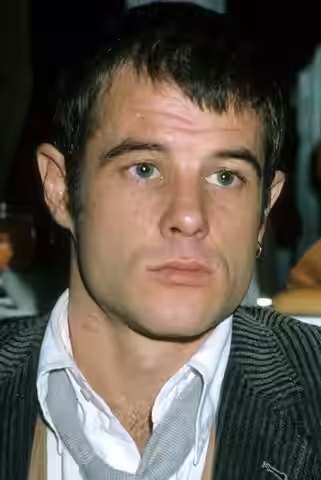
What he had was a face that read as open and a body that read as ordinary, and the willingness to let both be wrecked. He was not often given the chance to do it again; the breakthrough did not turn into the career it promised.
There is not much to see, so see it in order. Midnight Express first, for what is taken away. Chariots of Fire for a glimpse of him at ease. Querelle if Fassbinder is your taste and you are prepared for a film that is nothing like the other two. That is nearly the whole shelf.
Biography
Brad Davis (born Robert Creel Davis) was an American actor. He made his film debut as Billy Hayes in Alan Parker's Midnight Express (1978), for which he won the Golden Globe Award for New Star of the Year – Actor and received BAFTA nominations for Best Actor in a Leading Role and Most Promising Newcomer to Leading Film Roles.
Davis trained at the American Academy of Dramatic Arts in New York. His other film roles include Jackson Scholz in Chariots of Fire (1981) and the title character in Rainer Werner Fassbinder's Querelle (1982). He appeared in television productions including Roots (1977) and Sybil (1976), and originated the role of Ned Weeks in the stage play The Normal Heart (1985).
Davis was married to casting director Susan Bluestein. He died in 1991.