Bruce Robinson writes men who talk their way around their troubles rather than out of them. In Withnail & I that habit produced a comedy of real sadness; pointed at a war, in The Killing Fields, the talk runs on past the point where the pictures had done the work.
Fi1m perspective
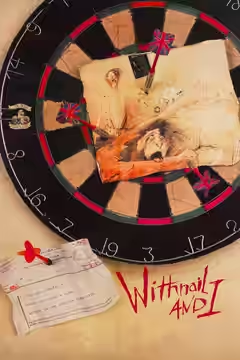
Withnail has a grievance and he wants it heard. Nobody in the room is obliged to listen, and the length of the complaint is the joke. Bruce Robinson's dialogue works like that all through Withnail & I (1987): a grievance runs a sentence longer than it needs to, then another, and the extra sentences are where the laughs and the sadness both live. The lines get collected and recited, but they were written for particular mouths, and Richard E. Grant's is the one they fit.
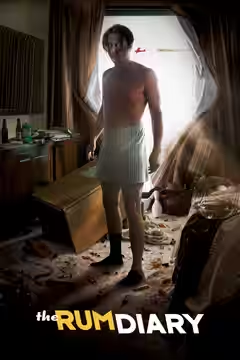
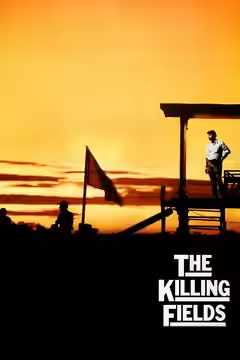
Robinson began as an actor, with Benvolio in Franco Zeffirelli's Romeo and Juliet (1968) among his early parts, and turned to writing in the mid-1970s. His first major credit was the screenplay for The Killing Fields (1984), Roland Joffé's account of Cambodia's catastrophe told through the friendship of the reporter Sydney Schanberg and his guide Dith Pran. Then came Withnail & I, which he also directed and drew from his own years as a struggling actor in late-1960s London. How to Get Ahead in Advertising (1989), again with Grant, turned the same voice on advertising and British politics. He went to Hollywood for Jennifer 8 (1992), which is generally held to have been knocked about by the studio and which we have not reviewed, and did not direct another feature until The Rum Diary (2011), from Hunter S. Thompson.
What works is the ear. Robinson knows how a man makes his disappointment somebody else's problem, and he knows the one unnecessary clause that gives the game away. We laughed at Withnail for the whole film and were caught out by how sad we felt when it finished, because the comedy had never once pretended he would be all right. What works less well is the same habit applied to a serious subject. In The Killing Fields his script gives the friendship between Schanberg and Pran a great deal of explaining to do, and the film is at its best when the two men are too busy staying alive to explain anything. Haing S. Ngor's Pran does not need the words; Sam Waterston's Schanberg is handed too many of them. Robinson has said of How to Get Ahead in Advertising, "It's just me ranting, really", and the rant is a form he has returned to more than once.
Grant is the actor his sentences were built for, and David Puttnam the producer who stood behind three of the films. Start with Withnail & I, then The Killing Fields, and notice the same writer at work in both: one man talking too much, and another made to listen. In the comedy, that is the joke. In the war film, it is the problem.
Biography
Bruce Robinson (born 2 May 1946) is an English actor, director, screenwriter and novelist. He trained at the Royal Central School of Speech and Drama and began his career as an actor, appearing as Benvolio in Franco Zeffirelli's Romeo and Juliet (1968) and as Lieutenant Albert Pinson in François Truffaut's The Story of Adèle H. (1975).
Robinson wrote the screenplay for The Killing Fields (1984), for which he received a BAFTA Award for Best Adapted Screenplay and an Academy Award nomination. He wrote and directed the cult film Withnail and I (1987), drawing on his own experiences as a struggling actor. He later directed How to Get Ahead in Advertising (1989), Jennifer Eight (1992) and The Rum Diary (2011).
He returned to acting with a role in Still Crazy (1998). Robinson is married to illustrator Sophie Windham.