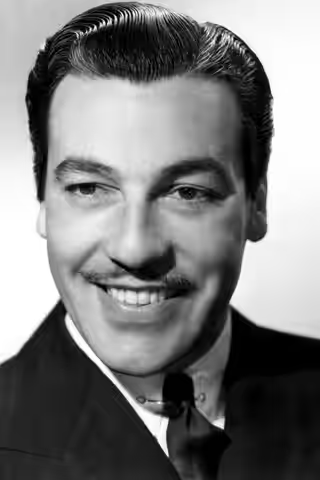
Cesar Romero spent thirty years as Hollywood's smooth Latin rogue, the well-dressed man who was never the hero. Then he painted his face white, kept the moustache and found the one part that wanted all of him. We are always glad when he turns up.
Fi1m perspective
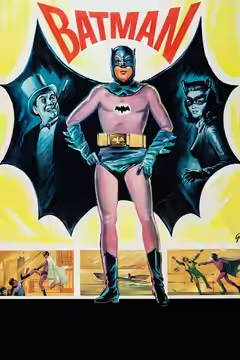
Look at the Joker's upper lip in Batman (1966). Under the white greasepaint there is a moustache, and nobody has painted over it. Romero would not shave it. We laughed at that moustache every time he came on, more than at any line he was given, because it tells you the man under the paint has not stopped being Cesar Romero and does not intend to. The rest of the performance follows: the cackle that runs on past the end of the sentence, the puns delivered as if they were good.
It took him a long time to get there. Romero was a professional ballroom dancer before he was an actor, on Broadway from 1927, and he came to Hollywood with The Thin Man (1934). For the next quarter century the studios, 20th Century Fox chiefly, cast him as the smooth Latin lover or the charming rogue, the man the heroine is with before she meets the hero. He was the Cisco Kid in six westerns between 1939 and 1941, danced opposite Carmen Miranda, Betty Grable and Shirley Temple, and played Cortés in Captain from Castile (1947), which is usually named as his best straight performance. He was good-looking and easy company, and his name and face kept him from the leads.
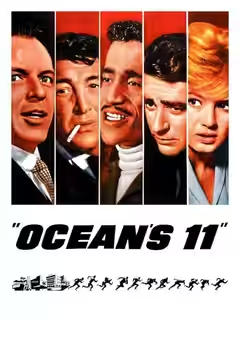
That is a supporting player's career, and Ocean's Eleven (1960) shows the trouble with it. Romero plays Duke Santos, the man the mother of Peter Lawford's Jimmy Foster is about to marry, a fellow with unhelpful friends. It is a part with one job, and the film, which spends its first hour on introductions with nothing in them, gives him no more room than anyone else. He looks prosperous and slightly dangerous, and the film does not notice. We held that against the film, which we scored 55, not against him; a man who has been decorative for thirty years does not break the pattern unasked.
The Joker broke it for him. He called it "the kind of part where you can do everything you've been told not to do as an actor", and the television series (1966 to 1968) and the film are the proof. Frank Gorshin's Riddler is the better performance, quicker and stranger, and Burgess Meredith's Penguin plainly enjoys himself, but Romero is the one who has been waiting thirty years for permission. Some later observers say his Joker is a clown and not a killer, and that the darker comic-book character got lost under the paint. That is true and it is not a flaw; the show he was in wanted a clown. Our own complaint is smaller. Put all four villains in a room together and they bicker, and Romero, who is loud, bickers loudest.
He worked on through the 1970s in Disney comedies and into the 1980s on Falcon Crest, and nothing after the Joker asked for all of him. There is no Cesar Romero film to seek out. There are films that happen to have him in them, and when he arrives, in a good suit with a bad intention, be glad of the company.
Biography
Cesar Romero was an American actor. Born in New York City, he began his career as a professional dancer and on the stage before making his film debut in The Thin Man (1934).
Over a career spanning nearly sixty years, he appeared in a wide range of roles, often as Latin lovers or in light comedies and costume dramas. He is best known for portraying The Joker in the 1966–1968 television series Batman and its 1966 feature film spin-off, a part he played without shaving his trademark moustache.