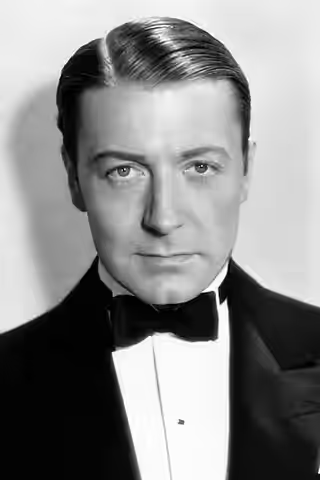
Clive Brook was Hollywood's Englishman for a decade: clipped, upright, decent and slightly stiff. We admire the steadiness. We are less sure that anyone, Brook included, ever found out what else he could do.
Fi1m perspective
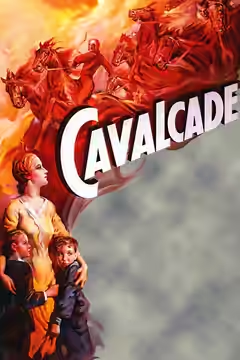
Clive Brook stands up straight. In Cavalcade (1933) he plays Robert Marryot with a moustache and a flag and takes the years on the chin, and the film asks nothing else of him. That was the job for most of his career: the reserved English gentleman, clipped of speech, dry of manner, unlikely to raise his voice. He did it in Hollywood for a decade and then he did it at home.
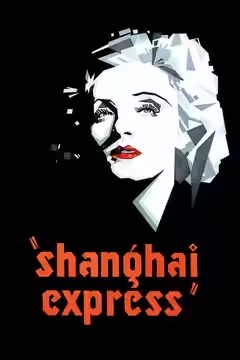
He came to acting late, after serving as a major in the war, and went on stage in 1918 and into British films in 1920. Paramount signed him in 1924 and he became a leading man across the end of the silents and the start of sound, which not every silent face managed; the voice, clipped and unhurried, turned out to be the point. He made Underworld (1927) and Shanghai Express (1932) with Josef von Sternberg, the second opposite Marlene Dietrich, and it is still the film people name first. He played Sherlock Holmes in some of the detective's earliest talkies between 1929 and 1932. Then he went back to Britain around 1935 and worked there until 1944.
The reserve is real and it is not nothing. Standing still and letting the other actor do the talking is a skill, and Brook could hold a frame without asking to be looked at. The trouble is what happens when the script has decided that standing still is all a decent Englishman does. In Cavalcade Diana Wynyard ages a lifetime with her face while Brook salutes beside her, and we found ourselves waiting, as the years went by, for him to be surprised by anything. He never is. That is Coward's doing and Frank Lloyd's before it is his, but he does not fight it, and the word critics reach for when he does not fight it is wooden. We would not go that far. Wood does not know it is being patient.
Late on he did the thing reserved actors rarely do and took charge. On Approval (1944) is his only film as director; he adapted it, produced it and played a duke in it, and then he stopped, apart from one appearance in The List of Adrian Messenger (1963). A man who kept to one manner for two decades, then made a single drawing-room comedy and left, knew exactly what shop he was keeping. We have reviewed only Cavalcade, and it is not the film to judge him by. Watch it for Wynyard; then find Shanghai Express, where the reputation was made.
Biography
Clive Brook was an English stage and film actor. Born Clifford Hardman Brook in Islington, London, he served as a major in the British Army during the First World War before making his professional stage debut in 1920.
He appeared in early British films and moved to Hollywood in 1924, where he became a leading man for Paramount. Notable roles include the lead in Josef von Sternberg’s Underworld (1927), Captain Donald 'Doc' Harvey in Shanghai Express (1932), Robert Marryot in Cavalcade (1933), and the first talking Sherlock Holmes. He also appeared as Capt. William Levison in East Lynne (1931) and later as the Marquis of Gleneyre in The List of Adrian Messenger (1963).
Brook returned to Britain in the mid-1930s and continued in film roles until retiring from the screen in 1944. He directed and starred in On Approval (1944).