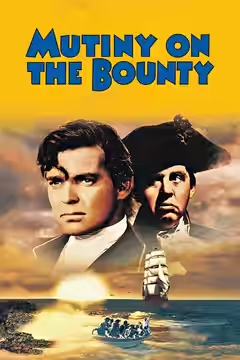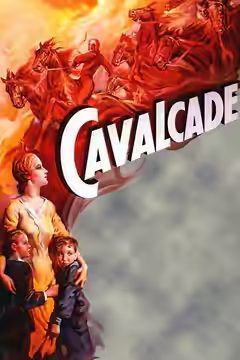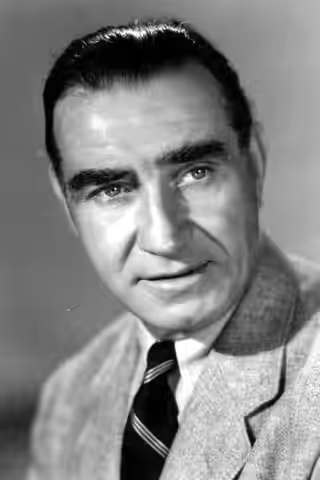
Frank Lloyd built big period pictures for the studios and built them well, on time and to order. In Cavalcade we saw the craft and the trouble at once: handsome streets, a fine actress held in close-up, and not one hard question asked.
Fi1m perspective
Watch what Frank Lloyd does when Diana Wynyard is handed bad news in Cavalcade (1933). He does not cut away and he does not bring the music in early; he holds on her face while it goes still. It is the best decision in the film, and it is the decision of a man who knows what he has and gets out of its way. That is Lloyd at his most useful. The trouble is that the same instinct, applied to a whole picture, leaves it with nothing to say.
He came to it from the stage. Born in Cambuslang, near Glasgow, in 1886, he worked in vaudeville and the theatre before leaving for Canada in 1909 and the United States in 1913, where he acted in films and began directing shorts in 1914. The silent years were prolific, at Paramount, Fox, Goldwyn and First National, with Les Misérables (1917) and The Sea Hawk (1924) among the features. Sound did not trouble him. The Divine Lady (1929) and East Lynne (1931) kept him in costume and melodrama, Cavalcade followed, and Mutiny on the Bounty (1935) remains the film most people can name. Then Wells Fargo (1937), Blood on the Sun (1945) with James Cagney, a retirement in the mid-1940s, and two late pictures for Republic in 1954 and 1955.
The pattern is plain: literary sources, history, big sets, established stars, delivered on schedule and without fuss, and no appetite for publicity. Most critics have filed him as a dependable craftsman rather than an author, and compared him unfavourably to Cecil B. DeMille. We would not go quite that far. There is judgement in Cavalcade. The streets and docks are properly built and populated, Una O'Connor's sniff and Herbert Mundin's Alfred Bridges are allowed to be funny, and the film knows Wynyard is its centre and keeps coming back to her.
What it lacks is any argument with its own material. Noël Coward's pageant salutes the flag and weeps on cue, and Lloyd salutes and weeps along with it. Every public calamity from 1899 to 1933 is arranged to pass in front of the same window, and nobody in the film, or behind the camera, asks why. We sat through most of its 112 minutes waiting for the picture to disagree with itself, even for a scene, and it never did; by the second hour we were bored, and cross about being bored by something so carefully and expensively made. A director who trusts his actress that much ought to have trusted his audience a little too.
That is the caveat with Lloyd, on our evidence: the craft is real and the politeness is total. If you want to see what a first-rank studio director could build in 1933, and what he would not touch, Cavalcade is the place to look. Go for Wynyard. Do not go expecting a question.
Biography
Frank Lloyd (1886–1960) was a Scottish-American film director, screenwriter, producer and actor. Born in Glasgow, he began his career on the London stage before emigrating to Canada in 1910 and moving to Hollywood in 1913, where he started as an actor and soon turned to directing.
Lloyd directed East Lynne (1931) and both directed and produced Cavalcade (1933). He is best known for Mutiny on the Bounty (1935), Cavalcade (1933) and Blood on the Sun (1945). He was among the founders of the Academy of Motion Picture Arts and Sciences and served as its president from 1934 to 1935. He won Academy Awards for Best Director for The Divine Lady (1929) and Cavalcade (1933), and received a further nomination for Mutiny on the Bounty (1935).