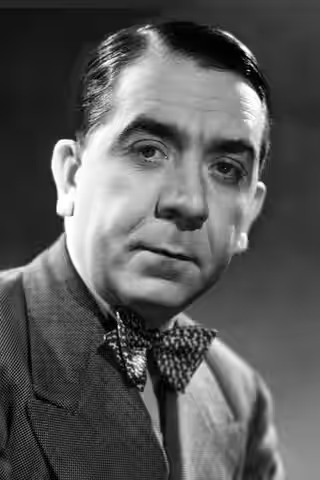
Herbert Mundin was the cheerful, jowly Englishman at the edge of the 1930s Hollywood frame, the Cockney servant or crewman who got the laugh and rarely the plot. In Cavalcade he was allowed something more, and he took it.
Fi1m perspective
Look for him at the edge of the frame. Herbert Mundin spent the 1930s in Hollywood playing the lower orders: butlers, publicans, sailors, servants, Cockney by accent and cheerful by nature, with a soft, jowled face that seemed already to have settled into middle age. He did not have to do much to be funny. He turned up, looked pleased to be there, and the scene had somewhere to rest.
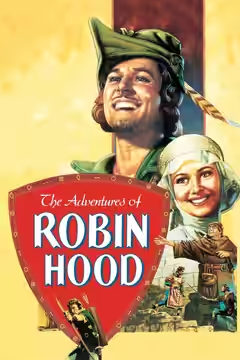
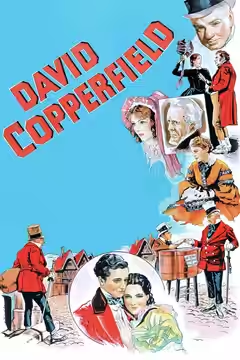
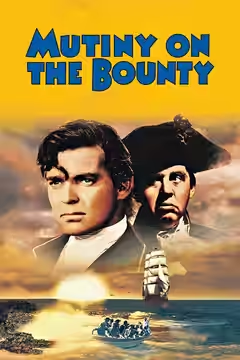
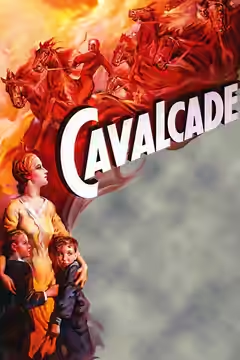
He came to it late and stayed a short time. After the Royal Navy in the First World War and a spell installing telephones, he was on the London stage by the early 1920s, on Broadway in Charlot revues from 1925, and in Australia and London before settling in America in 1931 under contract to Fox. Then more than fifty films in eight years: Alfred Bridges in Cavalcade (1933), Barkis in David Copperfield (1935), Smith in Mutiny on the Bounty (1935), Rawlins in Tarzan Escapes (1936) and, the part people remember, Much the miller's son in The Adventures of Robin Hood (1938). We have not reviewed Robin Hood and will not judge it here, but the reputation is for timing, and for getting the laugh in a crowded cast.
Cavalcade is the one to see for him. It is a stiff, saluting film that we did not much care for, and Mundin is the part of it that behaves like a person. Alfred Bridges is a butler who leaves service to run a pub, and Mundin plays it straight, without asking for a laugh or a tear. We were more touched than the film had any right to make us, because he lets Alfred enjoy himself, and the enjoyment is what hurts. Una O'Connor is his Ellen, sniffing at him across the bar; they were paired three times on screen and it is easy to see why. Her sourness needed his good humour, and his good humour needed something to push against.
The reservation is the obvious one, and it is not really his. The face and the voice fixed him as a type, and the studios were not in the business of arguing with a type that worked. In Mutiny on the Bounty he is Smith, one of the crew, and if you come away remembering Charles Laughton and not him, that is what a man like Mundin was for in a film like that. He filled the space he was given and did not spill over it.
If you want to know what he could do when the space was larger, it is a pub in Cavalcade, in a film that otherwise keeps its gloves on. He got few such chances, and the career stopped in 1939 before anyone thought to give him another.
Biography
Herbert Mundin was an English character actor. Born in St Helens, Lancashire, he served in the Royal Navy during the First World War and began his career on the London stage in the 1920s. He appeared on Broadway in Charlot's Revue in 1925 before moving permanently to the United States in 1931.
He received a contract with the Fox Film Corporation and appeared in over fifty films. Mundin is known for roles such as Alfred Bridges in Cavalcade (1933), Smith in Mutiny on the Bounty (1935), Barkis in David Copperfield (1935), and Much in The Adventures of Robin Hood (1938). He died in a car crash in Van Nuys, California, on 5 March 1939.