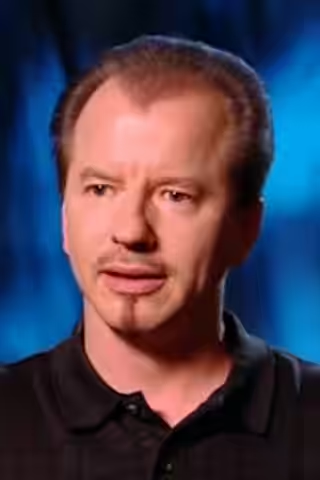
Eric Radomski's Gotham was painted light on black, and everything he has done since has lived in the shadow of that decision. A director of pictures more than of people, whose one feature is a small, sad detective story we still rate highly.
Fi1m perspective
Look at any night sky in Batman: The Animated Series (1992) and the black is not filled in. It was there first. Radomski had his background painters work on black paper and add the light, a window, a streetlamp, the glow off wet tarmac, instead of painting darkness onto white, and the difference is the difference between a cartoon set at night and a city that has gone dark. It is the single decision that made the programme look like nothing else on television, and it is why a children's cartoon could borrow its manners from mob films and war films and not look silly.
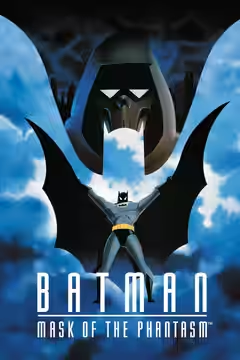
He had come up as a cel painter and office boy at a commercial studio in Cleveland, then as a background artist on Tiny Toon Adventures, which is to say he learned the trade from the back of the frame forwards. That shows. When he and Bruce Timm took the programme to the cinema with Batman: Mask of the Phantasm (1993), the result was 76 minutes about Bruce Wayne rather than the man in the cape: a proper mystery and a love story, with the Joker as a complication rather than the point. It is the Batman film we would hand to anyone who has had enough of the character. Radomski has said it "was basically an expanded episode", boarded and designed and shipped overseas like any other, and that is both its charm and its limit.
The limit is movement. The film is handsomely drawn and sometimes stiffly moved, a cartoon that moves like one, and there are passages where figures stand in beautifully lit rooms and wait for their turn to speak. What moved us, more than we expected from a spin-off of an afternoon programme, was the love story, and the plainness with which the film lets Wayne see the ordinary life he could have had and turn it down. The pictures do the work there. The rooms are dark, the man is small in them, and nobody has to say what he has lost.
After that the pictures stayed and the features did not. He directed on Freakazoid (1995), a superhero comedy, and was supervising director on Spawn: The Animated Series (1997), which took the same appetite for adult material to television animation. Then came executive chairs, at Throwback Entertainment from 2008 and at Marvel Animation until 2020, and the Marvel animated features that carry his name, Iron Man & Hulk: Heroes United (2013) among them, have not been received the way his Gotham was. We have not reviewed them and will not pretend to have a view. What we can say is that a man who once decided the dark should be painted first has spent most of his career in rooms where somebody else holds the brush. The 76 minutes are still there, and they are still enough.
Biography
Eric Radomski is an American animation producer and director. He began his career in the 1980s as an apprentice animator in a commercial studio in Cleveland, Ohio, before moving to California to work at Rick Reinert Pictures, where he became an assistant director. In the early 1990s he joined Warner Bros. Animation, where he co-created Batman: The Animated Series (1992) with Bruce Timm and was responsible for the series' distinctive painted-background art style.
Radomski co-directed and co-produced the theatrical feature Batman: Mask of the Phantasm (1993). He later directed episodes of Freakazoid! (1995) and Spawn: The Animated Series (1997–1999), and produced series including Xiaolin Showdown (2003). In 2010 he joined Marvel Animation as senior vice president, a role he held until 2020. He has received multiple Emmy Awards and nominations for his work in animation.