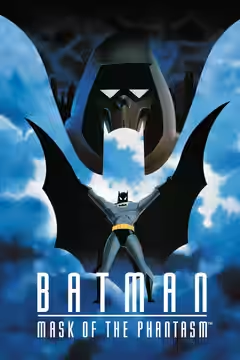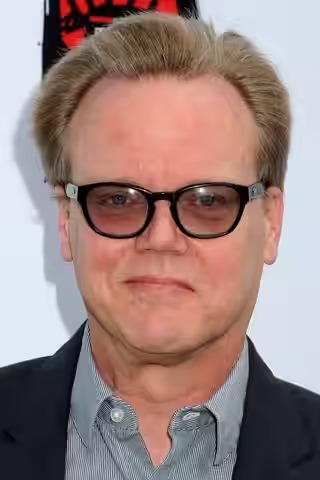
Timm drew Batman as a slab of a man with small eyes against skies painted on black paper, and the look has outlasted every fashion. The 1993 feature Batman: Mask of the Phantasm is still the place to start.
Fi1m perspective
The Gotham that Bruce Timm drew is a city at night even at noon. The backgrounds were painted on black paper, so the dark comes first and the art-deco towers and searchlights are laid on top of it like chalk on a blackboard. The people are built to match: shoulders like doorframes, jaws cut with a ruler, eyes reduced to two small marks. It is a look made to be animated and read at a glance from the back of a cinema, and it borrows from 1930s pulp and film noir without apologising to either. Timm has described it as putting classical animation technique on top of a comic-book style.
He came up through layouts at Filmation in the early 1980s, then Don Bluth, DIC and Warner Bros. on Tiny Toons, and the turn came in 1992 when he co-created Batman: The Animated Series with Paul Dini and Eric Radomski. What followed was less a run of films than one long programme under several titles: Superman: The Animated Series, Batman Beyond (1999), Justice League (2001) and Justice League Unlimited, all of them plainly the same world drawn by the same hand. He stepped down as supervising producer in 2013 and has stayed close since as executive producer or writer, most recently on Batman: Caped Crusader (2024).
Only one of these went to cinemas. Batman: Mask of the Phantasm (1993), co-directed with Radomski, runs 76 minutes on a PG certificate and spends most of them on Bruce Wayne rather than on Batman. It moved us more than a spin-off from a television cartoon had any business doing, and the reason is plain: it is about a man who once had the chance to be ordinary and turned it down. The drawing is handsome throughout. The movement is not always up to it: there are stretches where it is a cartoon that moves like one, and the hurry of the production shows. Timm knows it; he has said the film is "90 percent there" and that watching it makes him cringe. We are kinder than he is. Ninety per cent of this is more than a good many Batman films have managed.
What works is the discipline. Timm's stories go back to the pulp these characters came from rather than to the newer habit of treating them as gods with grievances, and the design keeps everyone in the same world. What works less well is that discipline can harden into habit. After enough years of square jaws and small eyes, a design stops looking like a choice and starts looking like a template, and movement, as Phantasm shows, was never the first thing on his mind. Start with Phantasm, then the 1992 series if it takes. He has been redrawing the same city for more than thirty years, and he is not finished.
Biography
Bruce Timm is an American animator, producer, director, writer and comic book artist. Born on 5 February 1961 in Oklahoma, he began his career in animation in the early 1980s.
He co-directed Batman: Mask of the Phantasm (1993) with Eric Radomski. Timm was a central figure in the DC Animated Universe as producer, director and story contributor on Batman: The Animated Series (1992–1995) and its spin-offs, including Superman: The Animated Series (1996–2000), Batman Beyond (1999–2001) and Justice League (2001–2004). He has executive produced numerous DC animated films such as Batman: Under the Red Hood (2010) and the two-part Batman: The Dark Knight Returns (2012–2013).
Timm received an Inkpot Award in 2013.