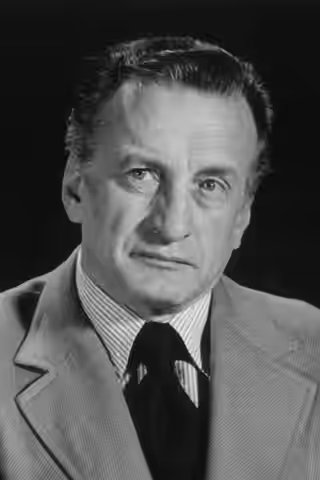
George C. Scott made authority sound persuasive even when the man exercising it was alarming. We value the force and the humour, though his broadest reactions can make dangerous men too easy to dismiss.
Fi1m perspective
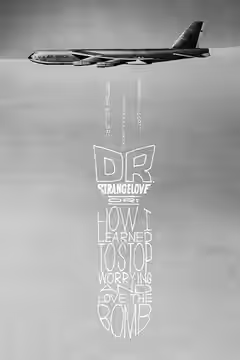
In Dr. Strangelove (1964), George C. Scott makes General ‘Buck’ Turgidson look delighted to be at work. His relish for military business is alarming because there is so little doubt in it. We laughed at that enthusiasm, then felt uneasy because Scott made it seem quite natural to the man. Stanley Kubrick gets comedy from an actor whose force might seem better suited to keeping everyone quiet. Scott is persuasive enough for the joke to remain uncomfortable, provided he does not push it too hard.
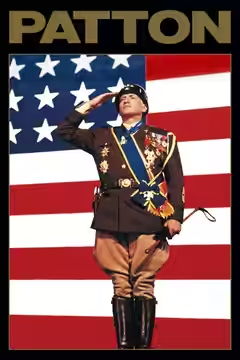
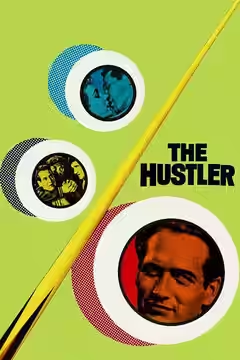
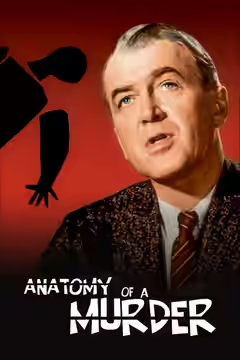
That force was established early in Anatomy of a Murder (1959), where Scott plays Claude Dancer and needs little movement or dialogue to hold attention. As the ruthless gambler Bert Gordon in The Hustler (1961), he gives a less official sort of authority the same threat. Patton (1970), with Scott as General George S. Patton Jr., became his defining screen role. The recurring attraction is a man accustomed to being taken seriously, played with enough conviction that we understand why others might oblige.
In Dr. Strangelove, the raspy voice is only part of what makes this work. Scott’s mobile face and physical tics give Kubrick plenty to use, while his conviction keeps Turgidson from becoming merely a collection of funny reactions. Occasionally, though, a reaction goes beyond what the joke needs, and the general becomes too easy to dismiss. Those are the moments when the performance starts to cost the film something. We need to recognise a man who might be given responsibility, and the broader clowning lets us stop doing that.
The later career included Paul Schrader’s Hardcore (1979), with Scott as Jake VanDorn, and continued across features and television through the 1980s and 1990s. Some of those parts relied too heavily on his presence, a poor substitute for giving an actor something to do. There is more to Scott than the ability to sound formidable. Start with Dr. Strangelove, and watch how much trouble he can suggest simply by looking pleased with himself.
Biography
George C. Scott was an American actor known for his work in film, television and on stage. Born George Campbell Scott on 18 October 1927 in Wise, Virginia, he died on 22 September 1999 in Westlake Village, California.
After serving in the United States Marine Corps and studying at the University of Missouri, Scott began his career in repertory theatre and gained attention for his performance as Richard III in a 1957 New York Shakespeare Festival production. He made his film debut in the late 1950s.
Scott is noted for his roles as the prosecutor Claude Dancer in Anatomy of a Murder (1959), Bert Gordon in The Hustler (1961), General 'Buck' Turgidson in Dr. Strangelove or: How I Learned to Stop Worrying and Love the Bomb (1964), and General George S. Patton Jr. in Patton (1970). He refused the Academy Award for Best Actor for the latter film.