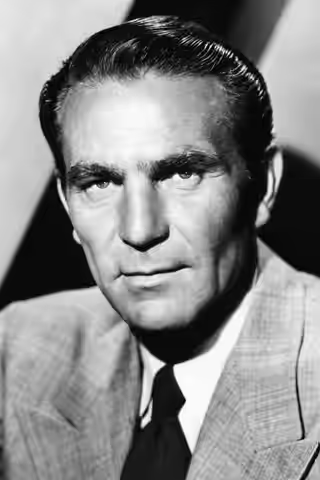
Henry Wilcoxon had a voice for pulpits and a frame for armour, and DeMille used both across six films. He was dependable rather than exciting, but dependable is rare in a DeMille picture, and in Mrs. Miniver he helped write the speech he is remembered for.
Fi1m perspective
Listen to Henry Wilcoxon before you look at him. The voice is deep, unhurried and pitched to reach the back of a large room, and for the best part of fifty years the pictures gave it to men who speak from a height: a Roman general, a prince, a vicar, a bishop. The straight back and the athlete's shoulders came with it. He was built for a Cecil B. DeMille film, and DeMille, who found him through a screen test, knew it.
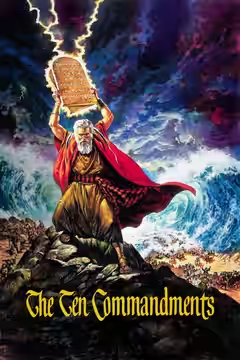
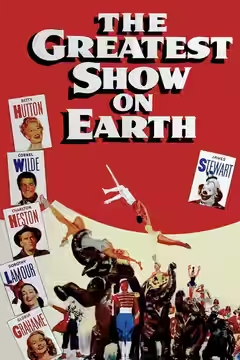
He arrived from the London stage with eight British films behind him. DeMille made him Marc Antony in Cleopatra (1934) and gave him the name Henry Wilcoxon. The lead in The Crusades (1935) followed; the film failed, and he spent the rest of the decade in B pictures. The United States Coast Guard took him from 1941 to 1946, and when he came back it was to DeMille again, as actor and, from the late 1940s, as associate producer: Prince Ahtur in Samson and Delilah (1949), Agent Gregory in The Greatest Show on Earth (1952), Pentaur in The Ten Commandments (1956). After DeMille died the work thinned to occasional film and television, and a last turn as the Bishop in Caddyshack (1980), which is where many people first met him.
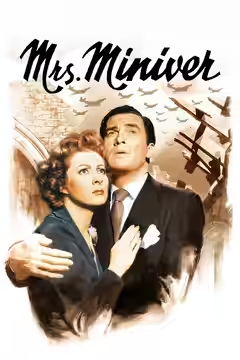
The part he is remembered for is smaller than any of those. The vicar in Mrs. Miniver (1942) is one of a village of decent people seen, as we said when we reviewed it, from a visiting producer's height, and Wilcoxon plays him as decently as the rest. What sets him apart is the sermon near the end, which he wrote with William Wyler and which travelled a long way beyond the cinemas during the war. For once the voice and the words belong to the same man.
We did not expect to think about him much in The Greatest Show on Earth. We found the film stiff whenever anyone opened their mouth, and 152 minutes is a long afternoon under canvas. But his Agent Gregory, who keeps turning up at the lot with questions about a clown who will not take his make-up off, belongs to the one story the film shows rather than announces, opposite James Stewart at his quietest, and we were sorry every time the trapeze romance cut in on it. Wilcoxon does little. He asks, he waits, he comes back. Among so much declaiming, a man who keeps turning up is a relief. He was associate producer on the picture too.
In 1976 he said of his director: "Contrary to popular conception, DeMille hated yes-men. He always used to say, 'I don't want everyone agreeing with me. I don't want 50 little DeMilles ... It's bad enough to have one.'" He stayed for six films all the same. Start with Mrs. Miniver. Save The Greatest Show on Earth for a wet Sunday, and when Agent Gregory walks onto the lot and starts asking questions, do not look away; the film takes its time telling you why he is there.
Biography
Henry Wilcoxon (born Harry Frederick Wilcoxon) was a British-American actor and film producer. He was born on 8 September 1905 in Roseau, Dominica, then part of the British West Indies, and died on 6 March 1984 in Burbank, California.
Wilcoxon made his stage debut in London in 1925 and his film debut in 1931. He became a regular in Cecil B. DeMille productions, appearing in films including Cleopatra (1934), Samson and Delilah (1949), The Greatest Show on Earth (1952) and The Ten Commandments (1956), on which he also served as associate producer. He played the Vicar in Mrs. Miniver (1942), for which he contributed to the closing speech, and reprised the role in the sequel The Miniver Story (1950).
During the Second World War he served in the United States Coast Guard, reaching the rank of lieutenant commander. Later credits include Caddyshack (1980).