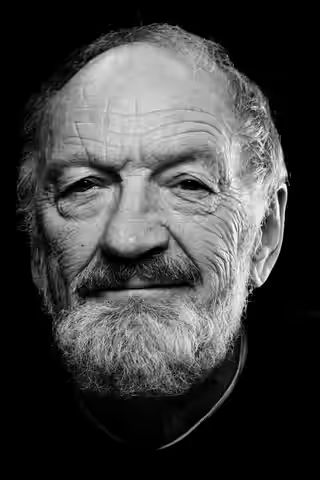
A tall, rasping, sardonic actor who made one lasting screen impression, as Zeffirelli's Mercutio in 1968, and then took his gifts back to the stage. The film roles that followed were few and scattered; the Mercutio has lasted.
Fi1m perspective
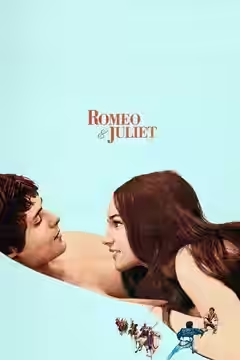
Most Mercutios treat the Queen Mab speech as a party piece, a chance to show their friends how quick they are. John McEnery, in Franco Zeffirelli's Romeo and Juliet (1968), starts it that way and then lets it get away from him. The jokes run on too long, the voice scrapes and cracks, and by the end he is talking about dreams as if one of them had followed him into the street. We were unsettled by it the first time and we still are, because McEnery lets us see that the mockery is what a frightened man does with his fear, and that is a harder thing to play than wit.
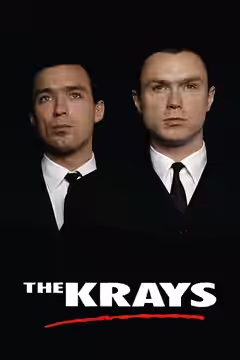
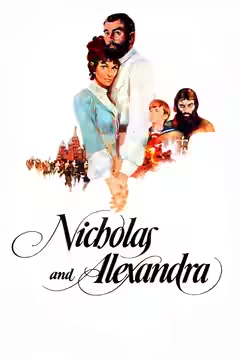
It was his first big screen part and it remains the one people know. That is not the shape of a man building a film career, and McEnery never built one. He was a stage actor first, in the National Theatre company from 1966, and Mercutio brought him attention rather than a run of work. The film parts came at intervals: the title role in Bartleby (1970) opposite Paul Scofield, Kerensky in Nicholas and Alexandra (1971), a duellist's second in Ridley Scott's The Duellists (1977), then long gaps before The Krays (1990) and Girl with a Pearl Earring (2003).
The stage took the rest. He was with the RSC through the 1970s and 80s, part of the Nicholas Nickleby company of 1980, doubling Mantalini and Snevellicci, and from the late 1990s he was at Shakespeare's Globe, where he played Shylock in 2007. The descriptions that recur are the ones Mercutio suggests: tall and rangy, blue-eyed, sardonic by default, a voice that could rasp and then give way. Critics reached for Nicol Williamson as the nearest comparison, and it fits: an abrasive, intuitive actor, best in flamboyant or caustic parts, the Fool, Pistol, Shylock, and not much interested in being pleasant.
What the screen got, then, was a fraction. The complaint about McEnery, and it is a fair one, is that he did not much care about arranging a film career after 1968, and that the public never quite fixed him in mind as a result: a name in the credits of period pieces, an intense face in a supporting part, without the leads that would have made him familiar. His Shylock and his Fool went home with the audiences who saw them.
Which leaves the Mercutio, and it is enough to be going on with. Zeffirelli's film has its faults, the verse suffers and the second half slows, but the middle is carried by its supporting cast and McEnery is the reason to stay through the first hour. Watch him in the square, showing off for his friends, and notice how quickly the showing off turns into something else. He did that on stage for the rest of his working life. We have the one record of it.
Biography
John McEnery (1943–2019) was a British actor. He trained at the Bristol Old Vic Theatre School and began his stage career with three seasons at the Everyman Theatre in Liverpool. He joined the National Theatre company in 1966.
McEnery played Mercutio in Franco Zeffirelli’s 1968 film adaptation of Romeo and Juliet, a performance that earned him a BAFTA nomination for Best Actor in a Supporting Role. His other screen credits include the title role in Bartleby (1970), Nicholas and Alexandra (1971), The Land That Time Forgot (1974) and The Duellists (1977). He appeared in guest roles on television series including Agatha Christie’s Poirot and Wallander.
His brother was the actor Peter McEnery. McEnery was married to actress Stephanie Beacham from 1973 to 1979.