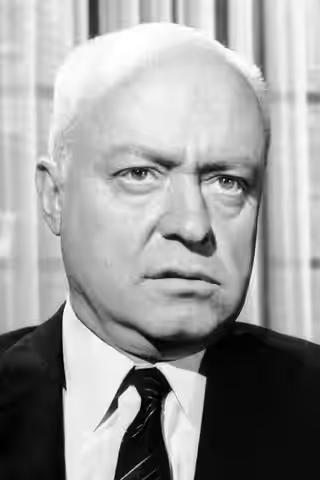
Larry Gates spent forty years playing the doctor, the judge and the man of standing, and did it so quietly that most people know him for a single slap. Watch what his face does after it; that is the actor.
Fi1m perspective
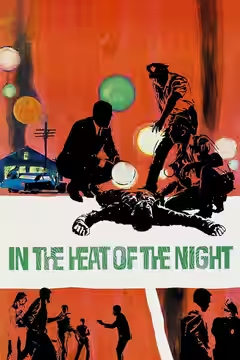
The moment everyone remembers is in a greenhouse in Mississippi. Eric Endicott, a cotton man who grows orchids, slaps Virgil Tibbs and is slapped back, and the clip has been shown so often that it has stopped being acting and become history. Watch the film instead of the clip. Norman Jewison holds on Larry Gates after the blow, and what Gates does is nothing: the mouth works, no sound comes out, and a man who has plainly never been contradicted in his own house finds he has no sentence ready. We knew the slap was coming and we still sat forward, and it was for that silence, not the blow.
That was In the Heat of the Night (1967), and by then Gates had been doing this kind of work for a decade. He came from the stage, in New York from 1939, and Broadway in Bell, Book and Candle in 1956 sent him into a steady run of film and television parts in which he was, more often than not, the doctor, the lawyer or the judge. He is Dr Kauffman in Invasion of the Body Snatchers (1956) and Dr Baugh in Cat on a Hot Tin Roof (1958): two films with nothing in common except that each needed a doctor and each got him. Hollywood decided early that his face meant standing, and used it for that.
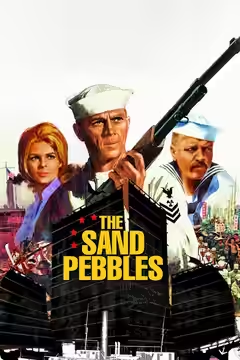
The trouble with playing authority is that the script seldom gives you anything to do with it. In The Sand Pebbles (1966) he is Jameson, the missionary who wants the navy out, and he has the best argument in a 196-minute film and about three scenes in which to make it. He makes it and the film moves on. That is the pattern of the career: small allowances, well spent. Jewison is the one director who noticed what happened when the standing was taken away from him, and it is no accident that the result is the part people remember.
The rest of the working life went where good character actors go: back to the stage, including Polonius opposite Sam Waterston, and to daytime television, thirteen years as H.B. Lewis on Guiding Light from 1983 until his death in 1996. Nobody will build a season around him. But if you are watching In the Heat of the Night tonight, and you should be, stay with the old man in the greenhouse for the moment after the slap, when the camera is still on him and he has nothing to say. It is the best thing he did on screen, and it is over before you have finished noticing it.
Biography
Larry Gates (also credited as Lawrence Wheaton Gates) was an American actor. Born in Saint Paul, Minnesota, he trained as a chemical engineer at the University of Minnesota before pursuing acting, with early experience at the Barter Theatre.
He made his Broadway debut in Bell, Book and Candle (1950) and received a Tony Award nomination for A Case of Libel (1964). His film roles include Dr. Baugh in Cat on a Hot Tin Roof (1958), Dr. Dan Kauffman in Invasion of the Body Snatchers (1956), Jameson in The Sand Pebbles (1966) and Eric Endicott in In the Heat of the Night (1967). On television he appeared in series including The Twilight Zone and Alfred Hitchcock Presents.
Gates played H.B. Lewis on the soap opera Guiding Light from 1983 until his death, winning the 1985 Daytime Emmy Award for Outstanding Supporting Actor in a Drama Series. He died in Sharon, Connecticut, in 1996.