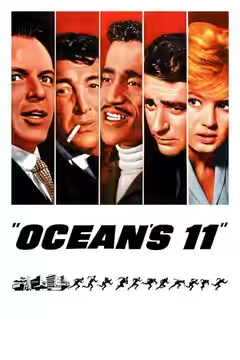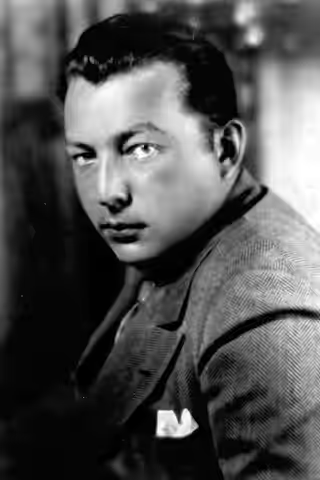
A director trained in the cutting room, who staged war as something that happens to groups rather than heroes, and whose last films handed him stars instead. Ocean's Eleven (1960) shows the habit surviving the assignment for about twenty minutes.
Fi1m perspective
Five casinos go dark in turn. In Ocean's Eleven (1960) Lewis Milestone stages the robbery of the Las Vegas Strip as a night raid, calm and exact, eleven former paratroopers moving through the blackout while Philip W. Anderson's cutting shows us where the money is and who is carrying it. It is the one stretch of the film in which the director is plainly the man who made All Quiet on the Western Front thirty years earlier. We sat up, and we had been waiting the better part of ninety minutes to do so.
Milestone came to directing from the cutting room, having worked as an editor and assistant director in Hollywood in the early 1920s, and he said later that "the cutting room was an excellent place to learn the rudiments of direction." It shows. His films are built on montage, on tracking shots and on a documentary plainness that owed something to Soviet cinema, and they are about groups rather than stars: soldiers, newspapermen, ranch hands. He began directing features in 1925, had an early success with Two Arabian Knights (1927), and then made All Quiet on the Western Front (1930), the film everything else he did is measured against. The Front Page (1931) and Of Mice and Men (1939) followed, adaptations that kept the detachment of their sources rather than warming them up.
That is the Milestone the histories describe, and we have not yet reviewed him at his height. What we have reviewed is the late work, and it is a different case. By 1960 he was being handed a Rat Pack picture, and Ocean's Eleven is a star vehicle for men who would rather be doing their nightclub act. Harry Brown and Charles Lederer's script has a clean military idea, treat the Strip like an enemy position, and Milestone plainly understands it; he also spends most of two hours letting Frank Sinatra and friends stand about in rooms before he is allowed to use it. The tone never settles. A heist needs the fear of capture and a Rat Pack film cannot permit it, and the director who solved harder problems than that in 1930 does not solve this one. We scored it 55, and the twenty good minutes are the reason it was not lower.
His final feature, Mutiny on the Bounty (1962), was a troubled production and is remembered as a disappointment; we have not reviewed it and will not judge it here. What the late credits suggest is a craftsman whose method needed an ensemble and a subject, and who was given, at the end, a cast that arrived with its own act. He said in 1969 that making the same kind of film over again would bore him, and on the evidence he was never in danger of it. Go to the blackout in Ocean's Eleven: the man who made All Quiet on the Western Front is in there for twenty minutes, and then the floor show comes back on.
Biography
Lewis Milestone was a Russian-born American film director. Born Lev Milstein on 30 September 1895 in Kishinev, Russian Empire, he immigrated to the United States around 1913 and became a naturalised citizen. He served in the US Army Signal Corps during the First World War before entering the film industry as an assistant editor and director in the early 1920s.
Milestone directed his first feature in 1925 and received Academy Awards for Best Director for Two Arabian Knights (1927) and All Quiet on the Western Front (1930), the latter also winning Best Picture. Other notable films include The Front Page (1931), Of Mice and Men (1939), A Walk in the Sun (1945) and The Strange Love of Martha Ivers (1946). He also directed and produced Ocean's Eleven (1960) and directed Mutiny on the Bounty (1962).
He worked in television from the mid-1950s and died in Los Angeles on 25 September 1980.