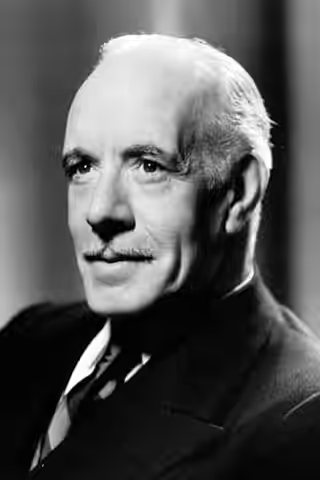
Lewis Stone did less than anyone else in the frame: a grey head, a still hand, a thought you could watch arrive. MGM kept him for twenty-nine years, and at the end put him behind a judge's bench he could not leave.
Fi1m perspective
Turn Lewis Stone away from the camera and he goes on acting. Directors kept noticing it: he could let a decision cross a face he was not showing you, so that a shot of the back of his grey head told you what the man had settled on before he turned round to say it. He had come from the stage, a leading man in stock and on Broadway before the First World War, and most actors who made that journey brought the stage with them. Stone brought the pause.
The silents used him as a hero first. He made his name in The Prisoner of Zenda (1922) and Scaramouche (1923), and was Sir John Roxton in The Lost World (1925). MGM signed him in 1924 and did not let him go until he died in 1953, the longest studio contract anyone has recorded. The hair had gone grey early, and the studio saw what that was for: ministers, doctors, wardens, the sophisticated man in the corner who has already worked out how the evening will end. Sound did not trouble him. He stood next to Greta Garbo seven times without looking either overawed or ambitious, and Clarence Brown, who directed him eight times, prized exactly that economy.
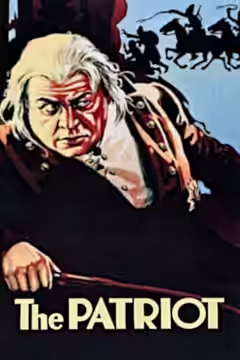
The film of his we have reviewed is the one nobody can see. In Ernst Lubitsch's The Patriot (1928) he was Count Pahlen, the minister who decides that Czar Paul I, played by Emil Jannings, must be removed for Russia's good, with Florence Vidor as the Countess Ostermann between the two men. The notices in 1928 were the kind a director keeps in a drawer. Then the film went missing, and no complete print is known to exist. We minded that more than we usually mind a lost film, because Pahlen is the part his whole method was built for: a man doing his thinking behind a closed face while a louder man rages beside him. There were 113 minutes of it. What is left is a trailer and a handful of scraps.
The talkies gave him the warden in The Big House (1930), Oxenstierna in Queen Christina (1933) and Doctor Otternschlag in Grand Hotel (1932), who is handed the film's famous last line. Then, in You're Only Young Once (1937), he sat down as Judge James Hardy opposite Mickey Rooney, and he did not get up for fourteen films. They fixed him as the kindly Judge, and he came to feel confined by the bench, which is not hard to understand. A technique made for Lubitsch and Garbo was now being spent on approving of Mickey Rooney.
Start with Grand Hotel (1932), where he gets the last word. Then, if anyone finds the rest of The Patriot, tell us.
Biography
Lewis Stone (also credited as Lewis Shepard Stone and Lewis S. Stone) was an American actor. He appeared as Count Pahlen in the 1928 film The Patriot and as Warden James Adams in the 1930 film The Big House.
Stone was a long-term MGM contract player from 1924 until his death. He received an Academy Award nomination for Best Actor for his performance in The Patriot. He appeared in seven films with Greta Garbo, including Grand Hotel (1932) and Queen Christina (1934). From 1937 he played Judge James Hardy in fifteen films in the Andy Hardy series.
Among his other notable roles were Sir John Roxton in The Lost World (1925), Andriani in Mata Hari (1931) and the Cardinal in the 1952 version of The Prisoner of Zenda. Stone died in Los Angeles on 12 September 1953.