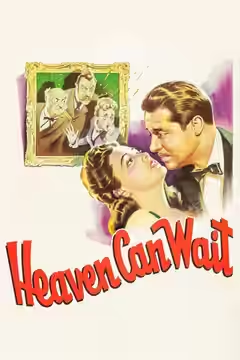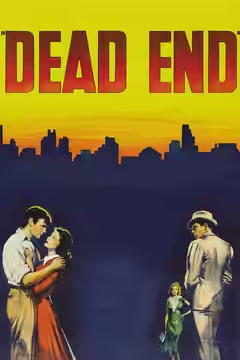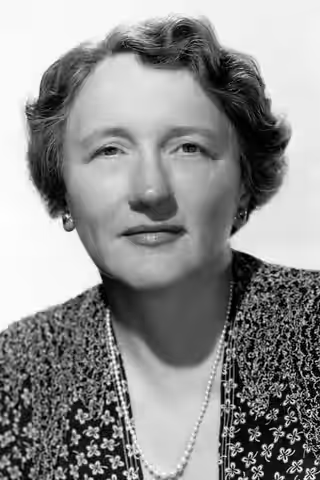
Marjorie Main built a career on loud, rough women and did her best work quietly. She has one scene in Dead End, never raises her voice, and it is the thing we remember; the Ma Kettle films are what everyone else remembers.
Fi1m perspective
Mrs Martin opens a door in Dead End (1937) and finds the son she has not seen in years, a wanted killer who has come home to be admired. Main plays the scene flat and tired. She does not shout and she does not weep, and for a minute the gangster picture around her stops. We had settled in for Bogart's film and had not expected to be winded by his mother; it was the lack of volume that did it. She had played the part on Broadway for 460 performances by then, and it shows in how little she needs to do.
That is not the Main most people know. The Main most people know rasps and swaggers, hands on hips, with a stride drawn from the farm women she had watched in Indiana. Hollywood cast her as mothers, landladies, cooks, widows and nosy neighbours, and she was good at all of them. In Test Pilot (1938) she is a landlady for a single scene and gets the biggest laugh in the picture, which is the trade in miniature: walk in, land it, leave.
She came up the long way, through vaudeville, Chautauqua and stock companies, then Broadway from 1916. Dead End and The Women (1939), both parts she had played on stage, got her to Hollywood; Wyoming got her an MGM contract in 1940. She made six comedies with Wallace Beery and played Katie the maid in Meet Me in St. Louis (1944). Then came The Egg and I (1947), Ma Kettle, and Percy Kilbride as Pa, eight films together, nine sequels in all, until The Kettles on Old MacDonald's Farm in 1957, when she stopped.
The complaint is that after the early successes the studios only ever asked for the abrasive matriarch, and it is a fair complaint. Off screen she was said to be soft-spoken and shy, which is not hard to believe after Dead End. Her own account of the job was plain: "Character actors are best, I believe, when they portray characters that give them a chance to draw on their own experiences, backgrounds and observations." The Kettles drew on the observations. The Martin scene drew on something else, and nobody much asked for it again.
Start with Dead End, which we have reviewed, and watch what she does with a minute of near silence before a decade of shouting. The Kettles will keep.
Biography
Marjorie Main, born Mary Tomlinson, was an American actress. She worked in vaudeville on the Orpheum circuit and in Chautauqua presentations before making her Broadway debut in 1916. Her first film was A House Divided (1931).
Main repeated her stage role as Mrs. Martin in the 1937 film Dead End. She transferred another stage performance to film as a dude-ranch operator in The Women (1939). Signed to an MGM contract in 1940, she remained with the studio until the mid-1950s and appeared in six films with Wallace Beery, including Barnacle Bill (1941). She is also known for Meet Me in St. Louis (1944) and Friendly Persuasion (1956).
Her most prominent later role was as Ma Kettle in the Ma and Pa Kettle film series, beginning with The Egg and I (1947).