Peter Bogdanovich made old Hollywood habits feel useful again: patient staging, lively ensembles and comedy that lets actors do the work. We rate the early films highly; the trouble came when affection for old styles became a substitute for judgement.
Fi1m perspective
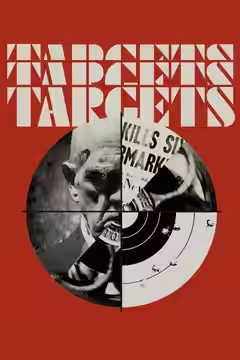
Bogdanovich often keeps several people in focus and lets the scene run without cutting away. We can watch someone listening as well as someone speaking, and his actors have time to make an impression without forcing it. The influence of Hawks, Ford and Welles is apparent, but knowing those directors is no prerequisite for enjoying his films. Even Targets (1968), his first credited feature, put Boris Karloff and an affection for old horror beside contemporary violence.
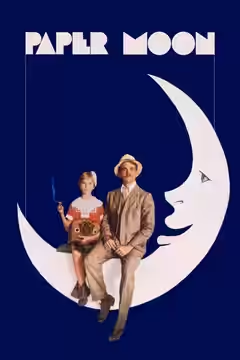
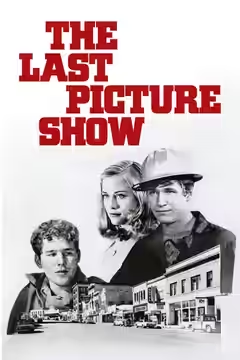
The concentrated run from The Last Picture Show (1971) through What's Up, Doc? (1972) to Paper Moon (1973) gives us the strongest reason to recommend him. We were moved by The Last Picture Show, because the nuanced performances make its black-and-white account of small-town Texas life feel inhabited. The chaotic screwball set pieces of What's Up, Doc? and the Depression-era con artists of Paper Moon show how readily his attention to actors could serve comedy. In Paper Moon, especially, the period detail supports the story without becoming the main attraction.
His early films owe part of their character to production designer and co-writer Polly Platt. Cybill Shepherd and Ryan O'Neal were recurring acting collaborators, and his care with performers is a better reason to value him than his knowledge of old films. In At Long Last Love (1975), his fondness for older styles cannot make up for the misjudged tone. The setbacks of the mid-1970s need acknowledging, but the renewed critical attention for Mask (1985) should discourage anyone from writing off everything that followed.
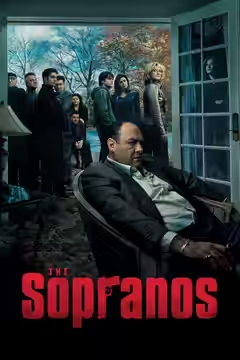
On television, he both acted in The Sopranos (1999) and directed its 2004 episode Sentimental Education. We recommend the series without hesitation, though its chief achievement for us is James Gandolfini's funny, frightening and painfully recognisable Tony. Bogdanovich's later films included the ensemble comedy She's Funny That Way (2015) and the Keaton documentary The Great Buster: A Celebration (2018). For the clearest sense of what he could do as a director, begin with The Last Picture Show, then let What's Up, Doc? change the mood.
Biography
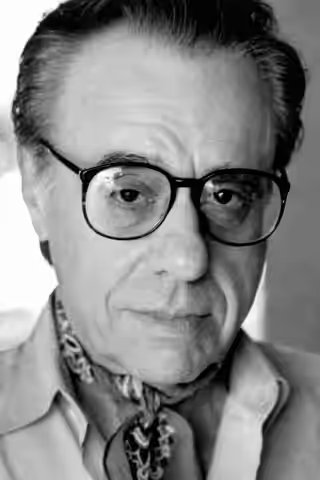
Peter Bogdanovich (1939–2022) was an American film director, screenwriter, actor, producer, critic and film historian. He began as a film critic for publications including Film Culture and Esquire before moving into directing, initially working with Roger Corman on The Wild Angels (1966). His credited feature debut was Targets (1968); he used the pseudonym Derek Thomas on the earlier Voyage to the Planet of Prehistoric Women (1968).
Bogdanovich achieved prominence with The Last Picture Show (1971), which earned Academy Award nominations for Best Director and Best Adapted Screenplay. Subsequent notable films include What's Up, Doc? (1972), Paper Moon (1973), Mask (1985), Noises Off... (1992) and The Cat's Meow (2001). He directed one episode of the HBO series The Sopranos (1999) and appeared in a recurring acting role across multiple seasons. He also directed documentaries such as Directed by John Ford (1971) and received a Grammy Award for Runnin' Down a Dream (2007).