A pulp anthology with a different director for every story and a body in each. Half of it is handsome dressing-up; the other half, including Soderbergh’s and Cuarón’s, proves how much a good short story and thirty minutes can hold.
Fallen Angels is an American anthology of half-hour crime stories, set in Los Angeles and taken from the pulp writers who gave the genre its furniture: Chandler, Hammett, Thompson, Woolrich, Goodis, Spillane, Ellroy, Mosley. William Horberg created it, and fourteen directors shared the episodes, among them Steven Soderbergh, Alfonso Cuarón, Agnieszka Holland, Peter Bogdanovich, John Dahl and, unexpectedly, Tom Cruise, Tom Hanks and Kiefer Sutherland. Six stories aired from 1 August 1993 and nine more from 8 October 1995. It is a good series, and like every anthology only as good as the episode you land on.
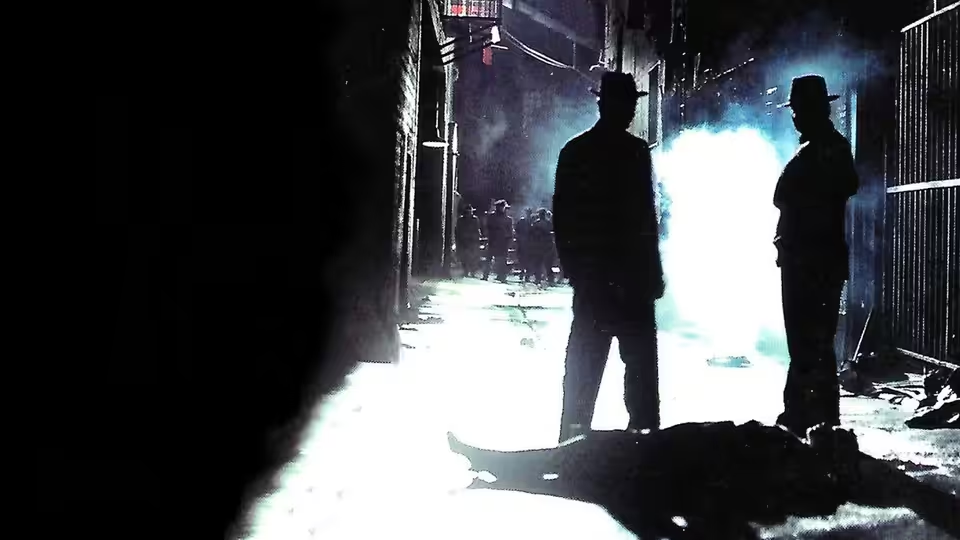
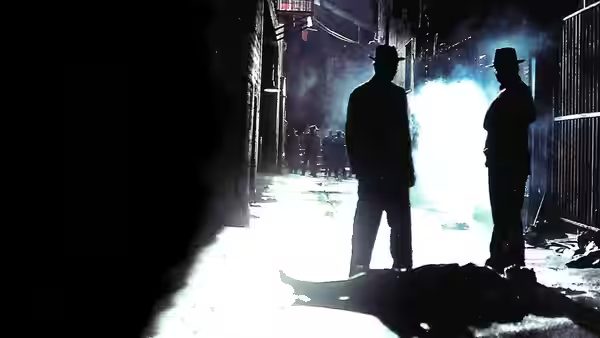
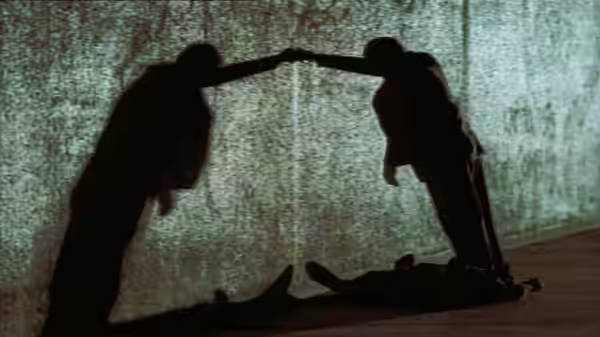
The framing has aged worst. Lynette Walden’s Fay Friendly introduces each story in a slinky dress and a slinkier voice, and after three or four the device feels like a joke told by someone already laughing. Past her, the series looks the part. Gary Frutkoff, Rick Heinrichs and Armin Ganz build a Los Angeles of rooming houses, bars with one working bulb and offices where the blinds are always down, and Shay Cunliffe and Katherine Dover put everyone in the right hat. The cinematographers, among them Emmanuel Lubezki, Peter Suschitzky and Declan Quinn, shoot in colour but drain most of it out, so the reds and neon greens land like bruises. Peter Bernstein’s music supplies the late-night brass the genre asks for and knows when to stop.
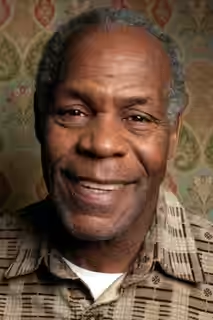
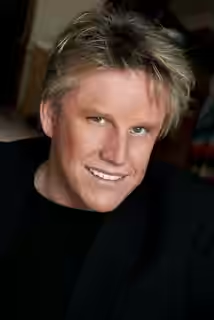
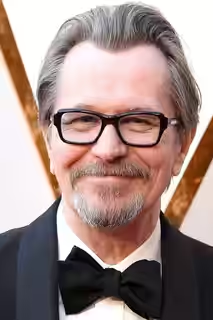
The best episodes understand that these were short stories and behave like them. Soderbergh’s The Quiet Room is the one most critics single out, and rightly: it stays in small spaces, keeps its voice down, lets two people be unpleasant to each other without raising a hand, and thirty minutes is exactly the length it needs. Cuarón, working with Lubezki, shoots his story as if nobody had told him it was television. The actors give the thing weight. Gary Oldman plays Pat Kelley with a stillness we do not associate with him, and Meg Tilly’s Lois Weldon is the woman the whole genre was built to be wary of. Danny Glover’s Marlowe is tired in the right way. Gary Busey, as ‘Buzz’ Meeks, is the opposite, and it suits the Ellroy material.
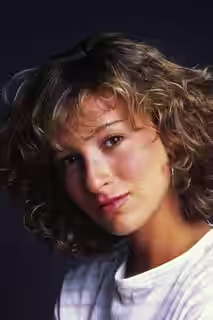
Laura Dern is the one who got at us. She plays Annie Ainsley as a woman so used to being overlooked that she seems to apologise for taking up the frame, and it moved us more than a half-hour of pulp has any right to; we had come for the hats and stayed for her face. That is the case for the series in one performance. Give a good actor a short story and a good director and you do not need the second half of a feature.
The case against it is the rest. Several episodes, more of them in the second run, treat noir as a dressing-up box: the fedora, the cigarette, the woman in the doorway, the narration that tells us it is raining while we can see that it is raining. The worst offenders are the ones that mistake the voice-over for the point. We were bored by a couple of these, and then irritated, because the same series had shown us how much thirty minutes could hold. The scripts are by capable people, Scott Frank, Howard A. Rodman, Amanda Silver, Donald E. Westlake and Jon Robin Baitz among them, but a Chandler sentence is written to be read and dies a little when spoken over a shot of a car.
Against the television anthologies of its era it stands up well. Against the books it cannot, and does not much try. Thompson and Woolrich wrote about people who were frightened all the time, and the series gets that fear onto the screen perhaps one episode in three. The other two are handsome, tidily cut by David Siegel, Stan Salfas and Quincy Z. Gunderson, and gone from the mind before the next one begins.
Watch it as it was made, one story at a time, and skip nothing, because the good ones are not where you would expect them. Fifteen half-hours, no two alike, about half worth your evening. For an anthology, that is a good rate.