A director remembered for a car chase whose best films do not have one. Peter Yates decided early how much directing a scene needed, and in Breaking Away and The Dresser the answer was very little, and he was right both times.
Fi1m perspective
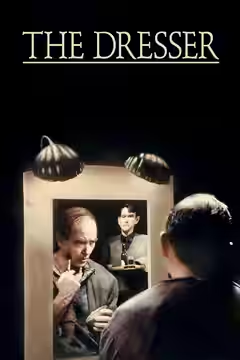
A man on a railway platform bellows at a departing train to stop, and it stops. It is the first thing Peter Yates does in The Dresser (1983) that Ronald Harwood's play could not have done, and it is nearly the last. After that he puts the camera in a dressing room with Albert Finney and Tom Courtenay and leaves it there for most of 118 minutes. That is the Yates habit worth knowing: he works out how much directing a film needs and does that much.
He is remembered for a different habit. Robbery (1967), a heist film, got him to America, and Bullitt (1968) gave him the car chase he is still known for. He followed it with The Friends of Eddie Coyle (1973), a sombre film about informers that he counted among his favourites, and The Deep (1977), which ran the Bullitt template again. Then came Breaking Away (1979) and The Dresser, and after them a long, mixed stretch that included Krull (1983) and Eleni (1985), generally thought uneven.
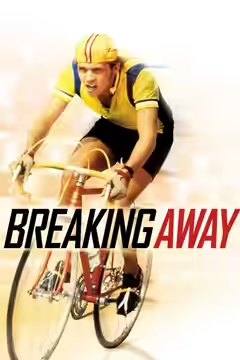
The pattern reads as a craftsman for hire, and that is how most critics have filed him. We think the two quiet films are the point and the chase is the footnote. In Breaking Away Steve Tesich, who wrote three films with him, gives him four quarrymen's sons with a summer to waste in a college town, and Yates never raises his voice. Betsy Cox puts the boys in cut-offs and the students in pressed campus clothes; when the two sides collide Yates stages it as a scuffle and is honest about who started it. The scene that moved us more than we expected has no bicycle in it: Paul Dooley's Ray walks his son through the campus, names the stone he cut for each building, and says he was never allowed inside, flat, looking at the wall.
The Dresser works the same way with different hands. Kelvin Pike shoots the theatre brown and gold and the town flat grey, so the building is the only warm place for miles. Stephen B. Grimes clutters the dressing room with wigs on their blocks, pots and a single bulb over the mirror. James Horner's score goes quiet when the two men are talking, and Ray Lovejoy cuts patiently and holds on faces. Finney and Courtenay need each other, one is a little better, and Yates does not tip the scale.
"I need contrast in my work," he said in 1979, having gone from The Deep to Bloomington. The contrast is real and it cost him a name: a director who makes Krull and The Dresser in the same year does not look like anyone in particular. Start with Breaking Away, which we think is his best. Save Bullitt for a night when you want to see what everyone else remembers.
Biography
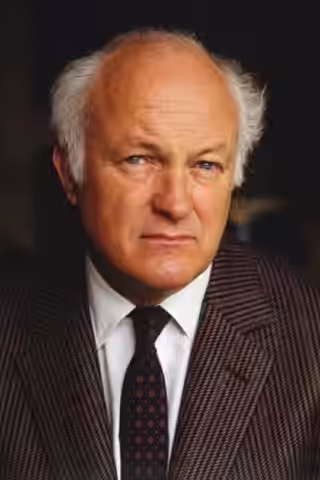
Peter James Yates (24 July 1929 – 9 January 2011) was an English film director and producer. He trained at the Royal Academy of Dramatic Art and began his career in theatre as an actor, director and stage manager before entering the film industry as a dubbing assistant and assistant director.
Yates's early feature films included Summer Holiday (1963) and Robbery (1967). He achieved international success with Bullitt (1968). He produced and directed Breaking Away (1979), which received five Academy Award nominations, including for Best Director and Best Picture. He also produced and directed The Dresser (1983), which earned five Oscar nominations and seven BAFTA nominations. His other notable films include The Deep (1977) and Krull (1983).