Film review

Breaking Away

1979 · Directed by Peter Yates · 1h 41m · MPA PG

In a sentenceA cutter’s son from Indiana has decided he is Italian, and his father’s stomach has not forgiven him

DramaComedy

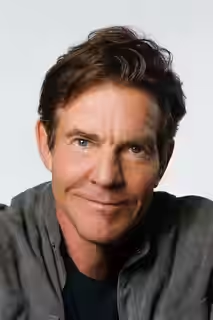
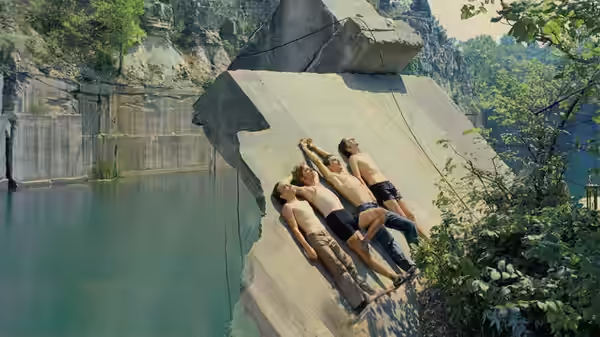
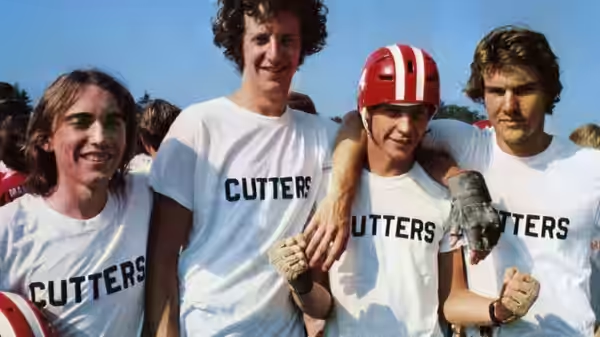
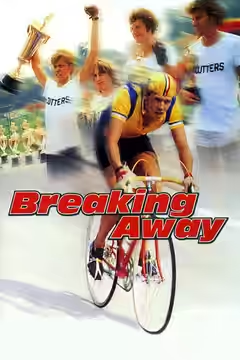
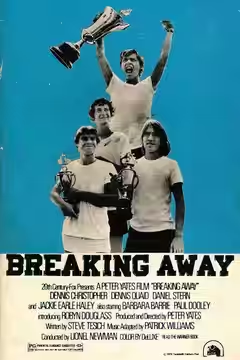
Bloomington, Indiana, the summer after high school. Dave Stoller (Dennis Christopher) and his friends Mike (Dennis Quaid), Cyril (Daniel Stern) and Moocher (Jackie Earle Haley) are “cutters”, sons of the men who quarried the limestone that built the university, and none of them has a plan. They swim in the flooded quarry and get into scraps with students. Dave has decided he is Italian: he shaves his legs, plays opera, speaks Italian to the cat and rides his racing bicycle everywhere, to the despair of his father Ray (Paul Dooley), a used-car dealer with a bad stomach, and the amusement of his mother Evelyn (Barbara Barrie). When he spots Katherine (Robyn Douglass) on campus, he courts her as an Italian exchange student, which her boyfriend Rod (Hart Bochner) does not care for.

Fi1m review

Peter Yates’s comedy about four quarrymen’s sons idling through a summer in a college town is warm, funny and plain about class. Paul Dooley and Barbara Barrie are two of the best screen parents we know; the race at the end is the least of it.

Bloomington, Indiana, has a university, a limestone industry and not much between them. The students arrive every autumn from somewhere better off. The men who cut the stone for their buildings live in town, and their sons, the summer they leave school, find that nobody has left anything for them to do. Steve Tesich’s script follows four of them, Peter Yates directs it without ever raising his voice, and we would put it in front of anyone.

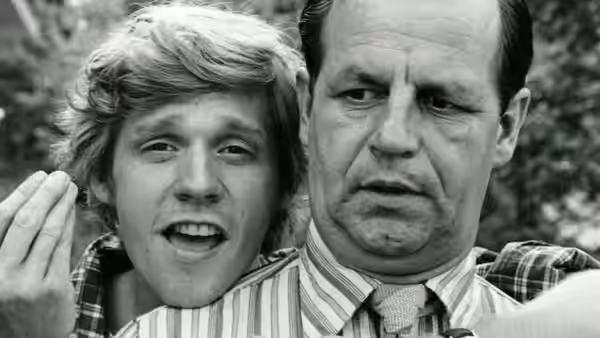
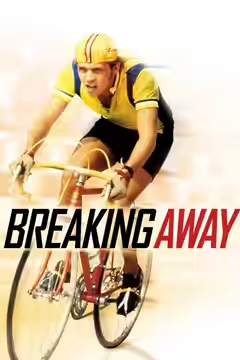
Dave Stoller (Dennis Christopher) has dealt with the problem by deciding he is Italian. He shaves his legs, plays opera in his bedroom, has named the cat Fellini and rides his racing bicycle round the county with a smile the town regards as a symptom. Christopher plays him as a boy who is sincere and knows, somewhere, that he is performing, and never tips into either. His father Ray (Paul Dooley), a former cutter who now sells used cars, takes each new Italian word as a blow to the stomach. The scene in which a customer brings a car back and Ray cannot make himself say the word “refund” made us laugh out loud, and the joke is that he is in real pain. Barbara Barrie’s Evelyn watches from the kitchen, cooking whatever Dave’s Italy requires.

Matthew F. Leonetti shoots the town in flat summer light and saves his colour for the quarry, an abandoned pit of green water walled in white stone where the boys spend their afternoons. It is the one place in the film that is theirs and he makes it look like it. Patrick Williams’s score leans on Mendelssohn and Rossini and uses them for speed. The sequence in which Dave tucks in behind a lorry on the highway and the driver holds up fingers to count him to sixty is cut by Cynthia Scheider to the music, and we grinned at it like children.

The other three are drawn quickly and well. Mike (Dennis Quaid) was the school quarterback and is angry all the time, because the students who look through him will be nineteen again next year and he will not. Cyril (Daniel Stern), the tall one, jokes because his father has told him to expect nothing. Moocher (Jackie Earle Haley) is small, out of work and about to marry Nancy (Amy Wright). Betsy Cox puts the four of them in work shirts and cut-offs and the students in pressed campus clothes, so when the two sides collide you can tell them apart at a glance. Yates stages the collision as a scuffle and is honest about who started it.

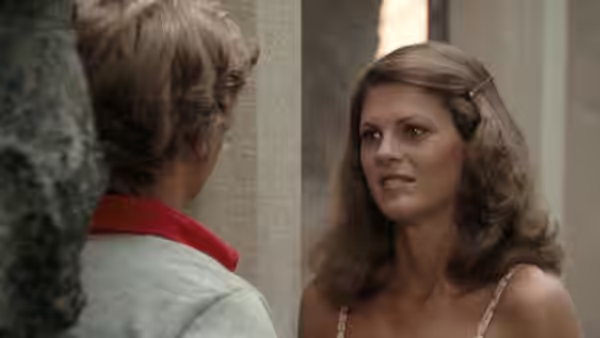
What does not work is the love story. Katherine (Robyn Douglass) is given a boyfriend, Rod (Hart Bochner), a sorority house and about one conversation of her own, and Douglass does what she can with a part that exists so that Dave can lie to it. Rod is a rich boy from a catalogue. When an Italian racing team comes through town, midway, the plot arranges the meeting to give Dave exactly what the story requires, and it is the one place we felt Tesich’s hand. What follows we will not describe. The final race, the university’s Little 500, is staged clearly, with Scheider keeping the laps and the positions legible, and it is also the one part of the film that could have come from any sports picture.

The scene that moved us more than we expected has no bicycle in it. Ray walks Dave through the campus one evening and points at the buildings, naming the stone he cut for them, and says he was proud of the work and never felt he was allowed inside. Dooley says it flat, looking at the wall. It is where the comedy and the subject turn out to be the same thing: a town that built a place it will never be invited into. Yates had made Bullitt and The Friends of Eddie Coyle before this and went on to bigger, noisier things. This is his gentlest film and, we think, his best.

It is a PG, 101 minutes, and the right thing to put on with anyone from about twelve upwards. Warn them that the father is not a bully. He is frightened for his boy, and about eighty minutes in they will see why.


Critical consensus AI synthesised

84
Positive
6
Mixed
0
Negative
0

The reviews are uniformly warm. Most critics take Breaking Away as a sunny, funny coming-of-age comedy about four working-class friends in an Indiana college town, and the praise clusters around three things: Steve Tesich’s script, its handling of class and small-town attitudes, and the performances. Paul Dooley as the father is named more than once, with Barbara Barrie and Dennis Christopher close behind. Several reviews single out the relationship between the dreamy son and his practical father as the film’s centre.

The spread is narrow; nobody dislikes it. The one real reservation comes from Variety, which finds the plot unoriginal and treats the film as a light comedy carried by its cast rather than anything more. Time Out reads it as more pointed about class than the others do, and notes that its optimism is unsentimental. Otherwise the reviews differ only in degree of warmth, and the film’s standing has not shifted across nearly fifty years of writing about it.

RogerEbert.com
1 January 1979 · Roger Ebert
90*

Ebert calls the film a wonderfully sunny, funny and intelligent treasure about four working-class friends coming of age in a college town. He singles out the loving and funny performances by Paul Dooley and Barbara Barrie as the parents for particular praise.

Read the full review →
The New York Times
18 July 1979 · Janet Maslin
90*

Maslin hails the film as a fresh, funny and wonderful classic sleeper with a strong sense of place and humor. She praises Peter Yates for delivering a subtle and imaginative success despite the cast and director's modest pedigrees.

Read the full review →
The Independent
24 June 2010
85*

Peter Yates's 1979 coming-of-age film provides a genuine feel-good experience through its story of four misfit friends in Indiana. The critic singles out the warm, central relationship between the dreamy son and his pragmatic father for particular praise.

Read the full review →
Time Out
10 September 2012 · DP
80*

The review praises Yates' film for its depiction of class conflict and small-town attitudes in working-class America, combined with a strong element of fantasy. It highlights the script by Steve Tesich and calls it Yates' best work since The Friends of Eddie Coyle, noting its unsentimental optimism.

Read the full review →
Variety
31 December 1978 · Variety Staff
70*

The review finds the film a thoroughly delightful light comedy despite an unoriginal plot, buoyed by strong performances from Dennis Christopher and Paul Dooley. It highlights the warm and funny relationships among the four young leads and the exciting climax race.

Read the full review →
/Film
26 April 2025 · Jeremy Smith
90*

The critic calls Peter Yates' 1979 comedy a sharply observed, lovely film about class, family, and coming of age that stands out among sports movies for its character focus over formula. It singles out the warm camaraderie among the leads and the strong screenplay for particular praise.

Read the full review →

Cast

Awards

Academy Awards, 1980

Nominated
Best Original Song Score
Nominated
Best Picture
Nominated
Best Supporting Actress
Won
Best Writing, Original Screenplay

If you liked this, try…

I Vitelloni poster

I Vitelloni

1953 · Fellini’s young men idling in a seaside town; Dave named the cat after him for a reason

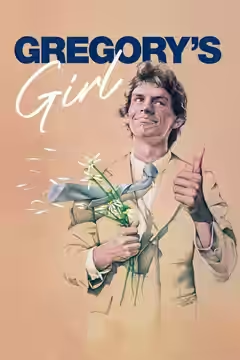
Gregory's Girl poster

Gregory's Girl

1981 · Cumbernauld’s answer: a gangly boy, a football pitch and the same kindness towards fools

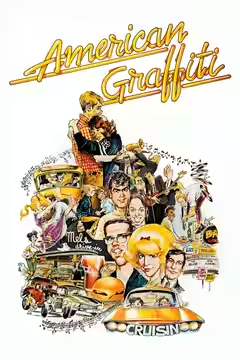
American Graffiti poster84

American Graffiti

1973 · One last night before the future arrives, with better cars and worse fathers

A Sunday in Hell poster

A Sunday in Hell

1976 · Paris–Roubaix as documentary; cycling filmed as the mud and cobbles it actually is

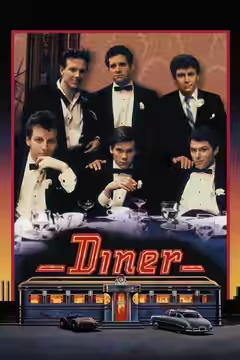
Diner poster84

Diner

1982 · Baltimore boys putting off adulthood in a booth; talkier, sadder, just as fond