Roy Battersby gave working lives and institutions serious attention, with a naturalistic style that suited both. We value his tense, character-led television, especially Cracker, even when the writing presses too hard.
Fi1m perspective
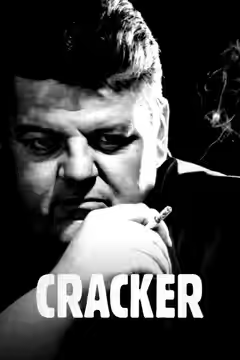
Robbie Coltrane lets Fitz be funny without making him easy company in Cracker. We laughed with relief, because that humour kept his excesses from wearing us out. Battersby directed its three-part story Brotherly Love (1995), bringing atmospheric tension to a series with a difficult, compelling centre. We rate Cracker highly, and his concentration on character suits it, though its success cannot sensibly be credited to one director.
Battersby moved from BBC documentaries into drama in the late 1960s, and the interest in working life remained. Some Women (1969) belongs to that early period; his 1974 Play for Today concerned a textile workers’ strike. He favoured naturalistic shooting, often in black and white, with stark opening images and voiceover establishing the social setting. Producer Tony Garnett and writer Colin Welland were among his collaborators. The research behind his dramas about labour and institutions gave him a firm basis for that approach: the circumstances around a character deserved attention too.
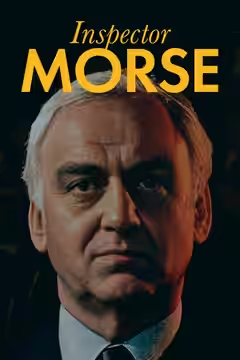
His return to directing in the 1980s brought sustained work across police and crime series. There was the Inspector Morse episode Fat Chance (1991), followed by work on Between the Lines (1992), with its police corruption and multi-episode stories. The change of format still left him room to examine authority and its abuses, rather than treating the police procedural simply as a succession of cases to solve. He later directed the hostage feature Red Mercury (2005), but we would begin with the television work.
Cracker also supplies the caveat to our enthusiasm: the writing sometimes pushes too hard. Fitz already gives the drama enough difficulty to be going on with, and further pressure can become tiring. Battersby’s feel for atmosphere is useful in this company, but it cannot make every emphatic piece of writing feel necessary. Start with Cracker, provided difficult company is what the evening calls for.
Biography
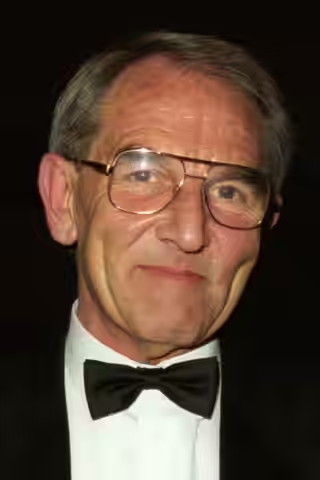
Roy John Battersby (1936–2024) was a British television director. He began his career making documentary features for the BBC, including work on Tomorrow's World, and directed the scientific documentary film The Body in 1970. He later moved into drama, directing television plays and episodes of Play for Today, often collaborating with writer Colin Welland.
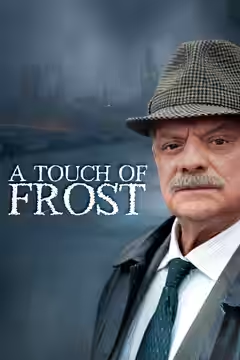
Battersby was a Trotskyist and organiser with the Workers Revolutionary Party, which led to him being blacklisted by the BBC. After his association with the party ended in the early 1980s, he returned to directing and became known for crime drama series including Between the Lines, Inspector Morse (1991), Cracker (1995) and A Touch of Frost (1994–2006). His 2005 feature Red Mercury was nominated for best film at the Montreal World Film Festival. In 1996 he received the BAFTA Alan Clarke award.
He was married to actress Judy Loe from 1997 and was stepfather to actress Kate Beckinsale.