William Dieterle came out of Max Reinhardt's theatre and never lost the habit of building a stage. When the material lets him dream, the pictures shimmer; when it asks him to instruct, they file past like exhibits. We rate the fairy wood above the great men.
Fi1m perspective
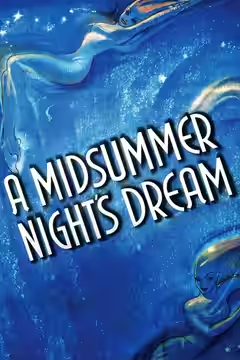
The wood at night in A Midsummer Night's Dream (1935) is what Dieterle looks like when he is enjoying himself. Glitter, gauze, fairies drifting across what is plainly a soundstage and no less lovely for it, and Felix Mendelssohn under nearly every line. We were charmed more than we expected to be by the fairies coming out of the dark and by James Cagney's Bottom, and we fidgeted whenever the lovers opened their mouths. Warner Bros. had filled the parts with contract players better known for gangster pictures and musicals, and Shakespeare did not sit easily on them. The film is good in patches, and the patches are the ones in the wood.
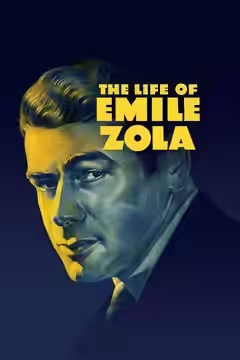
That pattern, the picture handsome and the people a problem, runs through the career. Dieterle had acted in Reinhardt's stage company and in more than sixty German films before he directed his first feature in 1923. He remembered the people behind Der Mensch am Wege (1923) as "just four or five very young, enthusiastic, and revolutionary people who wanted to do something different." Warner Bros. brought him to America in 1930, and Midsummer, which he co-directed with Reinhardt, got the Hollywood career moving. Then came the biopics: The Story of Louis Pasteur (1936), The Life of Emile Zola (1937), three films with Paul Muni, Henry Blanke producing. Later he moved to RKO and to David O. Selznick, made romantic dramas with Joseph Cotten, among them Portrait of Jennie (1948), and went back to Europe in the late 1950s.
The German training shows in the frames. He likes deep backgrounds and figures placed against them, space used to keep a static shot alive, and he is kind to his characters, who are understood rather than judged. Those are real virtues, and they are the ones that survive a stiff script. The biopics have long been called pedantic, and we would not argue hard against it; a great man's life laid out in order is not a story so much as a syllabus, and Dieterle was too respectful to skip a lesson. He is better when the material is strange. The Hunchback of Notre Dame (1939), All That Money Can Buy (1941) with its Bernard Herrmann score, and Portrait of Jennie all carry the reputation of films where the atmosphere does the work, and atmosphere was the thing he could always supply.
Start with the wood. Watch A Midsummer Night's Dream at home, where the gauze looks like gauze and nobody minds, and skip forward when the lovers start quarrelling. Then try one of the ghost stories before one of the biographies. Dieterle built beautiful rooms all his life; the question was always whether anyone interesting was allowed to stand in them.
Biography
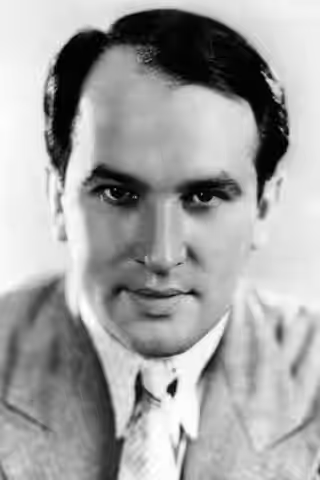
William Dieterle was a German actor and film director. Born Wilhelm Dieterle on 15 July 1893 in Ludwigshafen am Rhein, he began his career as an actor in German theatre and silent films, appearing as Valentin in F. W. Murnau's Faust (1926). He emigrated to the United States in 1930 and worked primarily as a director in Hollywood.
Dieterle directed A Midsummer Night's Dream (1935) with Max Reinhardt, The Story of Louis Pasteur (1936), The Life of Emile Zola (1937), The Hunchback of Notre Dame (1939), All That Money Can Buy (1941), Duel in the Sun (1946, co-director), Portrait of Jennie (1948) and Salome (1953). The Life of Emile Zola won the Academy Award for Best Picture. He died on 8 December 1972.